TL;DR: The modern hair clipper traces to a Serbian pig farmer named Nikola Bizumic, who invented a manual scissoring mechanism in rural Serbia before taking it to the barbershops of Ruma. In 1881, Herman Candrian of Chicago patented an adjustable-blade design that formalized the tool for professional use. Prints of the original patent are available framed or unframed.
Before hair clippers existed, a barber's speed was limited by scissors. A skilled barber could cut hair quickly, but the manual process of snipping individual sections was slow and left the result dependent entirely on the barber's hand. The problem was not precision but throughput. Barbershops in growing 19th-century cities needed tools that could move faster than scissors, and the solution came from an unexpected source: a pig farmer in rural Serbia who noticed that the same scissoring motion used in his agricultural work could be adapted for hair.
That observation, made by Nikola Bizumic sometime in the mid-to-late 1800s, launched a chain of invention that runs through Herman Candrian's 1881 Chicago patent, Leo Wahl's 1919 electric clipper, and every professional barbershop tool in use today.
Nikola Bizumic and the First Manual Clipper
The origin of the modern hair clipper is traced by historians to Nikola Bizumic, a Serbian barber who developed his invention while working as a pig farmer in rural Serbia. The mechanism Bizumic developed used intersecting blades that would cut when the handles were squeezed together, creating a scissoring action that could be drawn through hair quickly and consistently. The design eliminated the repeated opening and closing of traditional scissors and allowed the barber to move the tool continuously across the scalp.

Bizumic recognized the commercial value of his invention and left his farming life for the city of Ruma in Serbia, where he found work as a barber's apprentice. Working in an actual barbershop allowed him to refine the clipper design against the practical demands of daily professional use. The tool needed to work on different hair types, hold up to hours of continuous operation, and be maintained without specialized equipment. Bizumic's career as a barber and his evolution as an inventor were parallel processes.

From Ruma, knowledge of the clipper design spread to other barbershops in Serbia and eventually to the broader European barber trade. The design was simple enough to be reproduced and modified by other craftsmen, and no single company or patent controlled its early spread. Manual clippers became common in European barbershops during the latter half of the 19th century, each version reflecting the local craftsman's interpretation of the basic Bizumic mechanism.
Herman Candrian's 1881 Patent
In 1881, Herman Candrian of Chicago, Illinois, filed a patent for a manual hair clipper design that represented a significant refinement of the basic concept. Candrian's innovation was in the adjustment mechanism: his design allowed barbers to change the spacing between the cutting blades, enabling the same tool to cut hair at different lengths. Before adjustable clippers, a barber needed different tools for different cuts. Candrian's adjustable design compressed those tools into a single instrument.
The patent was Candrian's only known filing, which suggests he was a practitioner rather than a serial inventor. He had identified a specific problem, the inflexibility of fixed-blade manual clippers, and engineered a solution. The adjustable blade mechanism he patented in 1881 is a direct ancestor of the adjustment systems found on professional clippers today.
Candrian's patent placed the hair clipper's design formally on record with the U.S. Patent Office at a time when American barbershops were proliferating rapidly in growing urban centers. Chicago in 1881 was one of the fastest-growing cities in the world, and the demand for efficient barbershop tools was high. The patent sat at the intersection of a practical need and a moment of technological formalization.
Leo Wahl and the Electric Clipper
The next major leap in clipper technology came not from a barber but from an engineering student. Leo Wahl grew up in Illinois and began experimenting with electromagnetic motors while still in high school at Sterling High School. The electromagnetic motor principle, in which alternating current creates a vibrating motion, was the key insight that would eventually produce a workable electric clipper, but Wahl was not yet thinking about barbershops. He was interested in the motors themselves.

Wahl studied engineering at the University of Illinois, where his understanding of electromagnetic principles deepened. After graduating, he took over his uncle's manufacturing business, which gave him access to machinery and a production environment in which to experiment. The transition from theoretical interest in motors to practical clipper design was a function of that access: Wahl had a workshop, and he used it.
He applied for patents on his electric hair clipper design in 1919. The mechanism used an electromagnetic motor to drive the clipper blades back and forth in rapid alternating strokes, replicating the manual cutting action of the Bizumic design but at a speed no human hand could match. The Wahl Manufacturing Company began mass production shortly after the patent was granted. Electric clippers were in barbershops within years of the patent, and within a decade they had become the professional standard.

The Wahl company has operated continuously since the 1920s and remains one of the dominant professional clipper brands worldwide. Leo Wahl's 1919 patent transformed what had been a manually operated barbershop tool into an electric appliance, and the production line he built established the template for every clipper manufacturer that followed.
The Modern Era: Professional and Consumer Tools
The electric clipper spread from professional barbershops to consumer use as the technology became cheaper to manufacture. Consumer-grade clippers, designed for home use rather than professional volume, became widely available by the mid-20th century. The tools followed the same electromagnetic principle Wahl had patented, scaled down for occasional rather than continuous use.
Professional clippers continued to evolve through the second half of the 20th century. Blade materials improved from steel alloys to ceramic and titanium coatings. Motor designs became more refined, reducing heat and vibration during extended use. The adjustment mechanisms that Candrian had introduced in 1881 were integrated into sleeker housings designed for ergonomic professional use.
Today, while electric clippers dominate professional barbershops, manual clippers remain in use. Some barbers prefer them for specific techniques, particularly for close-cropped styles where precision matters more than speed. The manual clipper's simplicity, no motor, no cord, no heat, makes it useful in situations where an electric tool would be impractical.
The path from Nikola Bizumic's farmyard observation to the professional barbershop equipment of today passes directly through Herman Candrian's 1881 Chicago patent. Candrian formalized the adjustable mechanism, placed it on record with the patent office, and created the document that stands as the American starting point for the tool that defines what a barbershop is.
Frequently Asked Questions
Who invented the hair clipper?
Nikola Bizumic, a Serbian barber, is credited with inventing the first manual hair clipper in the mid-to-late 19th century. He developed the intersecting blade mechanism while working as a pig farmer in rural Serbia and later refined it as a barber in the city of Ruma. Herman Candrian of Chicago filed the first American patent for an adjustable-blade manual clipper design in 1881.
Who invented the electric hair clipper?
Leo Wahl invented the first practical electric hair clipper and filed for a patent on the design in 1919. Wahl began experimenting with electromagnetic motors as a high school student in Illinois and developed the electric clipper after taking over his uncle's manufacturing business. The Wahl Manufacturing Company has produced professional clippers continuously since the 1920s.
Timeless Patents makes museum-quality patent art prints from original U.S. Patent Office documents, celebrating the inventors behind the tools and objects we use every day. Every print is available framed or unframed. Shop the full collection →
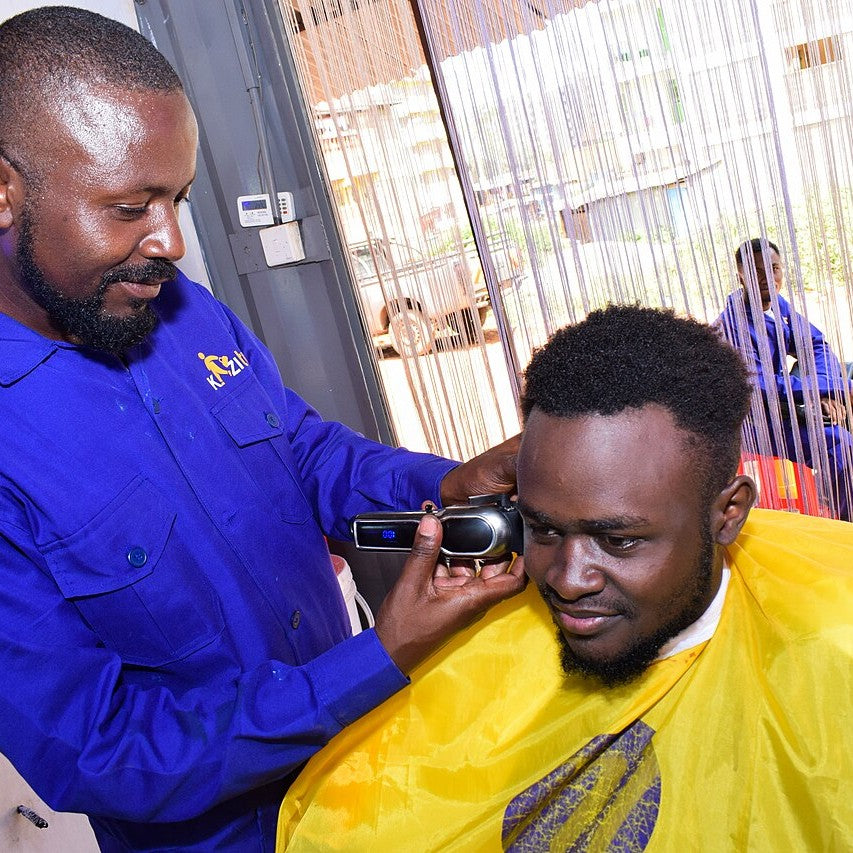
Cover image: "Barber trimming hair with clippers in Kenya" by Lebu Ayiga, licensed under CC BY-SA 4.0, via Wikimedia Commons.