TL;DR: The barber's chair has roots in Civil War-era America, but the design every shop still uses traces to Ernest Koken's 1900 hydraulic patent, which gave barbers foot-lever control over height, tilt, and rotation. Walter Koken's 1915 ornamental patent refined that design into an icon. Original prints are available framed or unframed.
Most people sit down in a barber's chair without thinking twice. The footrest, the hydraulic lift, the recline for a hot shave: it all feels inevitable. None of it was. The barber's chair as a designed object is roughly 160 years old, and the version that became standard across America traces to a single St. Louis inventor who died before his company reached its peak.
The chair's evolution tracks the evolution of the barbershop itself. Before the Civil War, many men visited barbers only for shaving. Haircuts were less frequent. The furniture reflected that: simple wooden chairs, no different from what you'd find in a dentist's office or a front parlor. As the barbershop became a social institution in the second half of the 19th century, barbers needed chairs built for the work.
Early Barber's Chairs: Before the Hydraulic Age
The first dedicated barber's chairs appeared in the mid-1800s. Early designs were cast iron or wood, fixed in height, and adjusted manually. To recline a customer for a shave, barbers used a ratchet mechanism that notched the back into position. To raise or lower the seat, they often had to ask the customer to stand while they cranked or adjusted the base.

Several manufacturers entered the market in the 1870s and 1880s, competing on ornamentation as much as function. Chairs of this period were elaborate: carved wooden arms, upholstered in tufted leather, fitted with porcelain headrests. They were status objects for the shop owner, signals of quality and permanence. But the mechanics remained crude. Getting a customer precisely positioned still required manual effort and, often, conversation.
The real limitation was the lift. A barber working on a short customer, then a tall one, had to manually adjust the chair's height between clients. In a busy shop, this wasted time and annoyed customers. What barbers needed was a chair that could be adjusted quickly, with one hand or one foot, without interrupting the flow of work.
Ernest Koken and the Hydraulic Revolution
Ernest Koken was born in Germany and immigrated to St. Louis, Missouri, where he founded a barbershop supply company in the 1880s. He had watched barbers struggle with the limitations of fixed and ratchet-adjusted chairs, and he went to work on a better mechanism.

In 1900, Koken patented a hydraulic barber's chair that changed the trade permanently. The mechanism used a foot-operated pump to raise the seat on a hydraulic column. The barber could lift a customer several inches with a single pump of the footrest lever, hands free, without interrupting the cut. The chair could also be rotated and reclined from the same position. A customer could be lowered for shampooing, raised for cutting, and tilted back for a shave, all controlled by the barber without the customer needing to move.
The Koken Hydraulic Barber Chair sold immediately. Barbershops across the United States adopted it in the early 1900s, and the Koken Barber's Supply Company grew into the largest of its kind in the country. The design's logic was clear: it reduced the physical effort of the work, allowed faster client turnover, and gave barbers complete control over positioning without interrupting the cut.
Ernest Koken died in 1909 of heart failure. He did not live to see his company's peak, but he had already defined what a barber's chair was supposed to do.
Walter Koken and the 1915 Patent
Ernest's son, Walter Koken, took over the company and continued his father's work. Walter was more interested in the aesthetic dimension of the chair than the mechanical one. His father had solved the functional problem. Walter wanted to solve the visual one.
In 1915, Walter Koken filed an ornamental design patent for a barber's chair with a distinctive shield motif. The back, seat, apron, and footrest were all shaped and finished to echo the form of a heraldic shield. The design was more decorative than structural, but that was the point: ornamental patents protect the appearance of an object, not its mechanics. Walter was establishing that the Koken chair had a specific, recognizable form that competitors could not copy.
The 1915 design became one of the most reproduced barber's chairs in American history. Its proportions and detailing became so standard that many later manufacturers copied the silhouette even after the patent expired. Walk into a vintage barbershop today and the chair in the corner will likely have lines that trace back to Walter Koken's 1915 drawing.
The Decline of Koken and the Chair's Lasting Legacy
The Koken Barber's Supply Company dominated the American market for decades. By mid-century, the company's chairs were installed in tens of thousands of shops across the country. The hydraulic mechanism that Ernest Koken patented in 1900 became so embedded in the trade that "barber's chair" and "hydraulic chair" were effectively synonymous.
The 1960s brought competition that Koken could not absorb. Lower-cost domestic and imported chairs entered the market, targeting the price-sensitive end of the trade. Koken's overhead and manufacturing costs, built for a premium product, could not compete. The company filed for bankruptcy and closed.
The chairs themselves survived. Koken originals from the 1910s through the 1950s are now collector's items, regularly restored and resold for several thousand dollars each. Antique dealers and barbershop enthusiasts seek them out specifically for the quality of the castings and the durability of the hydraulic systems, many of which still function after a century of use.
The design also survived in a different way. Modern hydraulic barber's chairs, manufactured across the globe, use the same basic mechanism that Ernest Koken patented in 1900: a foot-pump hydraulic column, a rotating base, a reclining back. The chair has changed in materials and styling. The underlying logic has not.
Shop Barber's Chair Patent Art Prints
The original U.S. Patent Office drawing that defined the American barbershop. Starting at $49.99 unframed.
Barber's Chair (1915), Walter Koken
Walter Koken's 1915 ornamental patent captures the design that made the Koken chair an American icon. The shield-shaped back and footrest are exactly as drawn in the original filing, reproduced from the U.S. Patent Office records. It's the kind of print that works in a barbershop, a home bar, or any space where the history of American craft belongs on the wall.
Best for: Barbers, barbershop owners, history enthusiasts, anyone who grew up in a classic barbershop

Frequently Asked Questions
When was the barber's chair invented?
Dedicated barber's chairs first appeared in the mid-1800s, but they were fixed-height wooden or cast iron seats with manual adjustments. The modern barber's chair as we know it, with hydraulic lift and foot-pump controls, was invented by Ernest Koken of St. Louis, who patented his hydraulic mechanism in 1900.
Who invented the hydraulic barber's chair?
Ernest Koken, a German immigrant and St. Louis barbershop supplier, patented the hydraulic barber's chair in 1900. His design used a foot-operated pump to raise and lower the seat without interrupting the cut. Koken died in 1909, but his son Walter continued the company and filed additional patents, including the ornamental design patent of 1915.
What does the Walter Koken 1915 patent cover?
Walter Koken's 1915 filing is an ornamental design patent, which protects the appearance of the chair rather than its mechanical function. The patent covered the shield-shaped back, seat, apron, and footrest that became the Koken chair's visual signature. Ornamental design patents are common for objects where the aesthetic form is the primary commercial value.
Why did the Koken Barber's Supply Company go out of business?
Koken dominated the American barber chair market from the early 1900s through the mid-20th century. The company collapsed in the 1960s when low-price competitors, including imported chairs, undercut Koken's premium pricing. The chairs themselves outlasted the company: Koken originals are now collector's items, and working antique examples regularly sell for several thousand dollars.
Is a barber's chair patent print a good gift for a barber?
It's one of the more specific and fitting gifts you can give someone in the trade. The Koken patent is the direct ancestor of every hydraulic chair a barber has worked from. A framed print of the 1915 drawing connects the everyday tool of the work to its specific origin, which is a more interesting story than most barbers know. Available framed or unframed starting at $49.99.
Written by Jackie Crino, owner of Timeless Patents. Timeless Patents makes museum-quality patent art prints from original U.S. Patent Office documents, celebrating the inventors behind your favorite sports, hobbies, and passions. Every print is available framed or unframed, starting at $49.99. Shop the full barbershop collection →
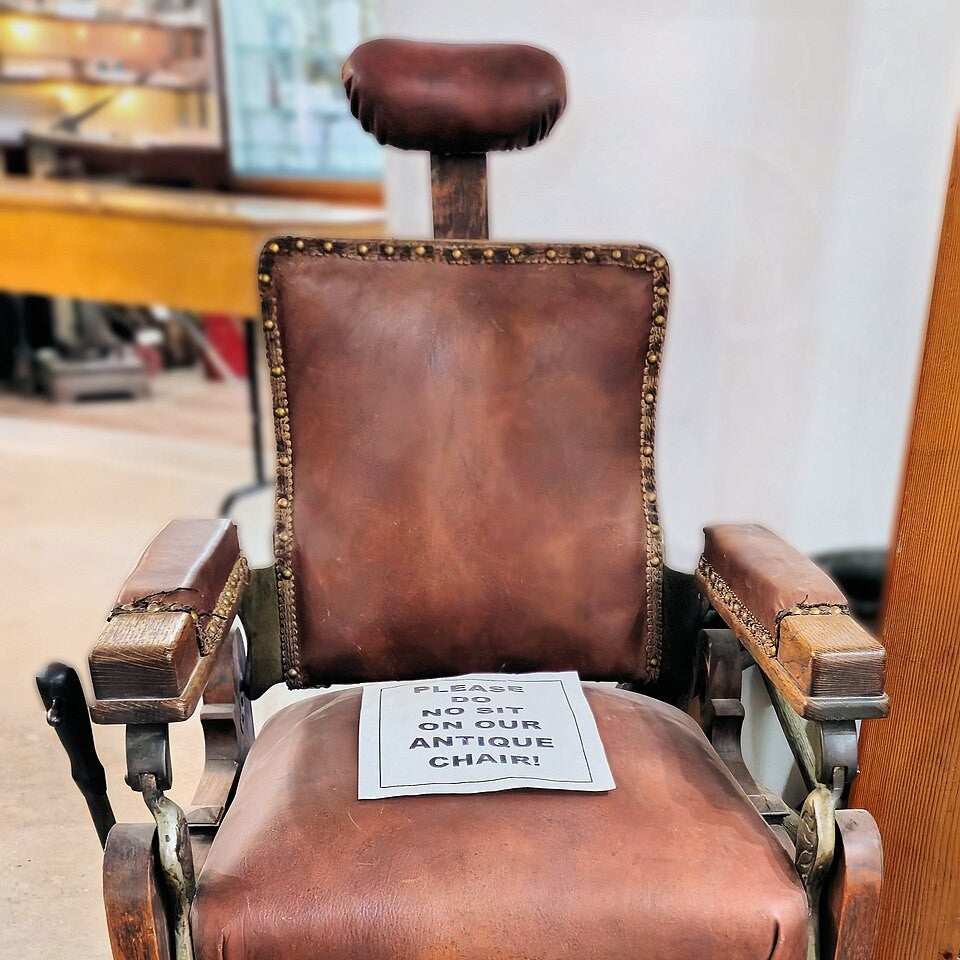
Cover image: "Antique 'Star' model barber chair" by Eric Polk, licensed under CC BY-SA 4.0, via Wikimedia Commons.