TL;DR: Surfing is at least a thousand years old, originating in Polynesia as a spiritual practice tied to rank and status among Hawaiian ali'i, not a recreational sport. European missionaries came close to killing it entirely in the 19th century. John M. Kelly Jr.'s 1966 patent for a concave-nosed surfboard design helped define how modern boards handle waves. Original prints of that patent are available framed or unframed.
When Lieutenant James King of Captain Cook's expedition watched Hawaiians riding waves on wooden boards at Kealakekua Bay in 1779, he recorded what he saw with a mixture of admiration and bafflement. He had never seen anything like it. The Hawaiians had been doing it for centuries.
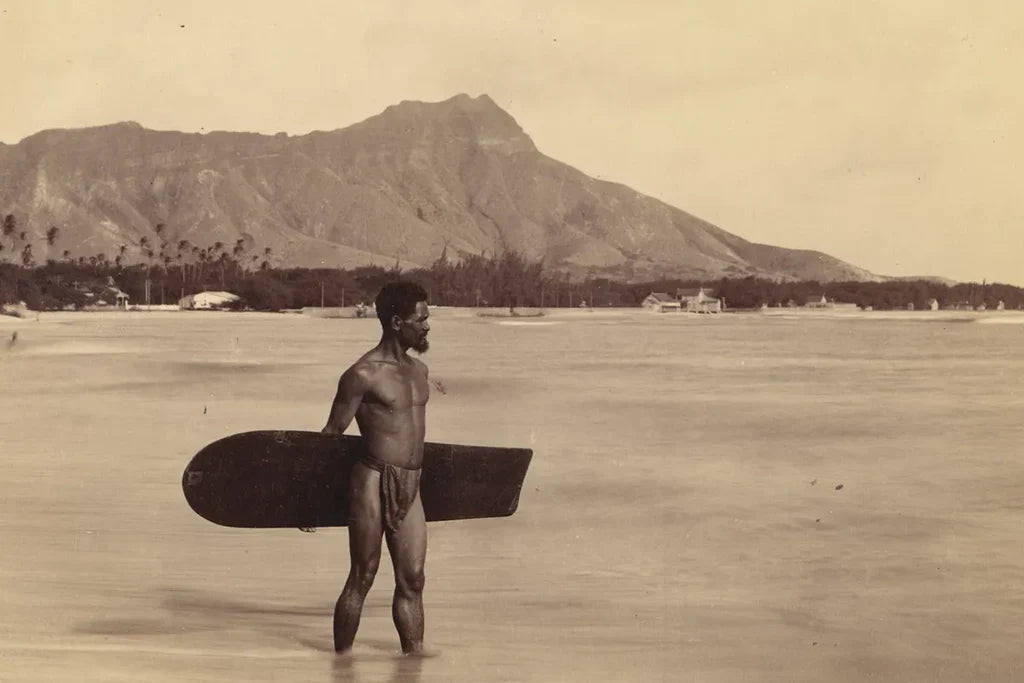
What King witnessed was not a sport in the European sense. It was he'e nalu, a Hawaiian term meaning "wave sliding," practiced by every level of Hawaiian society from commoners on short, rough boards to chiefs on polished hardwood planks up to 20 feet long. The length and quality of your board announced your rank. The right to ride certain waves was restricted by social position. Surfing was woven into the fabric of spiritual and political life in a way that King, with no cultural context, could not have understood from the shore.
The distance between that beach in 1779 and the World Surf League's Championship Tour, with its global circuit and Olympic inclusion, passes through a near-extinction, a revival built largely by one man, and a mid-century materials revolution that turned a 20-foot hardwood plank into a precision-engineered instrument.
The Polynesian Origins of Wave Riding
The oldest evidence of wave riding in the Pacific comes from Polynesia, the vast triangle of islands stretching from Hawaii in the north to New Zealand in the south and Easter Island to the east. Archaeological and oral historical evidence places surfing in the Hawaiian Islands at least as far back as the 12th century, and possibly significantly earlier.

In Hawaiian culture, surfing carried deep religious significance. Before shaping a board, a craftsman would offer prayers and make ritual offerings at the base of the tree from which the wood was to be taken. The most sacred boards were made from wiliwili, a lightweight native hardwood. Koa, denser and more durable, was used for longer boards reserved for high-ranking ali'i. After the board was shaped, additional ceremonies consecrated it for use.
The waves themselves were considered sacred. Specific breaks were reserved for chiefs, and surfing those waves without the appropriate rank was a serious transgression. Kahuna, the priests of Hawaiian spiritual life, had their own surfing practices and traditions. Competitions between surfers were common, with betting on outcomes. Champions were celebrated in chants and oral histories. The sport was not a casual leisure activity. It was one of the central expressions of Hawaiian identity and social order.

The Ancient Surfboard
The boards of pre-contact Hawaii were nothing like the fiberglass-and-foam equipment of the modern sport. They were massive wooden objects, shaped entirely by hand, that required significant strength just to carry into the water.
The olo board, the longest type, was reserved exclusively for ali'i. It could reach 18 to 24 feet in length, weigh more than 150 pounds, and was shaped from wiliwili wood for its relative lightness relative to koa. The alaia board, shorter and used by commoners, typically ran six to nine feet and was shaped from koa. A third type, the paipo, was a short, bodyboard-style design ridden lying down.

Shaping an olo or alaia required weeks of skilled work. The craftsman used stone adzes to rough out the form, then progressively finer tools to smooth it. The finished board was rubbed with oil from the kukui nut to seal and protect the wood. These boards had no fins, no leash attachment, no rocker in the modern sense. The rider controlled direction through subtle shifts of body weight and foot position. A competent surfer on an ancient alaia was demonstrating a level of balance and ocean reading that modern riders on finned, rockered shortboards would find difficult to replicate.
The Suppression of Surfing
The arrival of Protestant missionaries in Hawaii beginning in 1820 initiated a systematic dismantling of traditional Hawaiian culture. The missionaries regarded surfing, along with hula, gambling, and many other native practices, as heathen activities incompatible with Christian civilization. They did not use legal force to ban surfing directly. They achieved its near-disappearance through sustained cultural pressure and the reorganization of Hawaiian society around Christian norms of labor and leisure.
By the 1890s, surfing had been reduced to a marginal practice among a small number of Hawaiians in certain coastal areas. The boards, the techniques, the cultural knowledge, the associated ceremonies: most of it had been lost within three generations of missionary contact. What had taken centuries to develop had nearly vanished in decades.
Duke Kahanamoku and the Global Revival
The revival began in the early 20th century in Waikiki, where a small group of Hawaiian watermen kept surfing alive and began systematically introducing it to visitors. The most important figure in this revival was Duke Kahanamoku, born in Honolulu in 1890, who would become both an Olympic swimming champion and the most effective ambassador surfing has ever had.

Kahanamoku won his first Olympic gold in the 100-meter freestyle at the 1912 Stockholm Games. He spent the next several years traveling for swimming competitions and exhibitions, and wherever he went, he brought a surfboard. He gave demonstrations in New Zealand in 1914 and in Sydney's Freshwater Beach in December 1914 and January 1915, introducing surfing to Australian audiences who had never seen it. He demonstrated at beaches in the United States and Europe. His grace on the wave and his reputation as an Olympic champion gave surfing a cultural authority it had never enjoyed outside Hawaii.
The Outrigger Canoe Club and the Hui Nalu club at Waikiki became gathering points for both Hawaiian surfers and visiting enthusiasts. The surfboard itself began to evolve during this period. Tom Blake, an American surfer who spent extensive time in Hawaii, experimented with board design in the 1920s and 1930s and developed a hollow wooden board that was lighter and easier to paddle than the solid planks of the Hawaiian tradition. Blake also attached a skeg (a fixed fin) to the bottom of a board in the early 1930s, creating the first finned surfboard and introducing a level of directional control that transformed what was possible on a wave.
The Materials Revolution
The most significant transformation in surfboard technology came in the late 1940s, driven by materials developed during World War II. Fiberglass and polyurethane foam became available to board builders in the postwar period, and the results were immediate and dramatic.

A foam core covered in fiberglass cloth and sealed with polyester resin could be shaped into virtually any form, was dramatically lighter than balsa or redwood, and was consistent enough to allow repeatable designs. The craftsmen who shaped boards could now experiment precisely. A change in rocker, tail shape, or fin placement produced predictable, measurable effects rather than the variable results of working in wood.

The 1950s and early 1960s saw board lengths drop progressively as shapers discovered that shorter boards were faster and more maneuverable in the pocket of a wave. Hobie Alter, operating out of Dana Point in Southern California, built one of the first commercial foam and fiberglass surfboard operations and helped industrialize what had previously been cottage production. By the mid-1960s, Southern California had become the global center of surfboard manufacturing and surfing culture.
Surfing Goes Mainstream
The cultural explosion of surfing in the early 1960s was accelerated by media. The 1959 film Gidget, based on a novel by Frederick Kohner inspired by his daughter's surfing in Malibu, brought a sanitized version of surf culture to a mass American audience. The Endless Summer, Bruce Brown's 1966 documentary following two surfers around the world in search of the perfect wave, presented surfing as a global pursuit available to anyone willing to go looking for waves.

The surf music of the Beach Boys and Dick Dale gave the culture a soundtrack. The board industry that Alter and others had built was producing equipment at scale. Surf competitions were being organized up and down the California and Australian coasts. What had been an obscure Hawaiian practice in 1900 was a recognized global sport by 1966.
That same year, John M. Kelly Jr. was awarded a patent for a surfboard design with concave or slotted areas on the underside of the nose and midsection. The design was specifically engineered to trap water during maneuvers, generating lift and preventing the nose from submerging during nose-riding, a technique at the height of its popularity in the longboard era. Kelly's patent addressed a specific technical problem that surfers had been working around with body position and instinct. The patent formalized the engineering solution.

The Shortboard Revolution and Beyond
In 1967 and 1968, Australian shaper Bob McTavish and American shaper Nat Young began experimenting with dramatically shorter boards, drawn from vee-bottom hull designs borrowed from powerboat engineering. The boards they produced were six to seven feet long, far shorter than the nine-to-ten-foot logs that had defined the mainstream. They allowed a completely different style of surfing: rapid turning off the top of the wave, cutbacks, maneuvers in the critical section that were impossible on longer boards.
The shortboard revolution was disruptive enough that it effectively ended the longboard era almost overnight. Shapers who had built businesses on longboards had to retool entirely. Techniques that had taken years to develop became obsolete. The sport split into longboarding traditionalists and shortboard progressives, a division that persists in modified form today.

The decades that followed brought epoxy resin, carbon fiber reinforcement, computer-aided shaping, and hydrodynamic modeling. Professional competition organized into a structured world tour in the late 1970s. Kelly Slater won his first world championship in 1992 at age 20 and his eleventh in 2011, bracketing two decades of dominance that defined what athletic surfing could look like. Surfing was added to the Olympic program and debuted at the Tokyo 2020 Games.
The global surfing community today spans every continent with a coastline and a significant number without one. Inland wave pools, beginning with the technology developed by Slater and his engineering partners in the 2010s, have made it possible to surf without an ocean. The ancient Hawaiian practice that nearly disappeared under missionary pressure has become one of the most widely recognized action sports in the world.
And at the center of all of it, still, is a shaped piece of material that a person stands on in moving water. The olo board weighed 150 pounds and required a chief's right to ride it. The modern shortboard weighs under six pounds and is available to anyone willing to learn. The object changed. The act, the human on the wave, did not.
Shop Surfing Patent Art Prints
Surfboard (1966), John M. Kelly Jr.
Kelly's 1966 patent drawing documents the precise engineering behind one of surfing's most important design innovations: the concave nose that prevented boards from pearling during nose-riding. Filed the same year The Endless Summer brought surfing to a mass audience, the patent sits at the intersection of surfing's golden cultural moment and its most technically sophisticated period of board development. Clean technical lines, immediately recognizable shape. A piece that works in a surf house, a beach house, or anywhere someone has ever stood on a wave.
Best for: Surfers, ocean lovers, anyone who grew up near a beach or watched surfing at the Olympics

Frequently Asked Questions
Where did surfing originate?
Surfing originated in Polynesia, with the most developed early surfing culture in the Hawaiian Islands. The earliest documented evidence places wave riding in Hawaii at least as far back as the 12th century, with oral historical traditions suggesting earlier origins. Hawaiian surfing was a sophisticated cultural practice tied to spiritual beliefs, social rank, and political identity, not a recreational sport in the modern sense.
Who brought surfing to the rest of the world?
Duke Kahanamoku, an Olympic swimming champion from Honolulu, is most credited with spreading surfing globally in the early 20th century. Through exhibition surfing in Australia, New Zealand, and the United States during the 1910s and 1920s, Kahanamoku introduced the sport to audiences who had never seen it. His reputation as an Olympic athlete gave surfing a visibility and cultural legitimacy it had not previously had outside Hawaii.
When did fiberglass surfboards replace wooden boards?
Fiberglass and polyurethane foam boards began replacing balsa and redwood boards in the late 1940s, using materials developed during World War II. By the mid-1950s, foam and fiberglass construction had become the industry standard, allowing shapers to create lighter, more consistent boards in greater volume. The shift transformed surfing from a craft-based tradition to an industry.
What did John M. Kelly Jr.'s surfboard patent do?
Kelly's 1966 patent described a surfboard design with concave or slotted areas on the underside of the nose and midsection. These features were engineered to trap water during maneuvers, generating lift and preventing the nose from submerging during nose-riding. The design enhanced stability and maneuverability in a range of wave conditions and influenced subsequent surfboard design thinking about hull geometry.
What surfboard patent art prints are available?
The original U.S. Patent Office drawing for John M. Kelly Jr.'s surfboard design (1966) is available as a framed watercolor print, reproduced from the actual engineering document filed with the patent application. Each print is made in the USA on museum-quality paper and available framed or unframed. Shop the full surfing collection →
Written by Rider Tuff, founder of Timeless Patents. Timeless Patents makes museum-quality patent art prints from original U.S. Patent Office documents, celebrating the inventors behind your favorite sports, hobbies, and passions. Every print is available framed or unframed. Shop the full surfing collection →