TL;DR: Chinese checkers is neither Chinese nor a form of checkers. It was invented in Germany in 1892, popularized in the United States by two brothers named Pressman in 1928, and named for its exotic appeal to American consumers rather than any geographic connection. A 1940 patent by John Huffaker gave it the portable folding board that made it a household staple. Original prints of that patent drawing are available framed or unframed.
In 1928, Bill and Jack Pressman introduced a board game to the American market under the name "Chinese Checkers." The game was not Chinese. It was not a variation of checkers. It had been invented in Germany in 1892 and was already well known in Europe under the name Stern-Halma. The Pressmans chose the name because American consumers in the 1920s had a strong appetite for products with "oriental" branding, and a German game with an evocative foreign name sold better than the same game with an accurate one.
The name stuck, the game sold, and the Pressman brothers built a toy company on its success. The origin of the name was quickly forgotten, leaving generations of players with a fundamental misunderstanding of what they were playing and where it came from. Reconstructing that history requires going back further than Germany in 1892, to a Boston professor's parlor in the 1880s.
Halma: The American Original
The game now known as Chinese checkers descends directly from Halma, invented in 1883 or 1884 by George Howard Monks, a thoracic surgeon at Harvard Medical School. Monks developed the game in Boston with his brother Robert, who was visiting from England, and the design was influenced by a British game called Hoppity that Robert had encountered.
Halma (from the Greek word for "leap") was played on a square 16x16 board. Each player occupied a corner, and the goal was to move all of your pieces from your home corner to the diagonally opposite corner before any opponent could do the same. Movement was one square at a time in any direction, or hopping over adjacent pieces, including chains of hops that could carry a piece across much of the board in a single turn.

Halma was commercially published by E.I. Horsman Company in 1885 and became popular in the United States and Britain in the following years. The game's appeal was its scalability: it could be played by two, three, or four players on the same board, with players occupying different corners. This flexibility made it unusually social for a board game of its era.
Stern-Halma: The German Adaptation
In 1892, a German adaptation of Halma appeared under the name Stern-Halma. "Stern" is German for star, and the name described the game's most significant innovation: replacing Halma's square board with a six-pointed star-shaped board.
The star shape was not merely aesthetic. It transformed the game's structure in important ways. Where Halma accommodated up to four players using the four corners of a square, the six-pointed star accommodated up to six players using the six points of the star. The star board also created a more visually striking object and a more dynamic game board, with the natural target areas of each player's home zone clearly visible as one of the six points.

The movement rules of Stern-Halma were identical to Halma: pieces move one square at a time, or hop over adjacent pieces, with chain-hopping allowed. The goal remained the same: move all of your pieces to the opposite point of the star. The star board changed the visual identity and the player count but left the core game unchanged.
Stern-Halma was commercially successful in Europe through the late 19th and early 20th centuries. It arrived in the United States through the usual routes of imported goods and immigrant cultural transfer, but had not been aggressively marketed to American consumers when the Pressman brothers encountered it.
The Pressman Rebranding and American Success
Bill and Jack Pressman were New York toy distributors looking for games to sell in the American market. When they encountered Stern-Halma in the late 1920s, they recognized its commercial potential but also understood that German branding would not help in the American market of 1928. Germany and the United States had been at war a decade earlier. Meanwhile, American consumer culture in the 1920s had a documented appetite for goods with Asian or "oriental" branding, reflecting a broader cultural fascination that historians have linked to trade patterns, immigration, and popular entertainment.

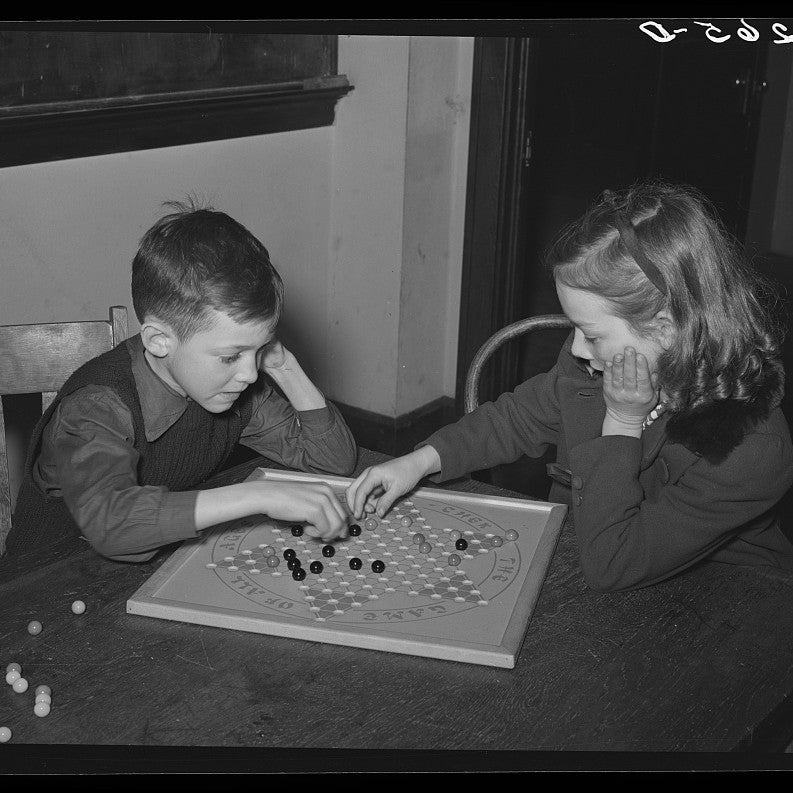
The Pressmans renamed the game "Chinese Checkers," changed the playing pieces from the flat discs of European Halma variants to marbles (which were cheaper to produce and more appealing to American children), and launched it with packaging that emphasized its exotic-sounding name. The game was an immediate commercial success.
The success of Chinese Checkers helped the Pressman brothers establish what became the Pressman Toy Corporation, a New York-based toy company that went on to produce dozens of successful games through the 20th century, including Mastermind, Rummikub, and several licensed games. Chinese Checkers remained one of their signature products.
How the Game Is Played
Chinese checkers is played on the six-pointed star board that Stern-Halma established in 1892. Each of the six points of the star serves as a home zone for one player. A two-player game uses opposite points; a three-player game uses alternating points; six players use all six. Each player begins with 10 marbles in their home point.

On each turn, a player either moves a marble one space in any direction into an adjacent empty space, or hops over an adjacent marble (any player's marble) into the space directly beyond it. If a landing space makes another hop available, the player may continue hopping in a chain, potentially crossing the entire board in a single turn. Pieces that are hopped over are not captured and remain on the board.
The first player to move all 10 of their marbles from their home point to the opposite point wins. Because the game rewards setting up "ladders" of marbles for other pieces to hop through, cooperation and disruption are both available as strategic tools, making the game unusual in its social dynamics for a competitive game.
The Patent That Made It Portable
The commercial success of Chinese Checkers in the 1930s created a practical problem: the star-shaped board was awkward to store and transport. Unlike a square or rectangular board, it could not simply be folded in half without the fold crossing the playing surface awkwardly. Storing the marbles separately from the board meant pieces were frequently lost.
In 1940, John Huffaker of Bloomington, Illinois was granted U.S. Patent for a Chinese checkers game board that solved both problems. Huffaker's design included a folding mechanism that allowed the star-shaped board to collapse into a compact form suitable for storage and travel. Built-in piece storage in the folded board kept the marbles with the game. You could store a mid-game board without losing piece positions and carry the whole game in one hand.

Huffaker's patent is his only known filing. The problem he solved was specific, practical, and unglamorous: the game needed a better container. His solution became the standard form for Chinese checkers sets, and variations of the fold-and-store design he documented in 1940 are still the most common format for the game sold today. The game that Bill Pressman renamed for marketing reasons and George Howard Monks invented in a Boston parlor in 1883 has never had a more practical physical form than the one John Huffaker designed in Bloomington, Illinois, over fifty years later.
Frequently Asked Questions
Is Chinese checkers actually Chinese?
No. Chinese checkers was invented in Germany in 1892 under the name Stern-Halma and introduced to the American market in 1928 by Bill and Jack Pressman, who renamed it "Chinese Checkers" to capitalize on American consumer interest in goods with Asian branding. The game has no connection to China or any part of Asia.
What is the difference between Halma and Chinese checkers?
Halma, invented in Boston in 1883 by George Howard Monks, is played on a square 16x16 board with up to four players. Chinese checkers descends from Stern-Halma, a 1892 German adaptation that replaced the square board with a six-pointed star board and allowed up to six players. The movement rules are essentially the same in both games.
How do you play Chinese checkers?
Each player starts with 10 marbles in their home point (one of the six points of the star). On each turn, you move one marble one space in any direction or hop over an adjacent marble into the empty space beyond, with chain-hopping allowed. Hopped pieces are not captured. The first player to move all 10 marbles to the opposite point of the star wins. The game supports two to six players.
What did John Huffaker patent in 1940?
John Huffaker of Bloomington, Illinois was granted a patent in 1940 for a folding Chinese checkers game board with integrated piece storage. The design allowed the star-shaped board to fold into a compact form and store all the marbles inside, making the game practical to transport and store. It is Huffaker's only known patent.
Who started the Pressman Toy Company?
Jack Pressman founded what became the Pressman Toy Corporation after the commercial success of Chinese Checkers, which he and his brother Bill introduced to the American market in 1928. The company went on to produce many successful games including Mastermind and Rummikub. Chinese Checkers remained one of their signature products throughout the 20th century.
Timeless Patents makes museum-quality patent art prints from original U.S. Patent Office documents, celebrating the inventors behind your favorite sports, hobbies, and passions. Every print is available framed or unframed. Shop the full games collection →