TL;DR: Croquet evolved from a disputed French or Irish ball-and-mallet game into a Victorian sensation before being upstaged by lawn tennis, and in 1883 Alfred Farley of Kansas patented luminous croquet balls so players could find them in the grass. The original U.S. Patent Office drawing from that patent is available as a framed or unframed print.
In 1883, with croquet falling out of fashion, a man in Leavenworth, Kansas solved a problem that every backyard player still recognizes: the ball disappears into the grass. Alfred Farley's patent for a luminous covering on croquet balls was a small, practical invention at the tail end of the sport's golden era, but the drawing he filed with the U.S. Patent Office captures something more lasting. It is a record of a game that once filled the lawns of Victorian England and the estates of American celebrities, then retreated to the backyard, and never quite went away.
The Disputed Origins: France, Ireland, or Something Older
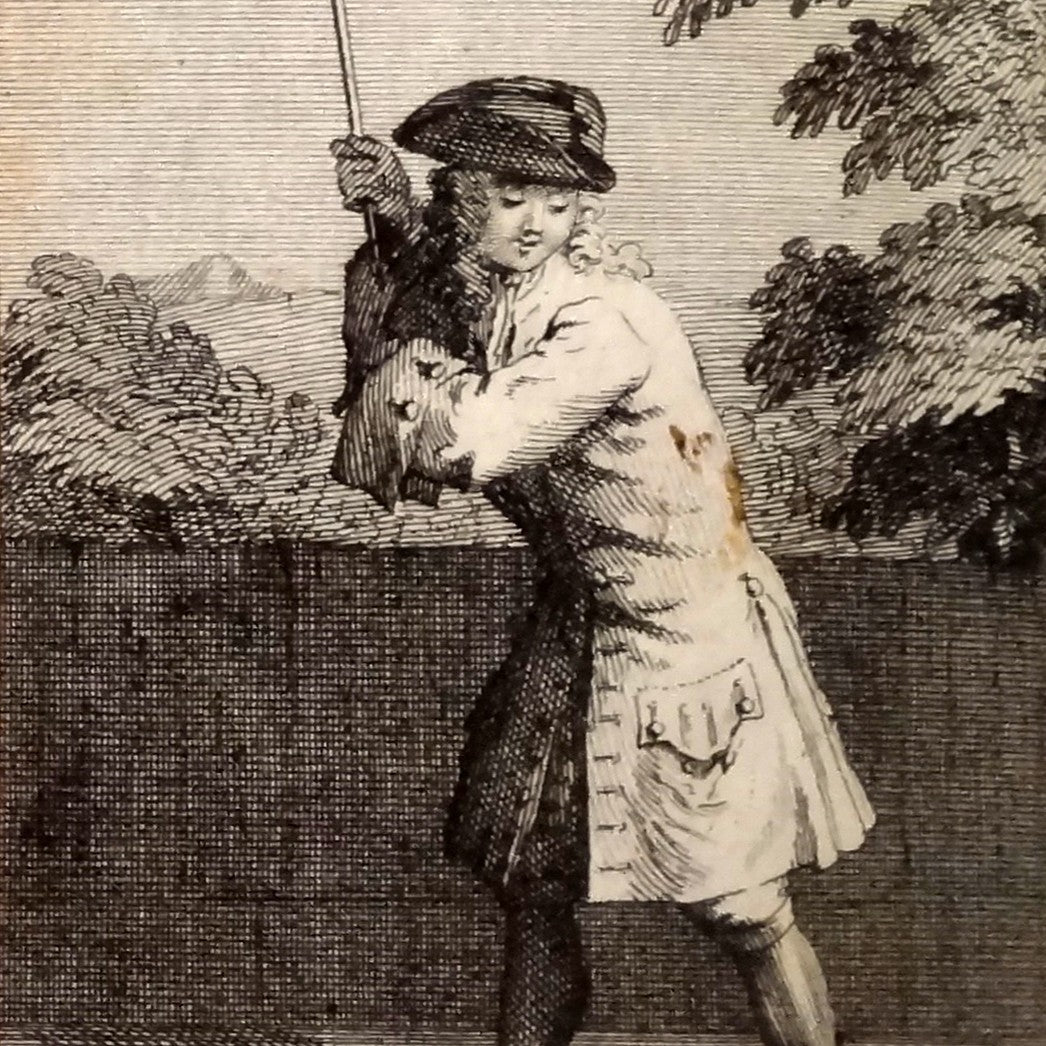
Croquet's early history is genuinely contested, and the competing theories say something about how the game traveled through different cultures before landing in Britain. One version holds that it arrived from France in the late 1600s under the name paille-maille, a game played with a mallet and ball through a series of hoops on a prepared course. The name survives in London place names: Pall Mall, the famous street, derives from an alley where the French game was played in the 17th century.

The competing theory places croquet's origins in Ireland, where a game called crookey was played in the 1830s and may have crossed the Irish Sea to England in the 1850s. Under this account, it was Irish emigrants who introduced the game to Britain, not French courtiers. The word "croquet" itself may derive from the French word for shepherd's crook, which describes the early curved-handled mallet used to hit the ball.
What both accounts agree on is that by the 1850s, a recognizable form of croquet had established itself in Britain and was spreading quickly through the middle and upper classes. The game required a flat lawn, a set of equipment, and a tolerance for precise, patient play. The Victorian era was well suited for all three.
The Victorian Boom: Cassiobury, Jaques, and the Earl of Essex
Croquet's rise to mainstream prominence in Britain came during the 1860s, and much of the credit belongs to a single aristocrat. The Earl of Essex embraced the game with genuine enthusiasm, hosting lavish croquet parties at Cassiobury House, his estate in Hertfordshire. The Cassiobury grounds became a social gathering point for the sport, and the Earl went further, launching a branded croquet set under the Cassiobury name. For a Victorian leisure activity, this was significant: the game had acquired a celebrity patron willing to attach his name to it.

John Jaques, a sporting goods manufacturer, played an equally important role. Jaques had been producing croquet sets since the 1850s, and his business scaled quickly with the sport's popularity. By the late 1860s, he had sold over 65,000 copies of his own Laws and Regulations of the game, a publishing achievement that effectively gave croquet a standardized rulebook before any governing body existed to provide one. The Jaques company also produced Alice's Adventures in Wonderland illustrator John Tenniel's famous flamingo-mallet, hedgehog-ball croquet imagery, lending the game a cultural presence that extended well beyond the lawn.

In 1870, the sport finally got its governing body. The United Croquet Club formed in England to standardize rules across the growing number of clubs, ending the era in which each estate might play by slightly different conventions. The sport spread through the British Commonwealth during this period: Australia, Canada, and the United States all developed croquet communities shaped by the English game.
The Fall: Lawn Tennis and the Gambling Problem
Croquet's decline was as rapid as its rise. By the late 1870s, the sport had developed two serious problems, and either one alone might have been manageable. Together, they were fatal to its mainstream appeal.
The first was gambling. Competitive croquet had attracted a culture of side betting, and the association with gambling gave the sport a disreputable edge that made it difficult for clubs and families to promote without reservation. Victorian respectability was not merely a social norm; it was a market requirement for any leisure activity that wanted broad participation.
The second was a new competitor. Lawn tennis was invented in 1873 by Major Walter Clopton Wingfield, who marketed it under the unwieldy name "Sphairistike." The name did not survive, but the game did. Tennis was faster, more athletic, and more naturally suited to spectators than croquet. It could be played on the same lawns. Clubs that had invested in croquet infrastructure found that it could be converted to tennis infrastructure with minimal effort.

The All England Croquet Club at Wimbledon, founded in 1868, is perhaps the most famous casualty of this transition. By 1877, the club had added lawn tennis to its grounds and held its first tennis championship. By 1882, the club had dropped "Croquet" from its name entirely, becoming the All England Lawn Tennis and Croquet Club, a formulation that preserved croquet in the name while making clear which sport was now primary. The Wimbledon name would go on to define tennis, not croquet.
Alfred Farley's Luminous Patent
It is in this context, with croquet retreating from mainstream clubs back to private lawns, that Alfred Farley filed his patent in 1883. Farley, working out of Leavenworth, Kansas, was not attempting to revive a sport. He was solving a practical problem for backyard players who had kept the game alive through the competitive era's collapse.
His invention was a luminous covering for croquet balls. The concept was straightforward: treat the exterior of the ball with a material that would catch available light, making the ball easier to locate when it rolled into shadow, tall grass, or undergrowth. Anyone who has played croquet on an uneven or partially shaded lawn understands the problem immediately. Balls disappear. Play stops. The game loses its rhythm.
Farley's patent was his only known filing, suggesting a practical man with a specific problem to solve rather than a serial inventor working through a portfolio of ideas. The patent drawing itself is spare and precise, the kind of functional document that the U.S. Patent Office produced by the thousands during this period, recording small innovations from inventors whose names history rarely preserved.
Hollywood and the Mid-20th Century Revival
Croquet's next significant moment came in a setting as far removed from Victorian England as possible: the lawns of Hollywood in the 1930s and 1940s. A circle of film industry figures took up the game with notable intensity. Harpo Marx, Alexander Woollcott, and Moss Hart were among the regulars at Croquet on the Green, a loose social gathering that played at private estates across Beverly Hills and Bel Air.

The Hollywood revival gave croquet a certain wry sophistication that it has never entirely lost. The game's reputation as a genteel activity with an unexpectedly competitive interior, strategic, precise, occasionally vicious in the polite way that only lawn games can be, suited the wit and competitiveness of the entertainment industry's creative class. The revival did not last long enough to restore the game to its Victorian mainstream, but it established a different kind of cultural cachet.
A more sustained revival came in the 1980s. By the mid-decade, over 350 croquet clubs had formed across North America, and the sport had developed a serious competitive structure. The World Croquet Federation now organizes international events through more than a dozen national associations. The game that the All England Club abandoned for tennis continues to be played at a competitive level, on precisely maintained lawns, by players who would not describe it as a backyard game at all.
The Patent That Captured the Moment
The 1883 Farley patent is not the drawing of croquet at its peak. It comes from the trailing edge of the Victorian boom, filed as the sport was losing ground to tennis and being pushed from clubs to private gardens. That timing gives it a particular character. It is the record of an inventor who believed in the game's continued future at exactly the moment the mainstream had moved on, and who was not wrong. Croquet survived, in living rooms and backyards and competitive clubs, for the next century and more.
The original U.S. Patent Office drawing from Farley's 1883 patent is the artifact of that moment: a precise, functional document that captures both the invention and the specific passage in croquet's long, contested history.
Frequently Asked Questions
Where did croquet originate?
Croquet's origins are genuinely disputed. One theory traces it to the French game paille-maille, which was played in Britain as early as the 17th century. Another holds that a game called crookey crossed from Ireland to England in the 1850s. Both traditions agree that a recognizable form of croquet was established in Britain by the 1850s and spread rapidly through the Victorian middle and upper classes during the 1860s.
Why did croquet fall out of popularity?
Croquet's decline in the late 1870s came from two directions at once. The sport had become associated with gambling, which made it difficult for clubs and families to endorse. At the same time, lawn tennis emerged in 1873 and offered a faster, more athletic game on the same lawns. Many clubs, including the All England Club at Wimbledon, converted their croquet grounds to tennis courts. Croquet survived as a backyard game but never regained its professional mainstream audience.
Who patented croquet?
Alfred Farley of Leavenworth, Kansas was granted a patent in 1883 for a croquet design featuring a luminous covering on the balls to make them easier to find during play. This was Farley's only known patent. He was not the inventor of croquet itself but rather a practical innovator who solved a specific problem for players during the period when the sport was transitioning from elite clubs to private lawns.
Is croquet still played competitively?
Yes. After a revival in the 1980s, croquet established a serious competitive structure in North America and internationally. The World Croquet Federation organizes events across more than a dozen national associations. The modern competitive game, played on closely maintained lawns with precise mallets and strict rules, is quite different from backyard croquet but directly descended from the Victorian standardized version.
What is the croquet patent art print?
The croquet patent art print is a reproduction of Alfred Farley's 1883 U.S. Patent Office drawing for luminous croquet balls, rendered in a watercolor style on museum-quality paper. It is available framed or unframed from Timeless Patents, and it is the original engineering drawing filed when the patent was new, not an illustration created after the fact.
Written by Jackie Crino, owner of Timeless Patents. Timeless Patents makes museum-quality patent art prints from original U.S. Patent Office documents, celebrating the inventors behind your favorite sports, hobbies, and passions. Every print is available framed or unframed, starting at $49.99. Shop the full games collection →