TL;DR: Fishing lures date back to 2000 BC, when early anglers fashioned hooks from animal bones and bronze, but it was not until 1950 that Lawrence Loeb of New Haven, Connecticut patented a translucent artificial lure with a hook hidden inside the body -- invisible to fish, a specific engineering solution to the problem of fish seeing the hook and refusing the bait. Original patent prints are available framed or unframed.
Somewhere around 2000 BC, an angler tied a curved piece of bone or hammered bronze to a line and lowered it into the water. Whether that constitutes a lure or a hook is a matter of definition, but the underlying logic -- that a fish can be deceived into biting something that is not food -- is as old as fishing itself. Every artificial lure ever made, from Nordic spoon lures to modern hard baits, runs on that same idea.
What changed over 4,000 years was not the idea but the execution: the materials, the shapes, the understanding of how fish perceive their environment, and eventually the precision engineering that allowed an inventor in 1950 to patent a lure with a hook buried invisibly inside a translucent plastic body. Lawrence Loeb's design was the end of a very long line of people trying to make fish believe something false.
The Earliest Lures: Bone, Bronze, and Hand Lines (2000 BC)
Archaeological evidence of fishing equipment goes back to the Neolithic period, but purposeful lures -- objects designed to attract and deceive fish rather than simply hook bait -- begin to appear clearly around 2000 BC in the form of composite hooks and weighted objects designed to suggest the movement of prey.

Early fishermen in the Near East and Egypt worked primarily with hand lines -- fishing line held directly between the fingers, without a rod. The hand line is a more sensitive tool than it might sound: a practiced hand-line angler can feel a fish investigate a bait and respond to the tension more immediately than a rod allows. Hand lines remained in common use well into the 19th century in many fishing cultures, and in some commercial fishing contexts they are still used today.
The hooks and lures at the end of these early hand lines were made from available materials. Animal bones were shaped into curved hooks with a notch cut for line attachment. Bronze provided a stronger, more workable material as metalworking developed. In both cases, the hook was typically attached to a lure or bait -- a piece of material designed to attract the fish close enough that the hook could find a purchase.
Bronze hooks created an interesting problem: the metal was strong and durable, but it was also highly visible to fish in clear water. Bronze does not approximate the color of most natural prey. This visibility issue drove the development of lure designs that would disguise the hook within something more naturalistic.
The Romans and the Spread of Lure Fishing
The ancient Romans took fishing seriously as both a food source and a leisure activity. Roman writers including Claudius Aelianus, writing in the 2nd and 3rd centuries AD, documented fishing practices in detail, including descriptions of artificial lures made from wool, feathers, and lead dressed to resemble insects.
Aelianus's description of Macedonian fishermen using "reddish wool" and "wax-colored feathers" to make artificial flies for trout is one of the earliest detailed accounts of fly fishing -- the practice of making a lure that imitates an insect on the water's surface. The Romans spread fishing practices, along with road networks and legions, across their empire. Fishing techniques developed in the Mediterranean moved into northern Europe and the British Isles during the centuries of Roman occupation.
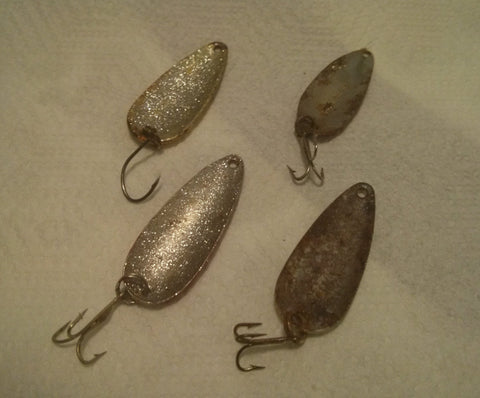
The Norse and Scandinavian fishing traditions developed in a different direction. By the 8th century AD, Nordic fishermen had developed the spoon lure: a metal oval, usually made from iron, bronze, or copper, with hooks attached. The spoon's curved shape causes it to wobble and flash as it moves through the water, imitating the motion of a small fish rather than an insect. Spoon lures were made in many sizes and proportions for different target species and different water conditions.
The spoon lure principle -- metal shaped to move attractively through water -- is still the basis of a large category of modern fishing lures. The underlying design has not changed substantially in more than a thousand years.
English Tackle Shops and the Rise of Manufactured Lures (1800s)
By 1800, English tackle shops were selling artificial fishing lures commercially. Early offerings included painted rubber representations of insects and small fish -- the first mass-produced lures available to ordinary anglers without the skill to make their own.
These early commercial lures were crude by later standards, but they represented a significant shift. For most of fishing's history, lures were handmade by individual anglers, craftsmen, or guides. Skill in lure making was part of the knowledge base of serious fishing. The commercial tackle shop democratized access to artificial lures for anglers who lacked the time or dexterity to make their own.
American manufacturers entered the lure market in the second half of the 19th century and quickly scaled up production. The American sporting goods industry, growing rapidly after the Civil War as recreational fishing spread across the country, invested in the manufacturing processes needed to produce lures in volume: die-cutting metal components, molding rubber and early plastic bodies, applying paint and finishes consistently across large batches.
Large-scale manufacturing brought down lure prices dramatically and expanded the range of designs available. By 1900, an American angler could walk into a sporting goods store in any major city and choose from dozens of lure designs for different species, water conditions, and seasons. The individual craftsman making custom lures for a specific stretch of river was still present, but the manufactured lure had become the baseline.
The Problem Loeb Solved: Hiding the Hook
Throughout the development of artificial lures, one problem persisted that every design addressed imperfectly: fish could see the hook. Under clear water conditions, a metal hook attached to or protruding from a lure body was visible to fish with good eyes -- and fish, particularly the game fish that anglers most wanted to catch, have excellent vision. A fish that saw the hook refused the lure. Hook visibility was a fundamental limit on lure effectiveness in clear-water conditions.
Lure makers approached the problem in different ways. Dark finishes on hooks reduced their visibility against shadowed backgrounds. Feathers and hair tied over the hook shaft obscured the metal. Treble hooks tucked into lure bodies were harder to see than single hooks dangling freely. But in clear, sunlit water with a wary fish, the hook was still there to be seen.
Lawrence Loeb of New Haven, Connecticut attacked the problem from a different angle in his 1950 patent. His design placed the hook entirely inside a lure body made from translucent plastic. The body itself was shaped and colored to imitate an insect -- specifically, one of the aquatic insects that form the primary food source for trout and other freshwater game fish. The translucent material allowed light to pass through the body, giving it the appearance of a real insect's wing cases and body segments rather than an opaque manufactured object.
The hook was built into the body. Not attached to the outside, not hanging below, not threaded through with points exposed -- built in, so that from a fish's perspective, there was no hook visible at all. A fish approaching the lure would see what appeared to be a real insect. When it struck, the hook was there, hidden inside what had looked like food.
Loeb's design was his only filed patent. It expired in 1967, seventeen years after it was filed. But the specific problem it solved -- hook visibility in clear water -- was a genuine one, and the translucent body approach he used influenced subsequent lure design in ways that extended beyond the specific patent.
The Modern Lure Industry
The second half of the 20th century brought materials and manufacturing techniques that transformed lure design. Injection-molded hard plastic replaced carved wood as the dominant body material for hard lures, allowing precise reproduction of complex shapes at industrial scale. Soft plastic lures -- worms, grubs, creature baits -- became an entire category of their own, using flexible materials that moved with a lifelike action in the water.
Modern fishing lures are engineered products in the fullest sense: tested in tanks for water action, refined through computer modeling, produced in hundreds of colorways targeted at specific conditions and species. The science of fish vision -- how fish see color at different depths and in different light conditions -- has been applied directly to lure color design.
The fundamental question, though, is still the same one that drove the bone-and-bronze fishermen of 2000 BC: what combination of shape, color, and movement will convince a fish that what it sees is food? Every lure patent in between -- including Loeb's 1950 translucent design -- is an answer to that question.
Shop Fishing Lure Patent Art Prints
The original U.S. Patent Office drawing that defined the translucent artificial lure. Starting at $49.99 unframed.
Fishing Lure (1950), Lawrence Loeb
Loeb's 1950 patent drawing shows the internal architecture of the translucent insect-imitating lure -- the body profile, the hidden hook placement, and the cross-section diagrams that reveal how the hook is buried within the plastic body. The blue-tinted drawing has an unusually striking visual quality for a patent document, the combination of technical precision and the recognizable insect shape making it one of the more interesting pieces in the fishing category. A strong wall piece for a fishing room, office, or anywhere a serious angler spends time.
Best for: Fly fishermen and trout anglers, fishing cabin or lodge decor, gift for the angler who has every piece of tackle but nothing on the walls

Frequently Asked Questions
How old are fishing lures?
Fishing lures in the sense of artificial objects designed to deceive fish date to approximately 2000 BC, when early anglers used hooks made from animal bone and bronze attached to materials intended to attract fish. The Roman writer Aelianus documented artificial fly fishing in the 2nd century AD, describing Macedonian fishermen using wool and feathers to imitate insects. The Norse spoon lure appeared by the 8th century AD. Commercial manufactured lures became available in England around 1800.
Who invented the fishing lure?
No single person invented the fishing lure -- the concept developed independently across many fishing cultures over thousands of years. The Norse spoon lure, the Roman artificial fly, and the early 19th-century English rubber insect imitations all represent independent development of the same basic idea. In the United States, large-scale lure manufacturing began in the second half of the 19th century. The specific translucent insect-imitating lure patented in 1950 by Lawrence Loeb of New Haven, Connecticut was a distinct contribution to the category.
What was unique about Lawrence Loeb's 1950 lure patent?
Loeb's design placed the hook entirely inside a translucent plastic body shaped to imitate an insect. Unlike previous lures where the hook was attached to or protruding from the outside of the body, Loeb's hook was built into the body itself. The translucent material allowed light to pass through, giving the lure the appearance of a real insect rather than an opaque manufactured object. The design specifically addressed the problem of fish seeing and refusing a lure because the hook was visible.
What is a spoon lure and where did it come from?
A spoon lure is a metal oval or elongated shape with hooks attached, designed to wobble and flash as it moves through the water, imitating the movement of a small fish. Nordic fishermen developed the spoon lure by the 8th century AD, making them from iron, bronze, or copper in various sizes for different species and conditions. The spoon lure principle -- metal shaped to move attractively through water -- remains the basis of a large category of modern fishing lures.
What is the difference between a lure and a fly in fishing?
A fly is a specific type of artificial lure designed to imitate insects at or near the water's surface, typically used in fly fishing with a fly rod and weighted line. Flies are usually tied from feathers, hair, and thread rather than molded or machined from hard materials. Lures is a broader term covering a wide range of artificial baits including hard lures, soft plastic baits, spoons, spinners, and jigs. Loeb's 1950 patent was technically a lure designed to imitate an insect but used a hard translucent body rather than traditional fly-tying materials.
Written by Rider Tuff, founder of Timeless Patents. Timeless Patents makes museum-quality patent art prints from original U.S. Patent Office documents, celebrating the inventors behind fishing, outdoor sports, and everyday tools. Every print is available framed or unframed, starting at $49.99. Shop the full fishing collection →
Cover image: "Lure Iceland" by TommyBee, licensed under Public domain, via Wikimedia Commons.