TL;DR: Golf shoes evolved from spiked street shoes to precision-engineered footwear, and in 1931 a Massachusetts inventor named Milton Reach filed a patent for a shoe designed to mechanically correct a golfer's footwork during the swing. That patent, filed on behalf of A.G. Spalding and Brothers, is one of the more quietly significant pieces of engineering in the game's equipment history. Original prints of the patent drawing are available framed or unframed.
In 1931, a patent examiner in Washington, D.C. reviewed a drawing for a golf shoe with a raised outer heel on each foot. The inventor, Milton Reach of Chicopee, Massachusetts, had designed the elevation deliberately: by lifting the outside edge of each heel, the shoe made it physically harder for a golfer to rock off their feet during the swing. The fix was built into the leather before the player ever took a stance. It was one of over 100 patents Reach would file in his lifetime, and it remains one of the more precise intersections of biomechanics and footwear in golf's equipment history.
Early Golf Shoes: Metal Cleats on Everyday Footwear
For most of golf's early history, there was no such thing as a golf shoe. Players wore whatever leather boots or street shoes they owned and drove metal cleats into the sole for traction on wet grass. The cleats helped. The rest of the shoe was not designed for the demands of a golf swing, and the difference showed in how golfers stood, turned, and transferred weight through the shot.

The problem with repurposed footwear was not just comfort. A golf swing places specific demands on the foot: lateral stability at the start of the backswing, controlled weight transfer through impact, and a stable base at follow-through. Shoes built for walking on pavement or cobblestones offered none of that by design. Golfers adapted their technique to their footwear rather than the other way around.
The Development of Purpose-Built Golf Shoes
The modern golf shoe began to take recognizable form in the late 1800s, as the sport spread from Scotland through England and into the United States. Shoemakers who understood the sport's requirements began producing shoes with a more sophisticated cleated sole, a raised heel for stability at address, and leather construction shaped for the athletic demands of a full-swing sport.

By the early 1900s, golf shoe design had incorporated perforated leather uppers for breathability and canvas linings that allowed moisture to move away from the foot during a round. A full 18 holes in summer heat generates significant perspiration, and a shoe that trapped that moisture became uncomfortable and unstable by the back nine. The material choices reflected an understanding that golf is an endurance activity as much as an athletic one.
The metal cleats of this era were effective for traction but created a new problem: they damaged golf course greens. The scraping and pivoting of metal spikes on putting surfaces left marks that affected the roll of the ball for players following behind. Greenkeepers and club members pushed back against metal spikes for decades before the sport industry developed alternatives. That tension between traction and course protection would define golf shoe development for most of the 20th century.
The 1931 Reach Patent: Correcting the Swing Through the Shoe
In 1931, Milton Reach of Chicopee, Massachusetts filed a patent assigned to A.G. Spalding and Brothers for a golf shoe design built around a specific mechanical problem. Many golfers, particularly higher-handicap players, tended to roll their weight to the outside of their feet during the swing, a motion that disrupted their base, reduced power transfer, and introduced inconsistency into the shot. Swing instruction could address the habit, but it took significant repetition to retrain.
Reach's design attacked the problem from the shoe outward. By raising the outer side of each heel, the shoe created a physical resistance to the rolling motion. When a golfer attempted to rock outward, the elevated heel pressed back, encouraging the foot to stay flat and the weight to transfer correctly through the ball. The correction happened before conscious technique had a chance to intervene or fail.

The patent was assigned to Spalding, one of the dominant sporting goods manufacturers of the era, which had the distribution network to bring the design to market at scale. Reach was a prolific inventor whose portfolio spanned sporting goods and industrial applications. His golf shoe patent reflects a period when American sporting goods companies were investing heavily in equipment engineering, applying systematic design thinking to gear that had previously evolved through craft tradition rather than mechanical analysis.
The Spiked Shoe Era and the Shift Away from Metal
Through the 1950s, metal spiked golf shoes remained the standard. The spike design had evolved considerably from the rough cleats of earlier decades, with standardized screw-in spikes that could be replaced when worn and positioned to provide traction at the points where a golfer's foot generates the most force during the swing.

The 1990s brought a genuine shift: manufacturers introduced soft-spike systems that provided equivalent traction without the metal-on-turf contact that damaged greens. The soft spikes were made from hard plastic or rubber, durable enough to grip wet fairway grass but gentle enough not to leave the spike marks that had plagued course superintendents for decades. Most major golf courses made the transition mandatory within a few years, and soft spikes became the industry standard.
Modern Golf Shoes: Materials Science on the Course
Contemporary golf shoes bear little visual resemblance to the leather-and-metal construction of their predecessors, though the underlying engineering goals remain the same: traction, lateral stability, comfort over 18 holes, and waterproofing. Modern designs use synthetic uppers, Gore-Tex membranes, injection-molded soles, and advanced cushioning systems adapted from athletic footwear.
The outsole design has grown more sophisticated as computer modeling allowed designers to map exactly where pressure concentrates during each phase of the golf swing. Spike placement in modern shoes is not random. It reflects precise biomechanical data about foot loading patterns at address, backswing, transition, impact, and follow-through. Every traction element is positioned where the data says the golfer's foot needs it most.
The logic of Milton Reach's 1931 patent, that the shoe itself can be engineered to support correct mechanics rather than merely protect the foot, runs through modern shoe design in more sophisticated form. Reach designed around weight transfer in one specific movement. Modern designers model the full kinetic chain from the ground up, using materials and geometries that Reach could not have imagined but would likely have recognized as the same fundamental problem approached with better tools.
The patent drawing filed in 1931 captures a specific moment when golf equipment engineering was beginning to intersect with biomechanics. A Chicopee inventor looked at a common swing fault, designed a physical solution, and drew it out for the patent examiner. The drawing is spare and precise, the way good engineering drawings tend to be.
Shop Golf Shoes Patent Art Prints
The original U.S. Patent Office drawing that defined engineered golf footwear. Starting at $49.99 unframed.
Golf Shoes (1931), Milton Reach
Reach's 1931 design is the patent that brought biomechanical thinking to golf footwear, building swing correction directly into the shoe's construction. Filed on behalf of A.G. Spalding and Brothers, the patent represents a pivotal moment when systematic engineering began replacing craft tradition in golf equipment design. The drawing is clean and precise, a product of a prolific inventor who filed over 100 patents in his lifetime. It reads clearly on a wall whether or not the viewer knows anything about golf.
Best for: Golfers focused on technique, sporting goods history enthusiasts, anyone who appreciates the engineering behind everyday athletic equipment

Frequently Asked Questions
When were golf shoes invented?
Purpose-built golf shoes developed in the late 1800s as the sport spread from Scotland to England and the United States. Before dedicated golf footwear existed, players attached metal cleats to ordinary street shoes for traction. The first designs built specifically for golf incorporated structured leather uppers, cleated soles, and heel construction designed for the demands of the golf swing.
Who patented the golf shoe?
Milton Reach of Chicopee, Massachusetts filed a notable golf shoe patent in 1931, assigned to A.G. Spalding and Brothers. His design addressed a specific biomechanical problem: by raising the outer side of each heel, the shoe made it physically harder for golfers to rock their weight incorrectly during the swing. Reach was a prolific inventor who filed over 100 patents during his career.
Why did golf courses ban metal spikes?
Metal spikes provided excellent traction but damaged putting green surfaces when golfers pivoted and scraped during their rounds. The spike marks affected how the ball rolled for players following behind. The development of soft-spike systems in the 1990s, using hard plastic or rubber traction elements, provided equivalent grip without the turf damage. Most major golf courses made soft spikes mandatory within a few years of their introduction.
What makes golf shoes different from regular athletic shoes?
Golf shoes are engineered specifically for the lateral forces generated during a golf swing, with traction elements positioned to support foot loading at address, backswing, transition, impact, and follow-through. Modern designs also emphasize waterproofing for early-morning rounds on wet grass, stability for standing on uneven terrain, and comfort over the four or five hours a typical round requires. The outsole geometry reflects biomechanical data about where a golfer's foot generates the most force at each phase of the swing.
What golf patent art prints are available?
The original U.S. Patent Office drawing for the golf shoe (1931) is available as a framed or unframed print from Timeless Patents. Each print is a reproduction of the actual engineering drawing filed when the invention was new, rendered in a watercolor style on museum-quality paper. See the full golf patent art collection →
Written by Jackie Crino, owner of Timeless Patents. Timeless Patents makes museum-quality patent art prints from original U.S. Patent Office documents, celebrating the inventors behind your favorite sports, hobbies, and passions. Every print is available framed or unframed, starting at $49.99. Shop the full golf collection →
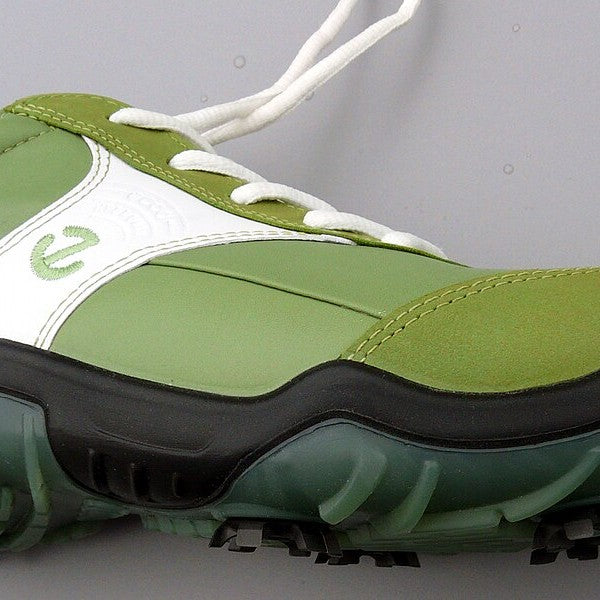
Cover image: "Golfschuhe 2 (fcm)" by Frank C. Müller, licensed under CC BY-SA 3.0, via Wikimedia Commons.