TL;DR: The golf cart went from a basic motorized utility vehicle in the 1930s to a technologically sophisticated piece of course equipment within a few decades, and in 1989 a Pennsylvania inventor named John Moglia patented the flexible windshield design that became a standard feature on modern carts. The story of how a vehicle originally designed for elderly and disabled golfers became standard equipment at courses worldwide is one of the more underappreciated chapters in golf's equipment history. Original prints of the patent drawing are available framed or unframed.
John Moglia of Allentown, Pennsylvania filed two patents in his lifetime. The second, filed in 1989, covered a flexible plastic windshield panel for a golf cart, designed to fold up during clear weather and fold down when rain or wind made visibility a problem. It is a practical solution to a specific discomfort, the kind of invention that golfers who own carts understand immediately and golfers who have never owned one might not think about at all. It is also a small piece of the larger story of how the golf cart went from a novelty to a necessity in fewer than four decades.
The Origins of the Golf Cart: A Vehicle for Accessibility
The golf cart was not designed for convenience. It was designed for access. The earliest motorized golf vehicles appeared in the 1930s, built to allow golfers with physical limitations, including elderly players and those with disabilities, to participate in the sport when walking the course was not practical. These first vehicles were rudimentary: small gasoline engines, metal or wooden frames, and no amenities beyond basic transportation from one hole to the next.

The early carts had no windshield, no roof, no storage, and limited range. They were slow enough that some golfers could walk alongside them without effort. What they provided was not speed but continuity: a golfer who could not reliably walk five miles over varied terrain could still play a full round. That original purpose, extending participation to players who would otherwise be excluded, is easy to forget when you see four able-bodied golfers riding between holes on a Saturday morning. But it is where the golf cart began.
The Shift to Electric Power
Gas-powered golf carts dominated the 1930s and 1940s, but they brought problems with them. The engines were noisy, required fuel storage on the course, produced exhaust in the open air, and needed regular maintenance. A course running a fleet of gas carts had to manage fuel logistics alongside every other operational concern.

In the 1950s, electric golf carts arrived in force and quickly demonstrated their advantages. They were quieter, produced no exhaust on the course, and required less mechanical maintenance than gasoline engines. The early electric models had limited range, which meant courses had to manage charging schedules and battery replacement carefully. But the operational simplicity of electric power over a fleet of vehicles outweighed the range limitation, and the industry moved decisively toward electric motors.
The development of larger, more powerful lead-acid batteries in the mid-1960s pushed the electric cart further. With 48-volt battery systems replacing earlier configurations, carts could travel farther between charges and carry heavier loads. A course could complete a full day of operations on a single overnight charge cycle rather than managing fuel delivery and mid-day refueling. The economics of electric power became compelling, and by the late 1960s, electric carts were the standard at most American courses.
The 1970s and the Four-Wheel Drive Cart
As golf course design grew more ambitious through the 1960s and 1970s, courses began incorporating steeper terrain, more complex routing, and greater distances between green and the next tee. The courses built during the golden era of American golf architecture, from the mid-1960s through the 1980s, often challenged golfers with elevation changes and hill climbs that early electric carts handled poorly.

The introduction of four-wheel drive capability in the early 1970s addressed the terrain problem directly. A cart with power delivered to all four wheels could climb grades that would leave a two-wheel drive model spinning or slipping, extending the range of courses where carts were practical and reducing the maintenance problems caused by carts struggling on hills. The wider capability meant that course designers could plan around cart access without artificially flattening their routing.
Amenities, Comfort, and the Modern Golf Cart
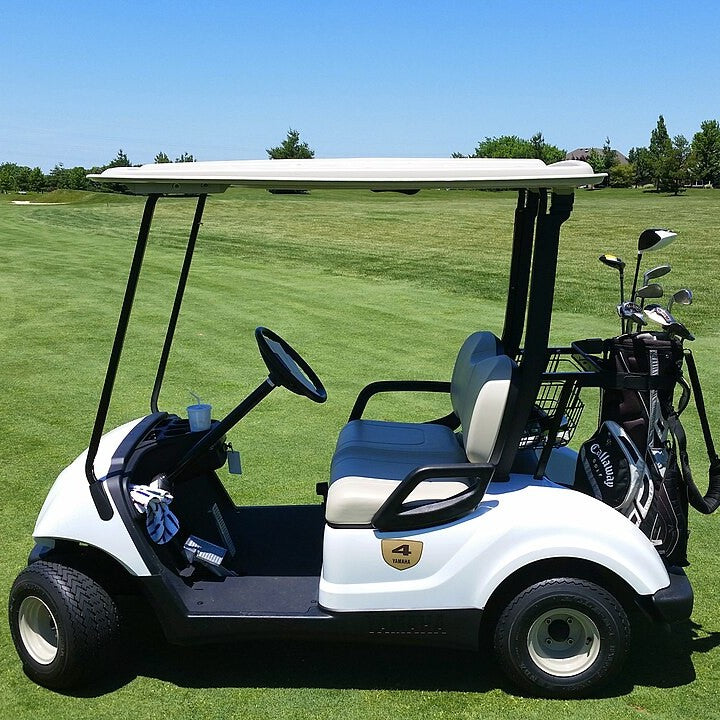
Through the 1980s and 1990s, the golf cart industry added features that had nothing to do with transportation and everything to do with comfort. Headlights extended the cart's usable hours into early morning and late evening rounds. Turn signals made cart traffic at busy courses safer. Speedometers allowed courses to enforce speed limits. Radios and eventually CD players turned the cart into a rolling lounge between shots.
The cultural status of the golf cart shifted during this period. It had begun as assistive equipment for players who needed it. By the 1980s, it had become a preference for a wide range of golfers, and many courses built their operational models, including cart path systems, cart barn infrastructure, and cart rental revenue, around the assumption that most players would ride. The cart was no longer an accommodation. It was a product.

The Moglia Windshield Patent
In this context of rapid feature development, John Moglia's 1989 patent for a flexible windshield addresses one of the more persistent comfort problems on a golf cart: weather. An enclosed cart with a fixed windshield is uncomfortable in warm weather, trapping heat and reducing airflow. A cart with no windshield or a permanently open front is miserable in rain or cold. Moglia's design offered a practical middle path: a flexible plastic panel that could be folded up and secured when weather was clear and folded down into position when conditions required protection.

The mechanism Moglia patented was not complex by engineering standards, but it solved a genuine usability problem with a minimal number of parts and a fold operation that any golfer could manage without tools. In inclement weather conditions that were not severe enough to take golfers off the course entirely but uncomfortable enough to make an open cart unpleasant, the folding windshield made the difference between a round that continued and one that ended early. For a product primarily sold to courses on the basis of revenue generation per round played, that difference has real economic value.
Moglia filed only two patents in his lifetime. The windshield patent is one of them, and it reflects the focused approach of an inventor who identified a specific problem, designed a specific solution, and committed it to the patent record.
The Golf Cart's Broader Legacy
The golf cart transformed course design, pace of play, and the economics of the golf industry in ways that were not fully anticipated when the first vehicles appeared in the 1930s. Courses built cart paths, designed routing around cart access, and structured their pricing models around cart rental revenue. The four-hour round, which became the standard expectation at American golf courses by the late 20th century, is partly a product of cart availability. Walking the same course often takes five or more hours at a comparable pace of play.
Modern golf carts incorporate GPS navigation, course mapping, yardage to the pin, beverage holders, USB charging ports, and in some premium models, individual wheel speed control for improved handling on slopes. The trajectory from Moglia's folding windshield to the connected, instrumented cart of today is a straight line of incremental improvement applied to the same basic vehicle.
The patent drawing Moglia filed in 1989 captures the cart at a specific moment in that trajectory: past its utilitarian origins, mid-way through the amenity era, on the cusp of the technology integration that would follow. The drawing is a record of a practical inventor solving a real problem on a vehicle that had already become indispensable to the sport.
Shop Golf Cart Patent Art Prints
The original U.S. Patent Office drawing that defined the modern golf cart's flexible windshield. Starting at $49.99 unframed.
Green Golf Cart (1989), John Moglia
Moglia's 1989 patent captures the golf cart at the height of its amenity evolution, with a practical windshield solution that any golfer who has ridden in rain will immediately understand. It is one of only two patents Moglia filed in his lifetime, and it represents the kind of focused problem-solving that defines golf's equipment history. The drawing is clean and geometric, presenting well on any wall where golf is part of the story.
Best for: Golfers who own or frequently rent carts, anyone who loves the behind-the-scenes engineering of sports equipment, gift buyers looking for something unexpected in the golf category

Frequently Asked Questions
When was the golf cart invented?
The first motorized golf vehicles appeared in the 1930s, initially designed to allow golfers with physical limitations to access the course. These early carts were gas-powered, had no amenities, and were limited in speed and range. Electric golf carts became predominant in the 1950s as battery technology improved, offering quieter operation and simpler maintenance at the course level.
Why did golf courses switch from gas to electric golf carts?
Electric golf carts offered significant operational advantages over gas-powered models: quieter operation that did not disturb players on adjacent holes, no exhaust on the course, and simpler maintenance without fuel storage requirements. The development of more powerful 48-volt battery systems in the mid-1960s addressed the range limitations of earlier electric models and made electric carts practical for full-day course operations.
Who patented the golf cart windshield?
John Moglia of Allentown, Pennsylvania patented a flexible plastic windshield design for golf carts in 1989. His patent covered a panel that could be folded up in clear weather to allow airflow and folded down in rain or wind for protection. The design addressed a practical comfort problem on a vehicle used in all weather conditions. It was one of only two patents Moglia filed in his lifetime.
How did the golf cart change course design?
The widespread adoption of golf carts prompted courses to build dedicated cart paths, design routing around cart access, and structure tee-to-green distances with motorized travel in mind. Course designers working from the 1960s onward could create more ambitious layouts with greater distances between holes without concern that the walk between them would be impractical. Cart rental revenue also became a significant part of course economics, influencing the business models of golf operations through the late 20th century.
What golf cart patent art prints are available?
The original U.S. Patent Office drawing for the green golf cart (1989) by John Moglia is available as a framed or unframed print from Timeless Patents. Each print is a reproduction of the actual engineering drawing filed when the invention was new, rendered in a watercolor style on museum-quality paper. See the full golf patent art collection →
Written by Jackie Crino, owner of Timeless Patents. Timeless Patents makes museum-quality patent art prints from original U.S. Patent Office documents, celebrating the inventors behind your favorite sports, hobbies, and passions. Every print is available framed or unframed, starting at $49.99. Shop the full golf collection →