TL;DR: The hockey puck began as a sliced wooden block at McGill University in 1875, evolved into a vulcanized rubber disc in 1910, and in 1940, Arthur Ross of Marshfield, Massachusetts, filed a patent for a roll-preventing design that rounded the puck's sharp edges and became the standard the NHL still uses. Original patent art prints are available framed or unframed.
At the first recorded indoor hockey game at McGill University in 1875, the players were not using a puck. They were using a lacrosse ball. It rolled. It bounced off the boards. It went under the benches. The solution was to slice the ball flat, creating a disc that would stay on the ice instead of skipping off it. That improvised wooden disc was the prototype for every hockey puck that followed, and the problem it solved, keeping the object of play on the playing surface, remained the central engineering challenge of puck design for the next six decades.
The history of the hockey puck is a history of solving that one problem progressively. From wood to rubber, from sharp edges to rounded corners, from inconsistent handmade discs to standardized manufactured objects, each iteration addressed a failure of the previous design. Arthur Ross's 1940 patent, which fixed the puck's tendency to roll by removing its sharp corners, was the last major structural change. The modern hockey puck is, in its essential geometry, the disc Ross designed.
The First Games and the Wooden Puck
Ice hockey as a recognizable sport developed in Canada during the second half of the 19th century. The game drew from elements of field hockey, lacrosse, and the stick-and-ball games that British soldiers and settlers had brought to Canada. The first widely documented indoor game was played at Victoria Skating Rink in Montreal on March 3, 1875, organized by James George Aylwin Creighton, a student at McGill University.

Creighton's game used a flat wooden disc rather than a round ball specifically because indoor rinks could not safely contain a rolling ball at high speed. The boards were not designed to absorb the impact, and spectators near the ice were at risk. A flat disc stayed low, slid across the ice, and could be controlled with a stick more reliably than a ball. The improvised nature of that first puck, a lacrosse ball cut in half, or possibly a carved wooden block, set the pattern for the wooden pucks that early hockey used in its formative years.
Wooden pucks were inconsistent. They splintered on hard shots, absorbed moisture and became heavy, and chipped in ways that changed their flight characteristics unpredictably. The sport needed a more durable material.
The Rubber Puck and the NHA Standard
The rubber hockey puck was introduced to organized league play by the National Hockey Association in 1910. Made from vulcanized rubber, the same material Charles Goodyear had developed for industrial use in the 1840s, the rubber puck was substantially more durable than wood. It resisted chipping and splitting, held its shape over repeated impacts against boards and sticks, and performed more consistently in cold temperatures.

The NHA also set the first formal dimensional standards for the puck: three inches in diameter and one inch thick. These dimensions were chosen to balance playability (large enough to be visible on ice, small enough to handle with a stick), safety (heavy enough to register on a goaltender but not so heavy as to cause serious injury), and manufacturing practicality. The three-by-one specification has remained the standard in the NHL to this day.
The National Hockey League, which succeeded the NHA in 1917, adopted the rubber puck as its official equipment standard from the start. The vulcanized rubber disc became the universal standard across North American hockey leagues within a decade of the NHA's initial adoption.

The Problem of Rolling
Despite the standardization of the rubber puck's dimensions, one persistent problem remained through the 1930s: the puck rolled. Standard manufacturing techniques left the puck's edges sharp, at a 90-degree angle between the flat face and the cylindrical side. When a puck hit the boards at a sharp angle or landed awkwardly on the ice, it would tip onto its edge and roll, sometimes the length of the ice, before a player could reach it. Rolling stoppages interrupted gameplay and frustrated players and spectators alike.
The problem was acknowledged by everyone who played the game, but solving it required rethinking the puck's geometry. The sharp edge was not a design choice. It was a manufacturing artifact, the natural result of cutting a rubber cylinder to the specified thickness. Addressing it required adding a deliberate feature to what had previously been a purely utilitarian object.
Arthur Ross and the 1940 Patent
Arthur Ross of Marshfield, Massachusetts, was already a significant figure in hockey before he filed his puck patent in 1940. Ross had played professional hockey in the early years of the NHA, won two Stanley Cup championships, and was serving as general manager of the Boston Bruins when he turned his attention to the puck's rolling problem. He was a practitioner first, and the patent emerged from decades of watching the game's deficiencies up close.
Ross's design removed the sharp corners from the puck's edges, replacing them with a beveled surface that made the puck far less likely to tip onto its edge on impact. The modification was geometrically simple but mechanically significant: a puck with rounded edges will wobble and settle flat rather than rolling in a sustained line. The Tyer Rubber Company was assigned the patent when it was filed, receiving the manufacturing rights to the design.

The NHL adopted the Ross puck design, and it became the standard for professional hockey. The beveled edge is present on every regulation hockey puck manufactured today. Ross was inducted into the Hockey Hall of Fame in 1945, and the NHL's scoring trophy, awarded annually to the league's top scorer, bears his name. The puck patent is rarely mentioned in his biography, but it is the design element that sits at the center of every game played at every level of hockey.
The Miracle on Ice and the Modern Puck
The most famous moment in hockey puck history arrived at the 1980 Winter Olympics in Lake Placid, New York. The United States men's hockey team, made up largely of amateur and college players, faced the Soviet Union team in the semifinal. The Soviets had won nearly every major international hockey competition for the previous two decades. The American team was not expected to compete, let alone win.

The American team won 4-3 in what was immediately recognized as one of the most significant upsets in sports history. The puck used in the game was preserved and is now housed in the Hockey Hall of Fame in Toronto. It is a standard vulcanized rubber disc, three inches in diameter, one inch thick, with beveled edges. The design Arthur Ross patented in 1940. The same puck that has been used in every NHL game since.

Today, the NHL specifies that pucks must weigh between 5.5 and 6 ounces and measure three inches in diameter and one inch in thickness. They are frozen before use to reduce bouncing on the ice surface, a practice that became standard in the NHL in the 1990s. Modern manufacturing ensures dimensional consistency that the handmade wooden discs of 1875 could never achieve. But the shape is the same one that emerged from two engineering decisions: the NHA's 1910 dimensional standard and Arthur Ross's 1940 edge geometry.
Shop Hockey Puck Patent Art Prints
Hockey Puck (1940), Arthur Ross
Ross's 1940 patent solved the rolling problem that had plagued hockey since the wooden puck era, and the beveled edge he designed is on every regulation puck used today. A clean, precise patent drawing that reads clearly on any wall. The kind of piece that a hockey fan will recognize immediately and a non-hockey fan will ask about.
Best for: Hockey fans, sports history collectors, den or game room walls
Frequently Asked Questions
When was the hockey puck invented?
The hockey puck in its original form dates to 1875, when players at the first recorded indoor hockey game at McGill University in Montreal used a flat wooden disc to keep the object of play on the ice. The rubber puck was introduced by the National Hockey Association in 1910, and Arthur Ross's roll-preventing design, which added beveled edges, was patented in 1940 and remains the standard today.
Why is a hockey puck made of rubber?
Hockey pucks are made of vulcanized rubber because it is durable, consistent, and performs predictably in cold temperatures. Earlier wooden pucks splintered, absorbed moisture, and chipped unpredictably. The NHA introduced the vulcanized rubber puck in 1910, and the NHL adopted it as the standard when the league was founded in 1917. The same material is used in every regulation puck today.
Who patented the hockey puck?
Arthur Ross of Marshfield, Massachusetts, filed a patent in 1940 for a roll-preventing hockey puck design. Ross removed the sharp corners from the puck's edges, replacing them with a beveled surface that prevented the puck from rolling on impact. The Tyer Rubber Company was assigned the patent. Ross was also a former player, two-time Stanley Cup champion, and longtime general manager of the Boston Bruins.
Why are NHL hockey pucks frozen before games?
Freezing pucks before use reduces the rubber's natural bounciness, making the puck behave more predictably on the ice surface. A room-temperature rubber puck bounces more on ice contact, which affects player control and game flow. The NHL standardized the practice of pre-freezing pucks in the 1990s, and it is now a routine part of game preparation at the professional level.
What hockey patent art prints are available?
The original U.S. Patent Office drawing from Arthur Ross's 1940 roll-preventing hockey puck patent is available as a framed or unframed art print. The print reproduces the actual engineering drawing filed with the patent office, showing the beveled edge design that became the NHL standard, rendered in a watercolor style on museum-quality paper. Shop the Hockey Puck Print →
Timeless Patents makes museum-quality patent art prints from original U.S. Patent Office documents, celebrating the inventors behind sports equipment, games, and everyday objects. Every print is available framed or unframed. Shop the full hockey collection →
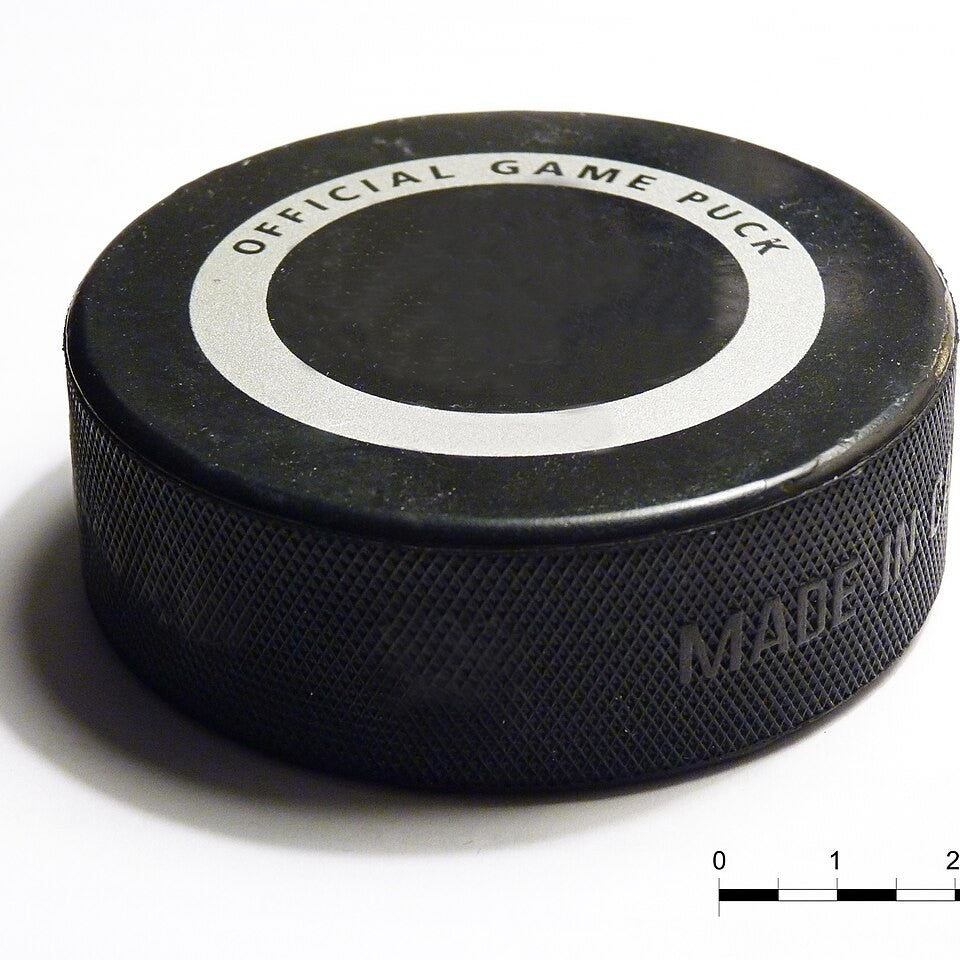
*Cover image: "Ice hockey puck - 2" by Matt Boulton
derivative work: MrPanyGoff, licensed under CC BY-SA 2.0, via Wikimedia Commons.*