TL;DR: Darts evolved from medieval English soldiers throwing at upturned barrels, and a 1908 court case proved it was a game of skill rather than chance, setting the stage for Thomas Tempest's 1937 patent for a dartboard with a replaceable bullseye. The original U.S. Patent Office drawing from that patent is available framed or unframed.
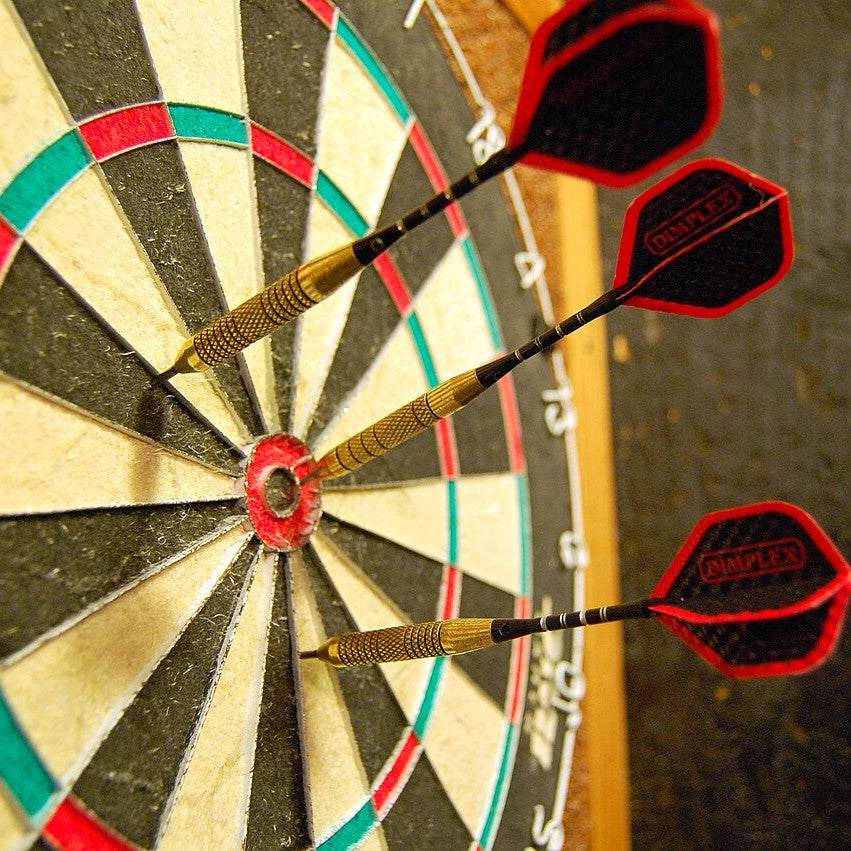
In 1908, a pub owner in Leeds named "Bigfoot" Annakin was taken to court for allowing darts to be played on his premises. English law at the time prohibited games of chance in licensed establishments. The authorities argued that darts qualified. The magistrate asked Annakin to demonstrate that it was not. He walked to the board and put three consecutive darts in the 20 segment. When the court clerk tried the same and hit only one, the case was dismissed. Darts was ruled a game of skill. That ruling changed the legal landscape for every pub in England, and the sport that benefited from it was already over five centuries old.
The Soldiers and the Barrels
The folk origin story of darts places it in England around the 1300s, and while origin stories are often embellished, this one has structural logic. Medieval soldiers between engagements were bored. They had short arrows, upturned wine barrels, and the competitive instinct that has never needed much encouragement to find an outlet.
The bottom of a barrel, when examined closely, suggests a target. The concentric rings of grain wood, when cut in cross-section, produce a pattern of circles around a dense center point. Soldiers who transitioned from barrel bottoms to cross-sections of tree trunks found that the growth rings of the tree made natural scoring zones: a center, a series of progressively larger circles, and the edges that tested the limits of precision.

Whether this account is literally true in every detail, the physical logic is sound. Tree cross-sections were used as early dartboards, and the concentric ring pattern of wood grain is a direct ancestor of the circular scoring zones on the modern board. The game was practiced enough among English soldiers that it spread naturally into civilian tavern culture during the late medieval period.
Henry VIII and the Spread Through British Courts
By the 16th century, darts had moved well beyond the barracks. King Henry VIII was a known player, and the game had spread through the English nobility with the endorsement that royal patronage typically provided. When Henry played a game, it was unlikely to remain a soldiers' tavern pursuit for long.

The Mayflower passengers reportedly brought a dart set when they sailed to America in 1620, suggesting that the game was established enough in English culture to be worth packing for a transatlantic voyage. Whether that account is precisely documented or part of the accumulated folklore around the Pilgrims is less certain than its persistence in darts histories, but it points to how embedded the game had become in English everyday life by the early 17th century.
Darts continued to evolve through the following centuries, but the physical form of the board changed slowly. The game was standardized enough to be widely recognized, loose enough that regional variations persisted. What did not exist for most of this period was a mathematically designed scoring system.
Brian Gamlin and the Number Arrangement
The numbering system on a standard dartboard, the sequence 20, 1, 18, 4, 13, 6, 10, 15, 2, 17, 3, 19, 7, 16, 8, 11, 14, 9, 12, 5, and back to 20, is not arbitrary. The arrangement is designed to punish inaccuracy. High-scoring segments are flanked by low-scoring neighbors, so that a dart that drifts slightly left or right of the intended target is penalized significantly. A player who aims for 20 and misses left hits 1; a miss to the right hits 5. This structure makes the game genuinely difficult and prevents luck from compensating for poor aim.
The credit for this arrangement is traditionally given to Brian Gamlin, a carpenter from Lancashire, England, who is said to have devised the numbering system in 1896. Gamlin died in 1903 before filing any patent, and the historical record is thin enough that some researchers have questioned whether the attribution is accurate. The system was certainly in use by the early 20th century, and Gamlin's name has been attached to it in darts histories for over a century.
What can be said with confidence is that by the time the Annakin court case settled the legal status of darts in 1908, the board that players were throwing at had the structure we recognize today: concentric scoring rings, a bullseye, and the carefully arranged number system designed to reward precision.
The 1908 Court Case and the Skill Question
The Annakin case deserves more attention than it usually receives in darts histories. The question of whether a game is skill or chance was not merely legal hair-splitting. In early 20th-century England, licensing laws around gambling were enforced with genuine seriousness, and the classification of a pub game could determine whether that game was legally playable in licensed establishments.

Darts had built its entire culture around the pub. The board was mounted on the wall, the players were regulars, and the social structure of the game was inseparable from the tavern setting in which it was played. A ruling against the game would have forced it out of exactly the environment it needed to survive and grow.
The magistrate's decision, confirmed by Annakin's demonstration and the court clerk's failure to replicate it, established darts as a game of skill in English law. That ruling gave the sport the institutional protection it needed to continue developing as a pub game through the first half of the 20th century and into the modern era.
World War II and the Spread to America
Darts reached its first peak of global popularity during World War II. The game was a morale staple in British military culture, and as American soldiers stationed in England encountered it, they brought it back to the United States. The wartime period saw the game spread more rapidly through international military networks than it had through centuries of civilian diffusion.
The timing of Thomas Tempest's patent in 1937 sits just before this surge. Tempest, working out of Philadelphia, Pennsylvania, was solving a specific problem with the board itself: the bullseye wore out faster than the rest of the playing surface. The center of a dartboard takes more hits per unit area than any other zone, because every throw is at least directionally aimed at it, and because the double and triple bullseye scoring incentivizes concentrated targeting.
Tempest's design allowed the bullseye section to be removed from the board and replaced independently when it wore out, extending the life of the board and reducing the cost of maintaining it. It was a practical engineering solution to a known maintenance problem, and the patent drawing shows the segmented construction that made it possible.
The Modern Professional Game
Darts became a major professional sport in Britain during the 1970s and 1980s, when television coverage turned top players into recognizable public figures. The British Darts Organisation, founded in 1973, and later the Professional Darts Corporation, which broke away in 1993, created the tournament structures that now support a competitive circuit with significant prize money and international reach.
The boards used in professional play today are made from sisal fibers rather than wood, a material change that allows darts to be pulled cleanly without leaving holes that expand over time. The electronic dartboards developed in the late 20th century brought the game to new venues and new players who might not have encountered the traditional bristle board.
Through all of these changes, the basic geometry of the board, the arrangement of numbers, the double ring, the triple ring, and the bullseye at the center, has remained exactly what Brian Gamlin or whoever designed it in the 1890s established. The Tempest patent's contribution of a replaceable bullseye addressed the wear pattern that geometry creates.
The Drawing Behind the Board
The 1937 Tempest patent is the engineering document of a specific moment: just before the global surge in darts, in the period when the game had stabilized its form and professional players were developing the technique that would eventually become televised competition. The U.S. Patent Office drawing shows the sectional construction of a board designed to be maintained rather than simply replaced, a utilitarian approach to an instrument that was about to become a great deal more widely used.
Shop Dart Board Patent Art Prints
The original U.S. Patent Office drawing that defined the dartboard. Starting at $49.99 unframed.
Dartboard (1937), Thomas Tempest
Tempest's 1937 patent solved the most common maintenance problem in darts: the bullseye wears out before the rest of the board. This is the original engineering drawing from the U.S. Patent Office, filed just before World War II sent the sport global. The clean sectional diagram works well in a game room, a pub-style basement, or anywhere the game is taken seriously enough to care about where the board came from.
Best for: Dart players, game room decorators, pub enthusiasts

Frequently Asked Questions
Where did darts originate?
Darts is widely believed to have originated in England around the 1300s, when soldiers threw shortened arrows at the bottoms of wine barrels or cross-sections of tree trunks during idle periods between battles. The game spread through military culture and then into civilian taverns, where it became a fixture of English pub life. King Henry VIII was a known player by the 16th century, suggesting the game had reached aristocratic circles well before it formalized as a sport.
Who invented the dartboard numbering system?
The distinctive numbering arrangement on a standard dartboard, which places high-scoring segments next to low-scoring ones to punish inaccuracy, is traditionally credited to Brian Gamlin, a carpenter from Lancashire, England, who reportedly devised the layout in 1896. Gamlin died in 1903 without filing a patent, and the historical record is incomplete, but his name has been attached to the arrangement in darts histories for over a century.
Who patented the dartboard?
Thomas Tempest of Philadelphia, Pennsylvania was granted a patent for a dartboard design in 1937. His design featured a bullseye that could be removed from the board and replaced independently when worn, extending the board's useful life. This was Tempest's only known patent, and it expired in 1954.
When was darts ruled a game of skill?
In 1908, a Leeds pub owner known as "Bigfoot" Annakin was taken to court for allowing darts in his establishment. English law at the time restricted games of chance in licensed premises. To defend himself, Annakin threw three consecutive darts into the 20 segment; the court clerk attempting the same only hit one. The magistrate ruled darts a game of skill, establishing legal protection for the game in British pubs.
What is the dartboard patent art print?
The dartboard patent art print is a reproduction of Thomas Tempest's 1937 U.S. Patent Office drawing for a dartboard with a replaceable bullseye, rendered in a watercolor style on museum-quality paper. It is available framed or unframed from Timeless Patents, and it captures the actual engineering drawing filed when the patent was new.
Written by Jackie Crino, owner of Timeless Patents. Timeless Patents makes museum-quality patent art prints from original U.S. Patent Office documents, celebrating the inventors behind your favorite sports, hobbies, and passions. Every print is available framed or unframed, starting at $49.99. Shop the full games collection →