TL;DR: The Wright brothers made the first sustained, controlled, heavier-than-air powered flight at Kitty Hawk in December 1903, but several other inventors got machines airborne first under narrower definitions. The patent that settled the question of who would control the future of aviation was filed in 1906. Original prints of that patent are available framed or unframed.
The question of who invented the airplane depends entirely on how you define flight. If flight means any instance of a heavier-than-air machine leaving the ground under its own power, the answer predates the Wright brothers by more than a decade. If flight means a sustained, controlled, repeatable powered flight with a pilot aboard, the answer is Kitty Hawk, North Carolina, December 17, 1903. The Wright brothers understood that the second definition was the only one that mattered, and they filed the patent to prove it.
Early Experiments: Steam Power and Unstable Machines
The 19th century was full of people trying to build flying machines. Most of them failed in ways that ranged from undignified to fatal. What distinguished the serious engineers from the dreamers was whether they had a workable theory of lift and control, not just enthusiasm.
Clement Ader, a French engineer, was among the most technically serious of the early pioneers. In 1886, he completed his first aircraft, the Avion I (also called the Eole), a steam-powered machine with wings modeled on the anatomy of a bat. The wingspan was approximately 46 feet and the steam engine produced around 20 horsepower. The entire machine weighed roughly 660 pounds. In 1890, Ader claimed the Eole rose from the ground and traveled approximately 160 feet, though the machine was not steerable and the flight, if it occurred at all, was more of a sustained hop than a controlled flight.

Ader continued his work, building the Avion III in 1897 and testing it before French military observers. The military report was ambiguous. Ader claimed success. The observers recorded an uncontrolled run that ended in a crash. The French government terminated funding. Ader's contributions to aviation history are real: his bat-wing designs influenced later thinking on curved airfoil surfaces, and his work demonstrated the feasibility of steam-powered mechanical flight at a time when many considered it impossible. But sustained, controlled flight eluded him.
Samuel Langley, secretary of the Smithsonian Institution, was building large steam-powered models called Aerodromes that successfully flew without pilots from 1896 onward. His full-scale piloted machine, however, twice failed catastrophically on its launch catapult over the Potomac River in late 1903, just weeks before the Wright brothers flew at Kitty Hawk. Langley died in 1906 without resolving the control problem that had defeated him.
The Wright Brothers: Control as the Core Problem
Orville and Wilbur Wright were bicycle manufacturers from Dayton, Ohio. They began studying aeronautics in 1899 not by building an engine first, but by studying the literature of earlier failures. They concluded that the central unsolved problem was not power or lift but control: how to keep a flying machine stable and steerable in three dimensions simultaneously.

Their solution was three-axis control: a system that allowed the pilot to manage pitch (nose up/down), roll (wing tilt), and yaw (nose left/right) independently. The key insight was wing warping, a mechanism that twisted the wings' trailing edges in opposite directions to control roll. Combined with a movable front elevator for pitch and a rear rudder for yaw, the system gave the pilot full authority over the aircraft's attitude.
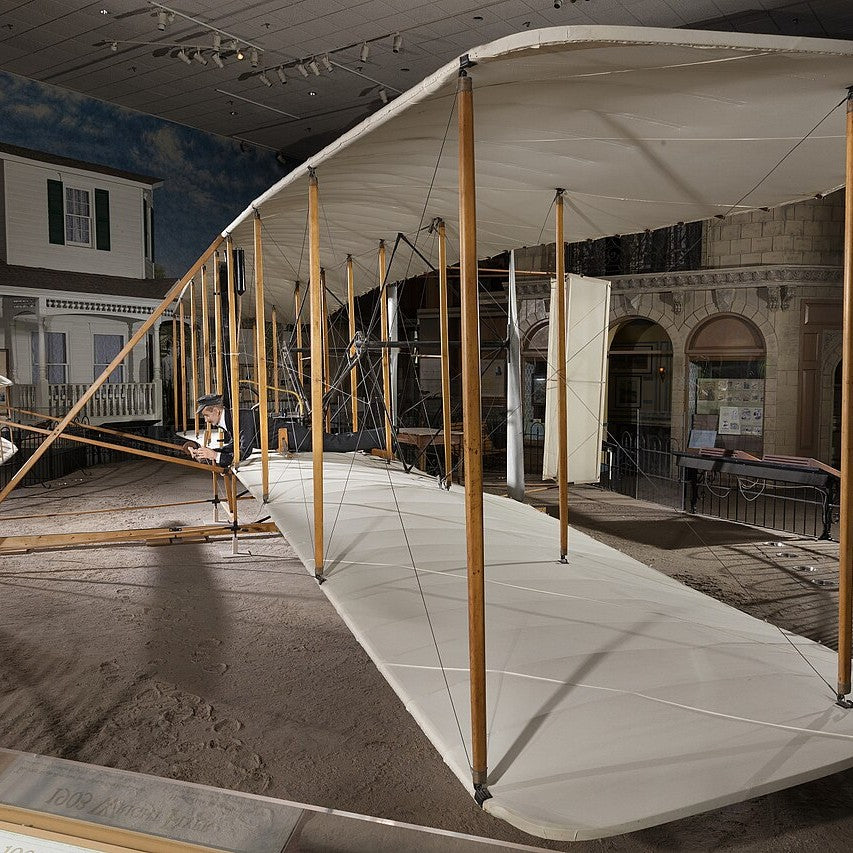
They tested control with unpowered gliders at Kitty Hawk, North Carolina, between 1900 and 1902, making hundreds of flights and refining their control system. Only when they were satisfied with control did they add a gasoline engine. On December 17, 1903, Orville made the first flight: 120 feet in 12 seconds. Three more flights followed that day. The longest, by Wilbur, covered 852 feet in 59 seconds. All four flights were documented with photographs.
The Wright Flyer III and the 1906 Patent
The Wright brothers continued development after 1903. The original Flyer was fragile and difficult to fly. By 1905 they had built the Wright Flyer III, capable of sustained, maneuverable flight. On October 5, 1905, Wilbur flew the Flyer III for 39 minutes and 23 seconds, covering approximately 24 miles in circles over a field in Huffman Prairie, Ohio. This flight, not the 1903 hops, was the demonstration that the problem of powered flight had been definitively solved.

In Europe, Alberto Santos-Dumont, a Brazilian aviation pioneer living in Paris, made the first publicly witnessed and officially documented airplane flight in Europe on October 23, 1906, covering approximately 197 feet in his 14-bis aircraft. On November 12 of the same year, he extended the record to 722 feet in 21.5 seconds, winning the Aero Club de France prize for the first flight exceeding 100 meters. Because the Wright brothers had not yet demonstrated their aircraft publicly in Europe, Santos-Dumont's flights were long considered the first in Europe, and he remains a national hero in Brazil, where he is sometimes called the inventor of the airplane.
The Wright brothers had filed their landmark patent application in 1903, the same year as their first flights. U.S. Patent 821,393, covering the flying machine and its three-axis control system, was granted on May 22, 1906. The patent described not just their specific aircraft but the general principles of three-axis control using wing warping, a broad claim that would fuel years of patent litigation as aviation developed.
The Aviation Race: World War I and Commercial Flight
The Wright patent became the central battleground of early American aviation. The Wright Company licensed their patents selectively and sued competitors who used control systems derived from their approach. Glenn Curtiss, the most significant American aviation pioneer after the Wright brothers, found his own wing-warping alternatives and aileron designs repeatedly challenged in court. By 1917, the U.S. government, needing rapid wartime aircraft production, forced the major patent holders into a cross-licensing arrangement that effectively ended the patent wars.
World War I accelerated aviation development faster than any peacetime program could have. Military aircraft went from fragile reconnaissance vehicles in 1914 to specialized fighters and bombers by 1918. Engines improved dramatically; airframes grew more durable; navigation and communication systems were integrated. By the end of the war, the basic technical problems of powered flight had been solved for practical purposes.
The first international commercial air service between the U.S. and Canada operated in 1919. Charles Lindbergh's 1927 solo transatlantic flight, New York to Paris in 33.5 hours, captured public attention worldwide and demonstrated that long-distance air travel was viable. Pan American Airways launched transoceanic passenger service across the Pacific in 1936 and across the Atlantic in 1939.
Howard Hughes and the Engineering of Spectacle
In the middle of World War II, Howard Hughes of Houston, Texas patented an aircraft design that was visually striking and technically inventive but never produced at scale. Hughes had already set multiple airspeed records and completed a round-the-world flight in 1938. His wartime patent was an ornamental design, intended for models or decorative representations rather than production aircraft. It reflected Hughes's characteristic approach: engineering pushed toward the spectacular, with practicality as a secondary consideration.

Hughes held over 80 patents in his lifetime, spanning aircraft design, film equipment, and tools. His most ambitious aviation project, the H-4 Hercules flying boat, known popularly as the Spruce Goose, was the largest aircraft ever built at the time and flew only once, in November 1947. It is preserved at the Evergreen Aviation and Space Museum in McMinnville, Oregon.
The Jet Age and Modern Aviation
The jet engine, developed independently in Britain by Frank Whittle and in Germany by Hans von Ohain in the 1930s, transformed aviation after World War II in ways that made the propeller-powered aircraft of the 1940s look primitive within a generation. The Boeing 707, entering commercial service in 1958, established jet travel as the standard for commercial aviation. By the 1970s, the Boeing 747 was carrying over 400 passengers per flight across oceanic routes.
The Smithsonian National Air and Space Museum in Washington, D.C. holds the original 1903 Wright Flyer, the most significant aircraft in history, along with Charles Lindbergh's Spirit of St. Louis and thousands of other objects documenting the history of flight from the earliest experiments through space exploration.
What the Wright brothers proved at Kitty Hawk was not just that a machine could leave the ground. It was that the problem of control had been solved, and that flight could be repeatable, predictable, and directed by a pilot. Everything that followed, from the first commercial airline to a 747 crossing the Atlantic, built on the control principles that Orville and Wilbur worked out in a field in Ohio and committed to paper in U.S. Patent 821,393.
Shop Airplane Patent Art Prints
The original U.S. Patent Office drawings that defined powered flight. Starting at $49.99 unframed.
Howard Hughes Aircraft Design (1940s), Howard Hughes
Hughes filed this ornamental aircraft design patent during World War II, one of over 80 patents he received in his lifetime. The design was intended for models and decorative applications rather than production aircraft, but it captures Hughes's engineering vision: clean lines, purposeful form, designed to look exactly like what a plane is supposed to look like. As a print, it's a study in mid-century aviation aesthetics and a document of one of history's most eccentric engineering minds.
Best for: Aviation enthusiasts, Hughes admirers, anyone who loves mid-century design, gift buyers for pilots and history fans

Frequently Asked Questions
Who really invented the airplane?
The Wright brothers, Orville and Wilbur, made the first sustained, controlled, heavier-than-air powered flights at Kitty Hawk, North Carolina on December 17, 1903. Other inventors including Clement Ader and Alberto Santos-Dumont achieved limited flights by some definitions, but neither produced a repeatable, controlled powered flight before 1903. The Wright brothers' U.S. Patent 821,393, granted in 1906, covered the three-axis control system that made their achievement reproducible and defined the foundation of all subsequent aircraft design.
What was Clement Ader's contribution to aviation?
Clement Ader, a French engineer, built and tested a series of steam-powered aircraft in the late 19th century. His Avion I of 1890 may have briefly left the ground in France, and his Avion III was tested before military observers in 1897. Ader's bat-wing designs contributed to thinking about curved airfoil surfaces, and his work demonstrated that powered mechanical flight might be achievable. He did not produce sustained, controlled flight, and French military funding for his program was terminated after the 1897 test.
What did the Wright brothers patent?
The Wright brothers received U.S. Patent 821,393 on May 22, 1906, for their flying machine. The key claim was the three-axis control system: the ability to control pitch, roll, and yaw independently, allowing a pilot to maintain stable, directed flight. Their specific implementation used wing warping to control roll, but the patent's claims were broad enough to cover related approaches, which led to extensive litigation as aviation developed in the 1910s.
When did commercial air travel begin?
The first international commercial air services between the United States and Canada began in 1919, shortly after World War I. Passenger service across oceanic routes became regular in the late 1930s, with Pan American Airways operating transpacific service from 1936 and transatlantic service from 1939. Commercial jet aviation began in earnest with the Boeing 707 entering service in 1958, establishing the template for modern air travel.
Is an airplane patent print a good gift for aviation fans?
It's a strong option for anyone who flies, studies aviation history, or has a particular interest in the engineering of flight. The Howard Hughes design patent print has an unusual combination of mid-century aesthetics and genuine historical context. The Wright brothers' 1906 flying machine patent is one of the most significant engineering documents in American history and a piece that most aviation enthusiasts haven't seen as a print. Available framed or unframed starting at $49.99.
Written by Rider Tuff, founder of Timeless Patents. Timeless Patents makes museum-quality patent art prints from original U.S. Patent Office documents, celebrating the inventors behind your favorite sports, hobbies, and passions. Every print is available framed or unframed, starting at $49.99. Shop the full aviation collection →