TL;DR: The golf cart began as a medical accommodation: a seat on wheels so a sick man in Florida could keep playing the game he loved. Within two decades, electric carts had transformed American golf courses from walking grounds into motorized operations, and Merle Williams's 1951 three-wheeled Marketeer sparked an industry that now moves millions of rounds per year. Original patent art prints of John Moglia's 1989 golf cart windshield design are available framed or unframed.
In 1932, a man named Lyman Beecher wanted to play golf at the Biltmore Forest Country Club in Clearwater, Florida. His health would not allow him to walk the course. Rather than stop playing, Beecher designed a solution: a wheeled seat with club straps and a handle, light enough to be pulled by two caddies. He was not trying to change the game. He was trying to keep playing it. That practical accommodation eventually became one of the most consequential pieces of infrastructure in American recreational sports.
Walking the Course: Golf Before the Cart
For the first four centuries of golf, walking was the game. Scottish links courses were built on coastal terrain that rewarded walking: firm ground, natural contours, relatively short distances between holes. Golfers walked. Caddies carried the bags. The physical act of traversing the course was considered part of the experience, not a burden to be eliminated.

When golf expanded to the United States in the late 19th century, American courses were often built on different terrain: hilly inland ground, longer layouts, greater distances between greens and subsequent tees. Walking a full 18 holes on an American parkland course could cover five miles or more of ground. The caddy system that worked in Scotland translated imperfectly to this environment, and walking remained the norm partly because no alternative had been invented.
Golfers with physical limitations, whether from age, injury, or illness, had few options. They could play fewer holes, play from a forward tee, or stop playing entirely. The question of how to transport a golfer around a course without walking had not been formally addressed.
Lyman Beecher and the First Human-Pulled Cart
Lyman Beecher's 1932 invention was modest by any technical measure but significant as a conceptual step. He designed a cart consisting of a seat for the golfer, a frame to hold the clubs, and handles that two caddies could use to pull the whole apparatus around the course. It was not motorized. It was not even self-propelled. It was a chair on wheels, configured for a golf course.

Beecher's cart was a personal solution rather than a commercial product, but it demonstrated the concept. A golfer who could not walk could still play 18 holes if the problem of locomotion was solved mechanically. That idea, once demonstrated, was available to be developed further.
The 1930s saw scattered experiments with motorized golf carts, most using small gasoline engines adapted from other applications. These early gas-powered attempts were generally too heavy, too loud, or too unreliable for regular course use. Golf course superintendents were not eager to allow heavy motorized vehicles onto turf maintained at significant expense. And most golfers, who were walking the course without difficulty, had no reason to want one.
Merle Williams and the Marketeer
The decisive development came in 1951. Merle Williams, a businessman in Redlands, California, founded a company called Marketeer and built the first electric cart explicitly designed for golf. The Marketeer ran on batteries, had three wheels, and could carry a golfer and a set of clubs around a course without the noise or fumes of a gas engine.

Williams built the Marketeer partly because he had seen the same problem Beecher had addressed two decades earlier: golfers with health limitations who wanted to play but could not walk the course. The battery-electric design made the cart quiet enough to be acceptable on a golf course and clean enough not to damage the turf with exhaust.
Initial adoption was slow and contentious. Many courses declined to permit carts, viewing them as a safety hazard on narrow fairways and arguing that they damaged the turf. Courses that did permit carts often required players to show a physician's note confirming a medical need. Golf's culture was walking culture, and the cart was seen as accommodation for the infirm rather than a convenience for everyone.
That perception began changing through the mid-1950s as course operators recognized the economic argument. A course that could move golfers around faster, and attract players who would not otherwise play, could put more rounds through per day. Cart rental fees were additional revenue. The cart was not just a medical accommodation: it was a business model.
The Industry Takes Shape: The 1960s and 1970s
By the early 1960s, several manufacturers had entered the golf cart market. E-Z-GO launched in Augusta, Georgia in 1954. Cushman, Harley-Davidson, and Taylor-Dunn all produced golf vehicles during this period. The competition drove down costs, improved reliability, and generated enough volume to make cart paths a standard feature of new course construction.
Gas-powered carts also returned in more refined form during this period. The two-seat gas cart, which could be produced more cheaply and could run longer between refueling than early battery carts, became a significant part of the market alongside electric models. Course operators often standardized on one type or the other depending on local conditions and preferences.
The cart bag appeared in response to this adoption. The traditional golf bag, designed to be carried over a shoulder, did not attach securely to cart brackets. Its tapered base was shaped for portability, not for sitting flat in a cart. Manufacturers introduced cart bags with flat bases and dedicated attachment points, allowing the bag to be strapped into the cart securely. The two products had been designed independently and were then redesigned around each other.
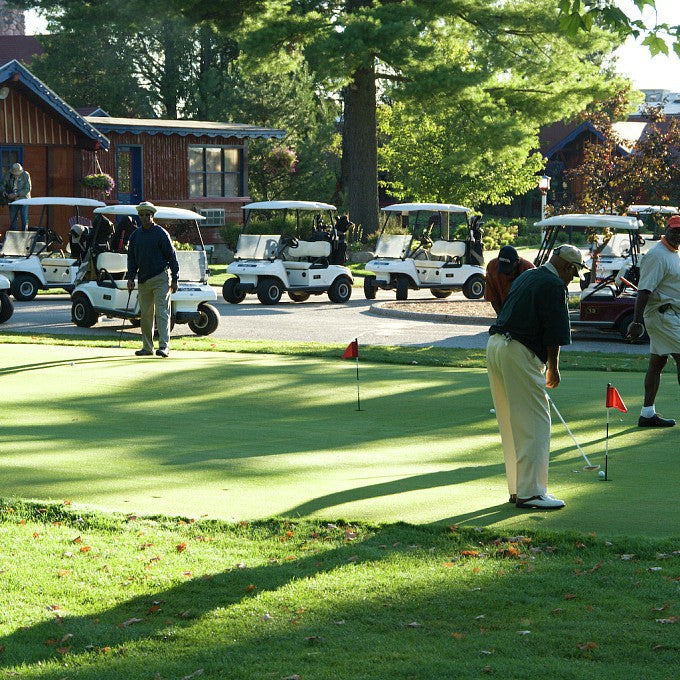
By the 1970s, the golf cart had become standard on American courses, expected rather than exceptional. Course architecture began to reflect this: cart paths were built from hole to hole, tees were positioned with cart-accessible staging areas, and distances between greens and subsequent tees that would have been impractical for walkers became normal design choices.
Moglia's 1989 Patent: Engineering the Ride
As the golf cart industry matured, innovation shifted from fundamental function to comfort and safety details. Seats, canopies, storage, and weather protection became the focus of incremental improvement.
In 1989, John Moglia of Allentown, Pennsylvania patented a golf cart windshield design that addressed a specific visibility problem. Earlier cart windshields were single-panel designs that provided weather protection but could obstruct the driver's view in certain conditions. Moglia's design used two plastic panels: a lower fixed section and an upper section capable of folding down flat. When the upper panel was folded, the driver had an unobstructed view over the top of the lower section, improving visibility while still providing partial weather protection.
The design reflects how cart innovation had evolved by the late 1980s. The fundamental vehicle had been established for decades. What remained to be engineered were the details that made the cart more comfortable and easier to use in varying conditions. Moglia's two-panel windshield was that kind of focused, practical improvement: not a new invention but a better solution to a specific problem that existing designs had not fully solved.
Today's golf carts have evolved considerably beyond the Marketeer's three-wheeled form. Lithium-ion battery systems have replaced lead-acid batteries in premium models, extending range and reducing charging time. GPS navigation displays built into the cart show hole layouts and distances. Quiet, high-torque electric motors make modern electric carts significantly more capable than their 1950s predecessors. Some courses operate autonomous cart systems under development for the coming decade.
The original problem Beecher set out to solve in 1932 remains at the center of all of it: how to move a golfer around a course comfortably and reliably so that the game can be played by people who cannot or choose not to walk. That problem has generated a multi-billion-dollar equipment category, reshaped American course design, and made golf accessible to players who would otherwise have stopped playing decades earlier.
Shop Golf Cart Patent Art Prints
The original U.S. Patent Office drawing that defined a key advancement in golf cart design. Starting at $49.99 unframed.
Blue Golf Cart (1989), John Moglia
Moglia's 1989 windshield patent represents the later phase of golf cart development, when the fundamental vehicle was established and inventors were focused on making the riding experience safer and more comfortable. The two-panel folding design solved a real visibility problem that earlier single-panel windshields created. The drawing, rendered in its watercolor treatment on museum-quality paper, brings a rich blue that makes it one of the more visually striking prints in the golf collection.
Best for: Golfers who ride rather than walk, anyone who has spent serious time on a cart course, gift buyers looking for a golf print with visual pop

Frequently Asked Questions
Who invented the golf cart?
Lyman Beecher of Clearwater, Florida built the first human-pulled golf cart in 1932, designing a wheeled seat with club storage so he could play despite declining health. The first electric golf cart designed specifically for golf was built by Merle Williams of Redlands, California in 1951 through his company Marketeer. Williams's three-wheeled electric design established the golf cart as a viable product and sparked the industry that followed.
When did golf carts become common on courses?
Golf carts became widely adopted on American courses through the 1950s and 1960s. Early adoption was slow because many courses viewed carts as hazardous or damaging to turf, and some required physician's notes for players to use them. As course operators recognized the revenue and throughput benefits of cart rental programs, adoption accelerated. By the 1970s, carts were a standard feature at most American public and private courses.
Are golf carts electric or gas powered?
Both. The first commercially successful golf cart, the Marketeer, was electric. Gas-powered carts entered the market in the 1960s and became popular for their lower cost and longer range between refueling. Today's market includes electric models (increasingly using lithium-ion batteries) and gas models. Many courses standardize on one type; electric carts are more common at courses that prioritize quiet and minimal emissions, while gas models remain common at courses with longer cart paths between holes.
Why did golf bag design change when carts became popular?
Traditional golf bags were designed to be carried over the shoulder, with tapered bases and flexible construction suited to walking. When golf carts became widespread, these bags did not attach securely to cart brackets. Manufacturers developed the cart bag, featuring a flat base and dedicated attachment points for cart straps, specifically to address this incompatibility. The cart bag and the carry bag have remained distinct product categories ever since.
What did John Moglia's 1989 golf cart patent cover?
Moglia's patent covered a two-panel golf cart windshield design. The upper panel was hinged to fold flat, allowing the driver to look over the top of the lower fixed panel for unobstructed forward visibility when needed. Earlier single-panel windshields provided weather protection but could restrict the driver's view in certain positions. Moglia's design improved visibility while retaining the weather-protection function of a full windshield.
Written by Jackie Crino, owner of Timeless Patents. Timeless Patents makes museum-quality patent art prints from original U.S. Patent Office documents, celebrating the inventors behind your favorite sports, hobbies, and passions. Every print is available framed or unframed, starting at $49.99. Shop the full golf collection →