TL;DR: Blood pressure measurement has a 300-year history, starting with the first direct arterial measurement on a horse in 1733 and reaching its modern form with Scipione Riva-Rocci's inflatable cuff in 1896. In 1914, Philadelphia inventors Francis Fraught and Charles Pilling patented a refined sphygmomanometer with a novel air pump and measuring dial. Original prints of that patent are available framed or unframed.
In 1733, a clergyman in Middlesex, England named Stephen Hales inserted a brass pipe into the artery of a horse and measured how high the blood pushed a column of fluid upward. The column rose nine feet. That experiment, brutal by any modern standard, produced the first quantitative blood pressure measurement in history. Medicine would not have another reliable method for measuring blood pressure in a living patient for more than 150 years.
The gap between Hales's experiment and the clinical sphygmomanometer tells the story of how difficult it was to measure something happening inside a closed circulatory system without cutting into it. Every instrument that came between those two points was an attempt to solve that problem, and each one left traces in the design we still use today.
Ancient Understanding of Circulation
Physicians in ancient China and India recognized, in broad terms, that the heart moved blood through the body. Chinese medical texts from the second century BC describe the pulse as a diagnostic tool, with different qualities of pulse indicating different states of health. Indian Ayurvedic practitioners developed pulse diagnosis into a detailed clinical practice. Neither tradition, however, had a mechanistic model of how circulation actually worked.
In ancient Greece, Galen of Pergamon, the most influential physician in Western medicine for more than a thousand years, taught that blood was produced in the liver and consumed by the body's organs rather than circulated. His model was wrong in fundamental ways, but it dominated European medicine through the medieval period. The idea that blood moved continuously around a closed loop would wait until the 17th century.
William Harvey and the Discovery of Circulation
William Harvey, an English physician educated in Padua, spent decades studying the heart and blood vessels through dissection and experiment. In 1628, he published "Exercitatio Anatomica de Motu Cordis et Sanguinis in Animalibus" (An Anatomical Study of the Motion of the Heart and of the Blood in Animals), making the case that blood circulates continuously, pumped by the heart through arteries and returned through veins.

Harvey's evidence was quantitative. He calculated that the heart pumps far more blood per hour than the body could possibly produce, which meant blood had to be circulating rather than being continuously generated and consumed. The argument was elegant and conclusive. It also upended more than a millennium of Galenic teaching and took decades to gain full acceptance from the European medical community.
Harvey's work established the foundation on which blood pressure measurement would eventually be built. If blood moved in a circuit under pressure, that pressure was in principle measurable. The question was how to measure it without killing the patient in the process.
The First Blood Pressure Measurements: From Hales to the Mercury Manometer
Stephen Hales's 1733 horse experiment was the proof of concept. It demonstrated that arterial blood pressure was a real, quantifiable physical phenomenon, not just a vague clinical impression. But his method required opening an artery, which was not compatible with routine clinical use.
The challenge for the next 150 years was developing a way to measure arterial pressure from outside the body. Various investigators tried compression devices and pressure gauges, with limited success. The readings were often inconsistent, and most approaches required some form of arterial cannulation to calibrate against.
In 1881, Samuel Siegfried Karl Ritter von Basch, an Austrian physician working in Vienna, introduced the sphygmomanometer, the first practical instrument for non-invasive blood pressure measurement. His device used a rubber bulb filled with water, connected to a mercury manometer. By pressing the bulb against the skin over an artery and watching when the pulse in the artery below disappeared, an examiner could estimate the pressure required to occlude the vessel.

Von Basch's instrument was an important step, but it had practical limitations. The localized compression was difficult to standardize, and readings varied depending on where and how firmly the examiner applied the bulb. Reproducibility, the quality that makes a clinical measurement clinically useful, was inconsistent.
Riva-Rocci's Cuff and the Modern Sphygmomanometer
The design breakthrough came in 1896 when Scipione Riva-Rocci, an Italian physician working in Turin, introduced a wraparound arm cuff connected to a mercury manometer. Instead of pressing a bulb against the skin over one spot, the cuff encircled the upper arm and inflated to compress the brachial artery uniformly. The examiner inflated the cuff until the radial pulse at the wrist disappeared, then slowly deflated it, noting the pressure at which the pulse returned. That pressure was the systolic reading.
Riva-Rocci's design solved the standardization problem. The cuff applied consistent circumferential pressure, and the mercury column gave a precise numerical reading. The instrument was portable, relatively simple to use, and reproducible across different examiners. According to the American Heart Association, the indirect arm cuff method Riva-Rocci established remains the basis of clinical blood pressure measurement today.
A final refinement came in 1905, when Russian physician Nikolai Korotkoff described the sounds produced by turbulent blood flow when a partially deflated cuff releases pressure, allowing both systolic and diastolic pressure to be measured using a stethoscope. The combination of Riva-Rocci's cuff with Korotkoff's auscultation technique produced the sphygmomanometer method still taught in medical schools worldwide.
The 1914 Fraught and Pilling Patent
By the early 20th century, the sphygmomanometer had entered clinical practice, but the instrument still had room for engineering refinement. In 1914, Francis Fraught and Charles Pilling of Philadelphia, Pennsylvania filed a patent for a sphygmomanometer with a redesigned air pump and measuring dial. Their design improved on existing models in two key ways: the air pump mechanism was simplified for easier one-handed inflation, and the dial gauge provided a more legible readout than the mercury columns used in earlier instruments.
The practical significance of those changes was real. A clinician taking blood pressure readings throughout a day benefits from an instrument that inflates smoothly, deflates controllably, and presents its reading without requiring the examiner to crouch down to read a mercury column. Fraught and Pilling were solving a usability problem for the clinical environment, not a theoretical one.
Francis Fraught filed only this one patent. Charles Pilling, by contrast, went on to patent more than 30 medical instrument designs over his career, many related to surgical and diagnostic tools. Their 1914 collaboration placed them at a productive moment in medical device history, when the basic principles of many instruments were established and the work shifted to refinement and manufacturability.
The patent drawing captures the instrument at a specific moment: before electronic measurement, before digital displays, before the automated home monitors now found in millions of households. It's a mechanical object engineered for a specific clinical purpose, and the drawing shows that engineering with the precision and clarity that patent documents require.
Frequently Asked Questions
When was blood pressure first measured?
The first quantitative blood pressure measurement was made in 1733 by Stephen Hales, who inserted a tube directly into a horse's artery and measured how high the blood pressure pushed a fluid column. The first non-invasive clinical measurement method came in 1881, when Samuel Siegfried Karl Ritter von Basch introduced the first sphygmomanometer using a water-filled bulb pressed against the skin.
Who invented the blood pressure cuff?
Scipione Riva-Rocci, an Italian physician, invented the inflatable arm cuff sphygmomanometer in 1896. His design wrapped around the upper arm and inflated to compress the brachial artery uniformly, producing consistent and reproducible readings. In 1905, Russian physician Nikolai Korotkoff added the auscultation technique that allowed both systolic and diastolic pressure to be measured, completing the design still used today.
What is the Fraught and Pilling 1914 patent?
Fraught and Pilling's 1914 patent covers a sphygmomanometer with an improved air pump mechanism and a dial gauge for reading pressure. Francis Fraught and Charles Pilling were based in Philadelphia. The patent improved on earlier designs by making inflation easier with one hand and providing a more legible pressure readout. Pilling went on to patent more than 30 medical instruments over his career.
What is a sphygmomanometer?
A sphygmomanometer is the technical name for a blood pressure monitor. The word comes from the Greek "sphygmos" (pulse) and "manos" (thin, loose). Modern sphygmomanometers use an inflatable cuff around the upper arm, a pressure gauge, and either a stethoscope or an automated sensor to detect when blood flow resumes as the cuff deflates. The basic design dates to Riva-Rocci's 1896 invention.
Is a blood pressure cuff patent print a good gift for a doctor or nurse?
It's a specific, thoughtful piece for anyone in healthcare who appreciates the history of medicine. The 1914 Fraught and Pilling patent print traces directly to the instruments still in use today, and most medical professionals have never seen the original drawings behind the tools they use daily. Available framed or unframed starting at $49.99, it works in a clinic, a home office, or a waiting room.
Written by Jackie Crino, owner of Timeless Patents. Timeless Patents makes museum-quality patent art prints from original U.S. Patent Office documents, celebrating the inventors behind your favorite sports, hobbies, and passions. Every print is available framed or unframed, starting at $49.99. Shop the full medical history collection →
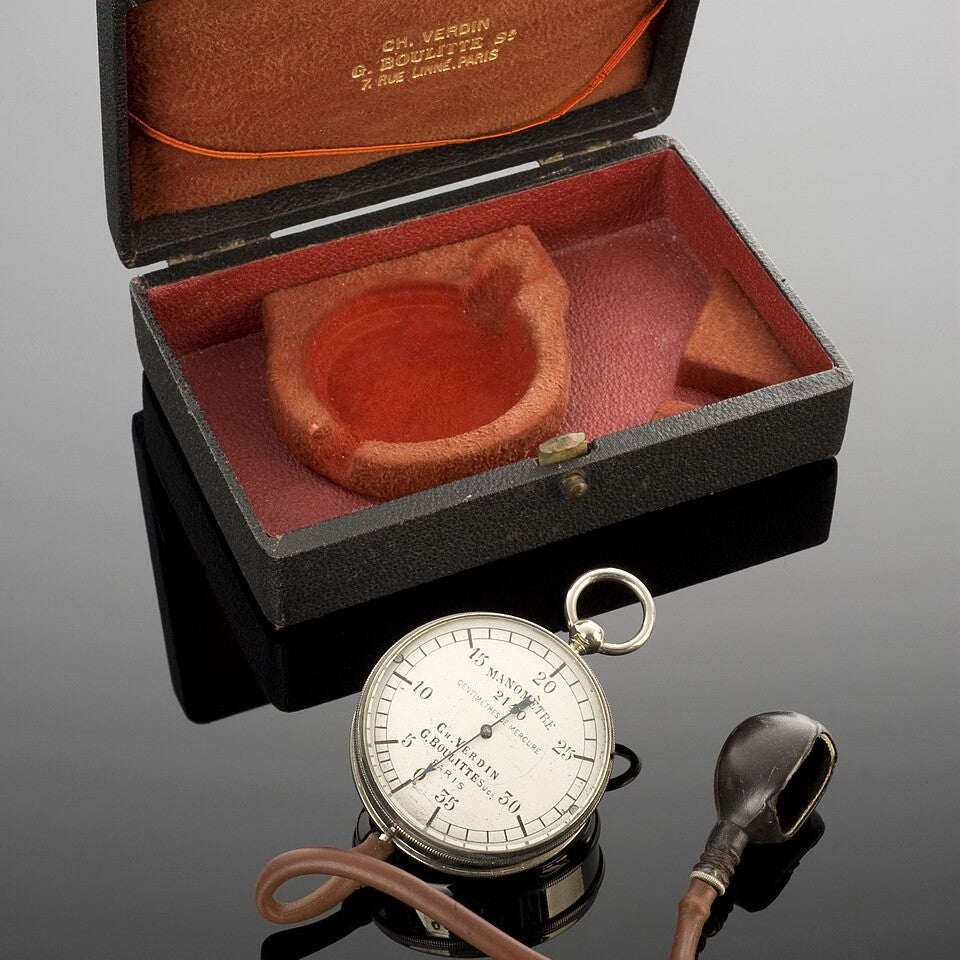
Cover image: "Potain type sphygmomanometer, Paris, 1898-1910" by Wellcome Collection, licensed under CC BY 4.0, via Wikimedia Commons.