TL;DR: Garden tools have existed for nearly 10,000 years, and the basic forms -- the shovel, hoe, spade, and rake -- have changed far less than most people realize. In 2000, Joseph Fornelli of Park Ridge, Illinois patented a garden tool handle designed to give users better leverage, a small but specific improvement to implements that had remained largely unchanged since the industrial revolution. Original prints of that patent are available framed or unframed.
In 1190 AD, a scholar named Alexander Neckam wrote a description of what he considered the complete equipment of a well-stocked peasant's shed. His list included broad-bladed long knives, a spade and shovel, a seed box, two baskets, a trap for vermin, a snare for wolves, and a wheelbarrow. It is a remarkably practical document, and the striking thing about it is not how different it is from what a well-equipped gardener would need today -- it is how similar.
More than 800 years separate Neckam's list from Joseph Fornelli's 2000 patent for a garden tool with an improved leverage handle. The spade and shovel Neckam described, the ones he considered essential, are still essential. The problem Fornelli addressed -- how to design a handle that gives the user better mechanical advantage -- is a problem that every person who has ever dug a hole, pulled a stubborn weed, or broken compacted soil has encountered. The tools are ancient. The engineering never stops.
The Bronze Age and the First Metal Garden Tools
The first garden tools were made from what was available: bone, wood, and stone. Digging sticks, sharpened to a point, broke soil for planting. Flat stones or bones shaped into crude scoops moved earth. These implements were functional but fragile, wearing down quickly and breaking under heavy use. The transition to metal was one of the most important technological shifts in the history of agriculture.

During the Bronze Age, beginning around 3000 BC in the Middle East and spreading across Europe and Asia over the following millennia, metalworkers began producing tools with bronze blades attached to wooden handles. Bronze shovels, hoes, and spades were harder and more durable than their predecessors, held a sharper edge, and could be repaired by a skilled metalworker rather than simply discarded. These tools were valuable objects -- expensive to produce, essential to survival, and carefully maintained.
Iron replaced bronze as the dominant metal for tools during the Iron Age, beginning around 1200 BC. Iron tools were harder than bronze and could be produced from ores that were more widely available than the copper and tin needed for bronze alloys. Iron shovels, spades, hoes, and rakes spread through farming societies across Europe, Asia, and Africa. The basic form of these tools -- a metal blade or head attached to a long wooden handle -- is the same form Joseph Fornelli improved in 2000.
Roman agricultural texts from writers like Columella and Pliny the Elder described in detail the tools used in Roman gardens and farms: the rastrum (a heavy-toothed rake), the sarculum (a type of hoe), the ligo (a mattock-like implement for heavy digging), and various forms of spade. Roman gardens were not simple vegetable plots -- they ranged from kitchen gardens on small farms to elaborate ornamental gardens attached to villas -- but the tools used in them were recognizable descendants of the Bronze Age implements that preceded them.
Alexander Neckam's List and Medieval Garden Tools
Alexander Neckam's 1190 description of a well-equipped peasant's shed is one of the most useful historical documents about medieval garden tools because of its specificity. Neckam was an English scholar who wrote extensively about natural philosophy and practical arts. His list was not theoretical -- it reflected the actual equipment that medieval English peasants used in their daily work.

The medieval English peasant's garden was not ornamental. It was a productive plot designed to supplement the household's food supply, growing vegetables, herbs, and some fruit. The tools Neckam listed reflect this practical purpose: cutting implements for clearing vegetation, digging implements for turning soil and planting, containers for seeds and harvested produce, and traps for the animals that threatened the crops.
By 1388, two centuries after Neckam wrote his list, the standard equipment had expanded. A note from that period added a long-handled scythe and two small sickles to the essential toolkit. These were harvesting tools -- used for cutting grain, removing weeds, and clearing vegetation at scale. The scythe became one of the defining images of rural life in pre-industrial Europe, a tool so closely associated with agricultural labor that it appears in medieval art as a symbol of both harvest and mortality.
The progression from Neckam's 1190 list to the 1388 list shows something important: garden tools evolved incrementally, with new forms being added to the repertoire rather than replacing existing ones. The spade that Neckam listed in 1190 did not disappear when the scythe became common. Both remained essential. The toolkit accumulated over centuries, each new tool addressing a specific task that existing tools handled less efficiently.
The Industrial Revolution and Mass Production
For most of human history, garden tools were made by individual craftsmen -- blacksmiths who forged metal blades to order, or woodworkers who turned handles for local use. Each tool was a handmade object, and quality varied by maker. Skilled craftsmen commanded premium prices, and a well-made set of garden tools was genuinely expensive by the standards of ordinary households.

The industrial revolution transformed this entirely. Beginning in England in the late 18th century and spreading through Europe and North America during the 19th, factory production made garden tools available at prices that ordinary working households could afford. Stamped metal blades replaced individually forged ones. Standardized handles replaced custom-turned ones. Quality became more consistent, prices dropped dramatically, and the tools that had been among a household's most prized possessions became affordable commodities.
This democratization had real consequences for home gardening. When tools were expensive, only households with sufficient means could equip themselves properly. When factory production made shovels, hoes, spades, and rakes affordable, kitchen gardens became more common across the economic spectrum. The industrial revolution that drove people from farms into cities simultaneously made urban and suburban home gardening more accessible to those city dwellers.
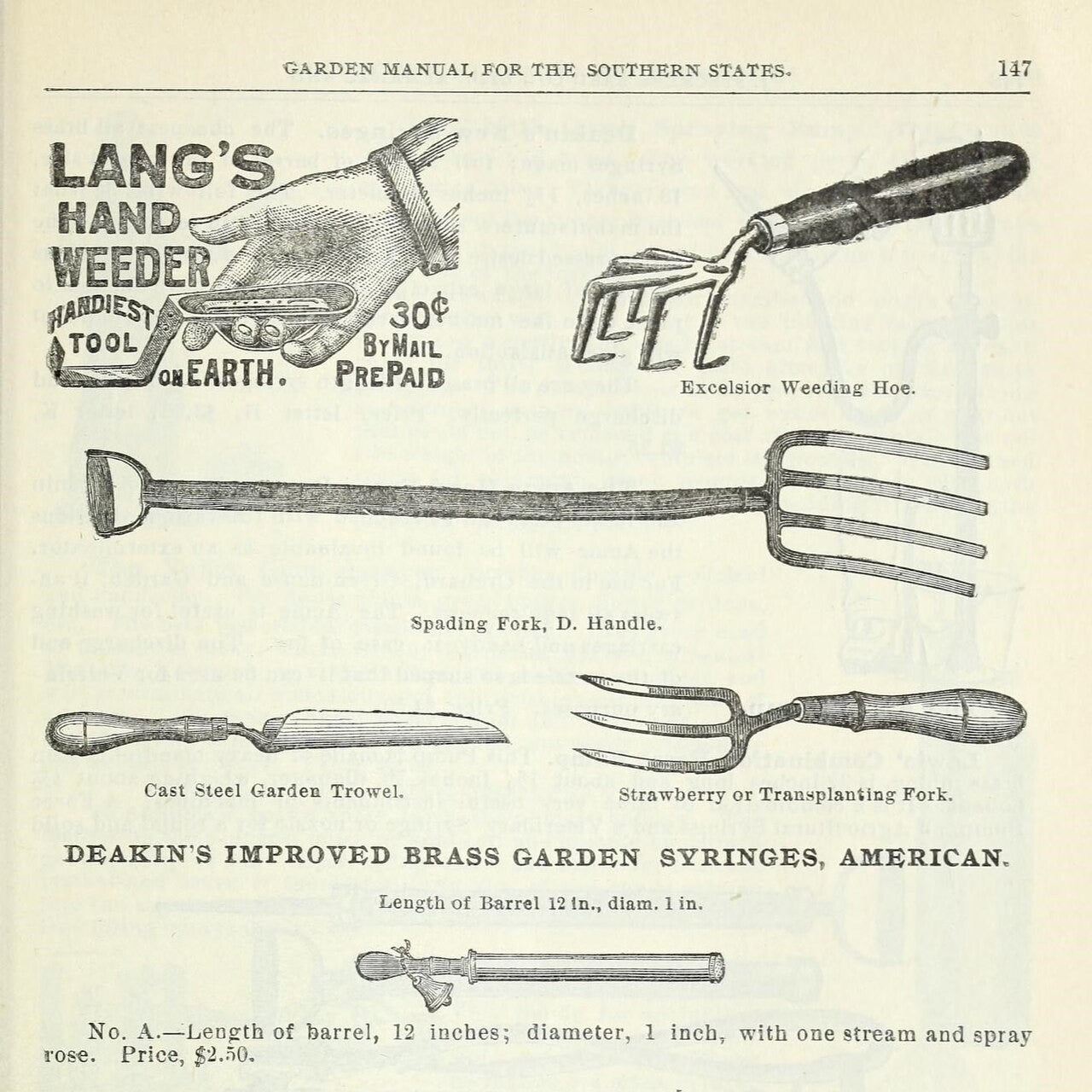
The increased access also drove a wave of specialized tool invention, not all of it necessary. The period produced cucumber straighteners, cactus shears, and other implements that served narrow functions on large estates but had little relevance to the practical home gardener. Innovation sometimes runs ahead of actual need, particularly when manufacturing costs are low and novelty has commercial appeal. But alongside the unnecessary inventions came genuine improvements: better steel alloys for blades, more ergonomic handle shapes, and more versatile attachments that allowed one handle to serve multiple tool heads.
Garden Tools in the 20th Century
The 20th century brought power tools to large-scale gardening and landscaping -- rotary tillers, power edgers, electric cultivators -- but the hand tool remained central to home gardening. Power tools are efficient over large areas and for heavy soil work, but they are imprecise near planted rows, difficult to use in tight spaces, and overkill for the scale of most home gardens.
Throughout the 20th century, manufacturers continued refining hand tool design. Handle materials expanded from wood to fiberglass to aluminum and composites. Head shapes were refined for specific tasks. Ergonomic research began influencing handle geometry -- the angle, diameter, and grip surface of a handle affects how much force a user can apply and how that force is distributed across the wrist, arm, and back over a day of work.
This is the context in which Joseph Fornelli's 2000 patent makes sense.
Joseph Fornelli's 2000 Garden Tool Patent
In 2000, Joseph Fornelli of Park Ridge, Illinois was granted a U.S. patent for a garden tool design focused on the handle. His specific innovation was an elongated handle configuration engineered to give users better mechanical advantage -- more leverage on the tool, allowing greater force to be applied with less effort and less strain on the user.

The problem Fornelli addressed is fundamental to all lever-based tools. A handle functions as a lever arm: force applied at one end (the user's hands) moves a load at the other end (the tool head in the soil). The longer the lever arm relative to the fulcrum, the more mechanical advantage the user gains. But handle length alone is not the complete solution -- the geometry of how the user grips the handle, the angle at which force is applied, and the distribution of that force along the user's body all determine how effective the tool actually is in practice.
Park Ridge, Illinois, Fornelli's home, is a suburb of Chicago with a strong tradition of home gardening. The specific context of a Midwestern suburban gardener -- working a backyard vegetable plot or flower bed, using a tool for hours at a time, experiencing the cumulative fatigue that comes from poorly designed handles -- likely shaped Fornelli's thinking. The patent represents the kind of incremental improvement that matters most to people who use tools seriously: not a reinvention of the shovel, but a better way to hold it.
This was Fornelli's only known patent. He identified a specific problem, engineered a specific solution, and filed the document with the U.S. Patent Office. The drawing that resulted -- precise, functional, capturing an improvement to a tool that traces its lineage back through the industrial revolution, the medieval period, the Roman Empire, and the Bronze Age -- is the artifact that the garden tools print preserves.
Frequently Asked Questions
How old are garden tools?
Garden tools in recognizable form have existed for nearly 10,000 years, beginning with sharpened sticks and bone implements used in early agricultural societies. Metal tools -- bronze shovels, hoes, and spades -- appeared during the Bronze Age around 3000 BC. Iron replaced bronze as the standard material starting around 1200 BC. The basic forms of the shovel, hoe, spade, and rake that emerged in the ancient world remain the standard forms used in gardens today.
What did medieval garden tools look like?
Medieval European garden tools were iron-bladed implements attached to wooden handles, made by local blacksmiths. Alexander Neckam's 1190 description of a well-equipped peasant's shed lists a spade, shovel, broad-bladed knives, seed boxes, and baskets as essential. By 1388, the standard toolkit had expanded to include a long-handled scythe and two small sickles for harvesting and weed removal. These tools were expensive, carefully maintained, and frequently passed down through wills.
How did the industrial revolution change garden tools?
The industrial revolution made garden tools affordable for ordinary households by shifting production from individual craftsmen to factories. Stamped metal blades and standardized handles replaced handmade ones, dramatically reducing costs and improving consistency. This democratization made home gardening more accessible across economic classes. It also drove a wave of specialized tool invention -- some useful, some unnecessary -- as low manufacturing costs enabled rapid product development.
Who was Joseph Fornelli?
Joseph Fornelli was an inventor from Park Ridge, Illinois who was granted a U.S. patent in 2000 for a garden tool design featuring an elongated handle engineered for improved leverage. His patent addressed the mechanics of how handle geometry affects the force a user can apply to a tool, with the goal of reducing effort and strain during extended garden work. The garden tools patent is his only known patent.
What is the garden tools patent print?
The garden tools patent print is a reproduction of Joseph Fornelli's 2000 U.S. Patent Office drawing, rendered in a watercolor style on museum-quality paper. It shows the engineering diagram of a garden tool handle designed for better leverage and control. Available framed or unframed, it is a piece that works for serious home gardeners, anyone who appreciates the history of tool design, or as a gift for someone who spends time in the garden.
Written by Jackie Crino, owner of Timeless Patents. Timeless Patents makes museum-quality patent art prints from original U.S. Patent Office documents, celebrating the inventors behind your favorite sports, hobbies, and passions. Every print is available framed or unframed, starting at $49.99. Shop the full garden collection →