TL;DR: The modern automobile was born in 1886 when Carl Benz patented the first gasoline-powered vehicle, and within 50 years the car had transformed from a mechanical curiosity into a mass-market product that reshaped cities, industries, and everyday life. In 1934, Harley Earl of Michigan filed a patent for an ornamental automobile body design -- protecting the visual form of the car itself, not just its mechanics. Original prints of that patent are available framed or unframed.
In the summer of 1888, Bertha Benz loaded her two teenage sons into her husband's prototype automobile and drove from Mannheim to Pforzheim -- a distance of about 66 miles -- without telling Carl Benz she was going. He had been developing the car for years but had not attempted a long-distance journey. Bertha wanted to prove it was possible. Along the way she repaired a fuel line with her garter, used a hairpin to clean a blocked fuel jet, had a cobbler in one village attach leather brake pads to the worn wooden blocks, and pushed the car up hills it could not climb under its own power.
She arrived in Pforzheim and sent a telegram home. The trip proved the car was practical. Newspapers covered the journey. Public interest in the Benz Patent-Motorwagen increased sharply. Bertha's 66-mile drive is now recognized as the first long-distance automobile journey in history, and she is considered by many historians to be as important to the early automotive story as her husband.
That story -- from Bertha Benz's 1888 drive to Harley Earl's 1934 design patent -- is the story of how a mechanical invention became a cultural object, and how an industry learned to protect not just how a car worked but what it looked like.
Carl Benz and the Birth of the Automobile
1886 is the year most historians mark as the beginning of the modern automobile. That year, Carl Benz, a German engineer working in Mannheim, patented his Benz Patent-Motorwagen -- a three-wheeled vehicle powered by a single-cylinder gasoline engine. The vehicle produced about 0.75 horsepower, traveled at roughly 10 miles per hour, and required the driver to steer with a tiller rather than a wheel.

Benz began production of the car in July of 1886. Between 1888 and 1893, 25 Benz vehicles were sold -- modest numbers, but enough to establish that a market existed. By 1899, Benz and Cie had become the largest automobile manufacturer in the world, producing 572 vehicles that year.
The Benz Patent-Motorwagen is recognized as a first in a specific sense: it was the first vehicle designed from the outset to be powered by a gasoline engine, rather than a modified horse-drawn carriage fitted with an engine. The distinction matters. Benz started from the premise that the vehicle would be powered by internal combustion, and designed everything around that premise. This makes it qualitatively different from the motorized carriages that other inventors were experimenting with simultaneously.
In 1896, Benz designed and patented the first internal-combustion flat engine -- an engine with horizontally opposed cylinders that produced more power in a more compact package than previous designs. The flat engine layout is still used in modern vehicles, including Porsche and Subaru models, more than 125 years later.
Gottlieb Daimler, Wilhelm Maybach, and the Mercedes
Working in parallel with Benz, and in competition with him, were Gottlieb Daimler and Wilhelm Maybach. Daimler and Maybach had developed their own gasoline engine independently in 1885, and by the early 1890s were building automobiles under the Daimler name. In 1890, they incorporated Daimler Motoren Gesellschaft and sold their first car in 1892.

Daimler died in 1900, but the company continued under Maybach's engineering leadership. Later that year, Maybach designed an innovative new engine called the Daimler-Mercedes -- named after the daughter of Emil Jellinek, an Austrian automobile dealer who had commissioned the design. The engine produced 35 horsepower, could propel vehicles to 53 miles per hour, and was more compact and reliable than anything built before it.

The Mercedes name attached to the new car became so strongly associated with quality and performance that Daimler Motoren Gesellschaft began using it as a brand for all their vehicles. The Daimler-Benz merger in 1926 combined the two pioneering companies into a single organization that still produces Mercedes-Benz vehicles today -- the direct corporate successor to both Benz's 1886 Patent-Motorwagen and Daimler and Maybach's 1885 engine.
The American Automobile Revolution
The European pioneers built the automobile. American manufacturers built the industry. By 1899, 30 American car manufacturers had produced 2,500 vehicles. Over the next decade, 485 companies would enter the American automobile industry -- an extraordinary burst of entrepreneurial activity around a technology that had not existed 15 years earlier.
Most of those 485 companies failed. The automobile industry proved to be a capital-intensive business where scale mattered enormously. Companies that could build volume quickly drove down costs; companies that could not were priced out of the market. By 1920, a handful of manufacturers dominated American automobile production.
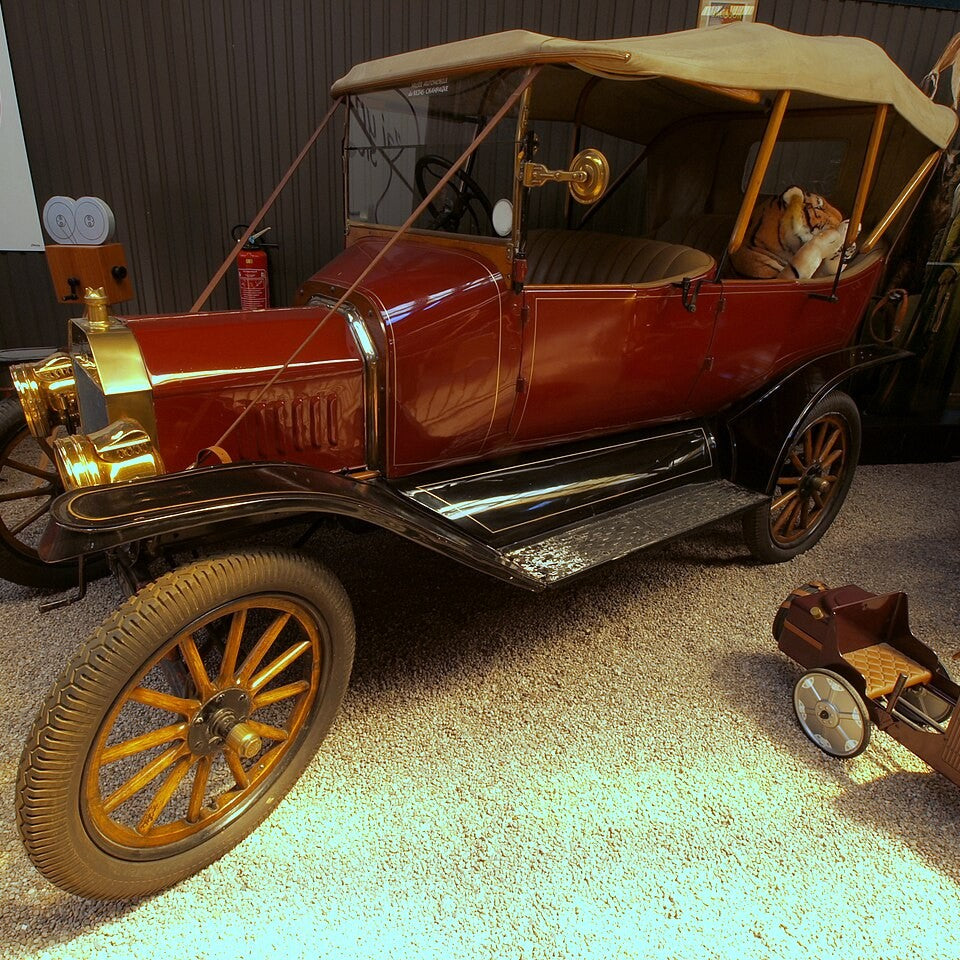
The pivotal figure was Henry Ford. In 1908, Ford introduced the Model T -- a simple, reliable, affordable car designed for ordinary American families rather than wealthy enthusiasts. The Model T was not the most technically sophisticated car of its era. It was the most practical.

Ford's real innovation was the moving assembly line, introduced at the Highland Park plant in 1913. By breaking automobile production into sequential steps where workers performed single repeated tasks on vehicles moving past them on a conveyor, Ford dramatically reduced the time required to build each car. Assembly time dropped from more than 12 hours per vehicle to about 93 minutes. Costs fell accordingly.

By the time the Model T was discontinued in 1927, 15 million units had been sold. The last Model T cost $290 -- roughly $5,000 in today's dollars -- a price that had fallen from $850 when the car was introduced. Ford's assembly line methods were adopted by manufacturers across every industry. The factory system that still produces most consumer goods in the world derives directly from the production model Ford developed to make automobiles affordable.
Design Becomes Competitive: The Rise of Styling
In the years after the Model T, automobile competition shifted. Ford had won the battle for affordability. General Motors, under the leadership of Alfred P. Sloan, adopted a different strategy: instead of competing on price alone, GM would compete on style, offering a range of vehicles at different price points with annual model changes that made last year's car look dated.
This strategy required someone to design the cars. In 1927, General Motors hired Harley Earl to lead a new department focused entirely on automobile styling. Earl had grown up in Los Angeles working in his father's custom coachbuilding shop, where he designed custom car bodies for movie stars and wealthy clients. He brought to GM a sensibility shaped by that clientele: cars should be beautiful objects, not just functional machines.
Earl became the first professional automobile designer at a major manufacturer. Under his leadership, GM's cars acquired flowing fenders, distinctive grilles, two-tone color schemes, and the kind of visual drama that made them aspirational objects rather than purely utilitarian ones. He also introduced the concept of the annual model change -- deliberate visual updates designed to make owners want new cars even when their existing ones were still functional.
Harley Earl's 1934 Ornamental Design Patent
In 1934, Harley Earl of Michigan filed a patent for an ornamental automobile design. The patent covered the specific visual form of the car's body -- its shape, proportions, and surface details -- rather than any mechanical component. This was a design patent, not a utility patent: it protected the way the invention looked, not how it worked.

Design patents for automobile bodies were a relatively new concept in 1934. The idea that a car's visual form could be protected intellectual property reflected the shift in competition from mechanical performance to styling that Earl himself had helped drive at GM. If the shape of a car was a meaningful competitive advantage -- and Earl's success at GM proved it was -- then protecting that shape with a patent made commercial sense.
Earl's 1934 patent shows the streamlined, flowing body form that was becoming the visual language of the mid-1930s automobile. The Streamline Moderne aesthetic -- influenced by aerodynamics, Art Deco design principles, and the general mid-century enthusiasm for speed and modernity -- was transforming industrial design across multiple product categories, and Earl was one of its leading practitioners in the automobile industry.
The patent drawing captures a specific aesthetic moment: the transition from the upright, boxy cars of the 1920s to the lower, longer, more aerodynamic forms that would define American automobiles through the 1950s and beyond. Every sleek car produced in the decades that followed owes something to the visual vocabulary that Earl and his contemporaries were developing in the early 1930s.
The Automobile Transforms America
From 1927 onward, the automobile did not merely provide transportation. It restructured American geography, culture, and economy. The highway system expanded. Suburbs grew around the assumption that residents would drive to work, to shopping, and to social activities. Drive-in theaters, drive-in restaurants, and drive-through services of every description emerged around the logic of the car-owning consumer.
By the mid-20th century, the automobile industry was the largest manufacturing sector in the American economy. Steel, glass, rubber, petroleum, and dozens of other industries were organized around automobile production and use. The design of cities, the location of housing, and the patterns of daily life were shaped by the car in ways that are still being negotiated today.
Harley Earl's 1934 patent sits at the hinge point of this story -- filed when the automobile had already proven itself as a mass-market product but before it had fully reshaped the world around it. The drawing shows a car designed to be beautiful, filed in the year before the streamlined aesthetic became the dominant visual language of American automobiles, by the man most responsible for making style a central feature of the industry.
Frequently Asked Questions
Who invented the automobile?
Carl Benz is generally credited as the inventor of the modern automobile, based on his 1886 patent for the Benz Patent-Motorwagen -- the first vehicle designed from the outset to be powered by a gasoline engine. Gottlieb Daimler and Wilhelm Maybach developed a gasoline engine independently in 1885 and built their own vehicles in parallel. Both developments are foundational to the automobile's history, and the two companies eventually merged to form Mercedes-Benz in 1926.
What was the first long-distance automobile journey?
The first long-distance automobile journey was completed in August 1888 by Bertha Benz, who drove her husband's Patent-Motorwagen from Mannheim to Pforzheim -- approximately 66 miles -- without Carl Benz's knowledge. Along the way she improvised repairs using a hairpin, her garter, and leather from a cobbler's shop. The trip proved the car's practical viability and generated significant public interest. Bertha Benz is recognized as a pioneering figure in automotive history for this journey.
How did Henry Ford change automobile manufacturing?
Henry Ford introduced the moving assembly line at his Highland Park plant in 1913, reducing the time to build a Model T from more than 12 hours to about 93 minutes. This allowed Ford to lower prices dramatically -- the Model T fell from $850 to $290 over its production run -- making automobiles affordable to ordinary American families. Ford's production methods were adopted across manufacturing industries worldwide and remain the foundation of modern mass production.
Who was Harley Earl?
Harley Earl was the first professional automobile designer at a major American manufacturer. Hired by General Motors in 1927, he led the company's styling department and introduced the concept of annual model changes -- deliberate visual updates designed to make existing cars look dated. Earl's background in custom coachbuilding in Los Angeles gave him a sensibility about cars as designed objects, not just machines, and he helped make visual styling a central competitive factor in the American automobile industry. His 1934 patent covered the ornamental design of a streamlined automobile body.
What is the green car patent print?
The green car patent print is a reproduction of Harley Earl's 1934 U.S. Patent Office ornamental design drawing, rendered in a watercolor style on museum-quality paper. It shows the streamlined body form that Earl patented -- the specific visual design of the car, not its mechanical components. Available framed or unframed, it is a piece that works for car enthusiasts, automotive design fans, and anyone who appreciates the visual history of the American automobile.
Written by Jackie Crino, owner of Timeless Patents. Timeless Patents makes museum-quality patent art prints from original U.S. Patent Office documents, celebrating the inventors behind your favorite sports, hobbies, and passions. Every print is available framed or unframed, starting at $49.99. Shop the full automotive collection →