TL;DR: Golfers already own everything functional, the balls, the polos, the gadgets. Patent art prints are something different: reproductions of the original U.S. Patent Office drawings filed when the golf tee, ball, and club were invented. They look like they belong in a clubhouse, and no golfer has received one before. Starting at $49.99, framed or unframed.
You've already bought the Pro V1s. The logoed polo. The novelty putting mat for his office. The divot repair kit he'll never use.
Here's what you haven't bought: the original U.S. Patent Office engineering drawing filed when someone invented the golf tee, the dimpled golf ball, the cavity-back iron. Every print in this guide is a reproduction of that actual document, rendered in a watercolor style on museum-quality paper. No golfer has received one of these before. That's the point.
What Are the Best Golf Patent Art Prints?
1. Golf Tee (1899), George F. Grant
George Franklin Grant was the first African American to graduate from Harvard Dental School, in 1870. He went on to join the faculty there. He was also an avid golfer, and in 1899 he patented a small wooden tee designed to lift the ball cleanly off the ground at the start of each hole.
He never commercialized it. He gave them away to friends. The patent went unnoticed for decades, and the wooden tee was reinvented and mass-marketed by others in the 1920s. Grant died in 1910 without recognition for the invention that every golfer uses on every par-4 and par-5 to this day.
That story, overlooked inventor, enduring invention, makes this the most meaningful print in the collection. For any golfer who cares about where the game came from, it's a conversation piece and a piece of history in one frame. Read the full story of the golf tee patent.
Best for: History-minded golfers, anyone who appreciates underdog inventor stories, golf instructors and coaches

2. Golf Ball (1902), Richard B. Cavanagh
Before the dimpled ball, golfers played with smooth gutta-percha spheres, and the experienced ones had noticed something strange: the beat-up, nicked-up balls flew truer than the new ones. The surface irregularities weren't a flaw. They were the feature.
Cavanagh's 1902 patent was part of the early engineering effort to understand and deliberately reproduce that effect. The dimple geometry that emerged from this era is still the basis of every golf ball manufactured today. The patent drawing itself is all geometry, precise rows of indentations mapped across a sphere, and it prints as cleanly as a mathematical diagram.
This one rewards close inspection. Hung in a home office or study, it reads as sophisticated without signaling "golf room." Read the full history of the golf ball patent.
Best for: Detail-oriented golfers, equipment nerds, home office wall art, golfers who don't want an obvious sports print

3. Golf Bag (1905), James Herbert Winslow
At the turn of the twentieth century, there was no standard way to get clubs to the course. Golfers carried them bundled under one arm or handed them off loose to caddies. Winslow's 1905 patent introduced the dedicated golf bag, a purpose-built carrier with dividers, straps, and structure.
It's one of those inventions so thoroughly absorbed into daily life that you stop seeing it. Every golfer has thrown a bag over their shoulder hundreds or thousands of times without thinking about who designed it or when. This print is a reminder that even the mundane parts of the game were engineered by someone with a specific problem to solve.
This is a consistent bestseller, and it earns it. The 1905 bag drawing is unusually symmetrical for a patent document, the kind of composition that works on its own without needing a story attached. If you're buying for someone who doesn't want to explain what's on their wall, this is the one.
Best for: Golfers who carry their own bag, weekend players, anyone who plays multiple rounds a week

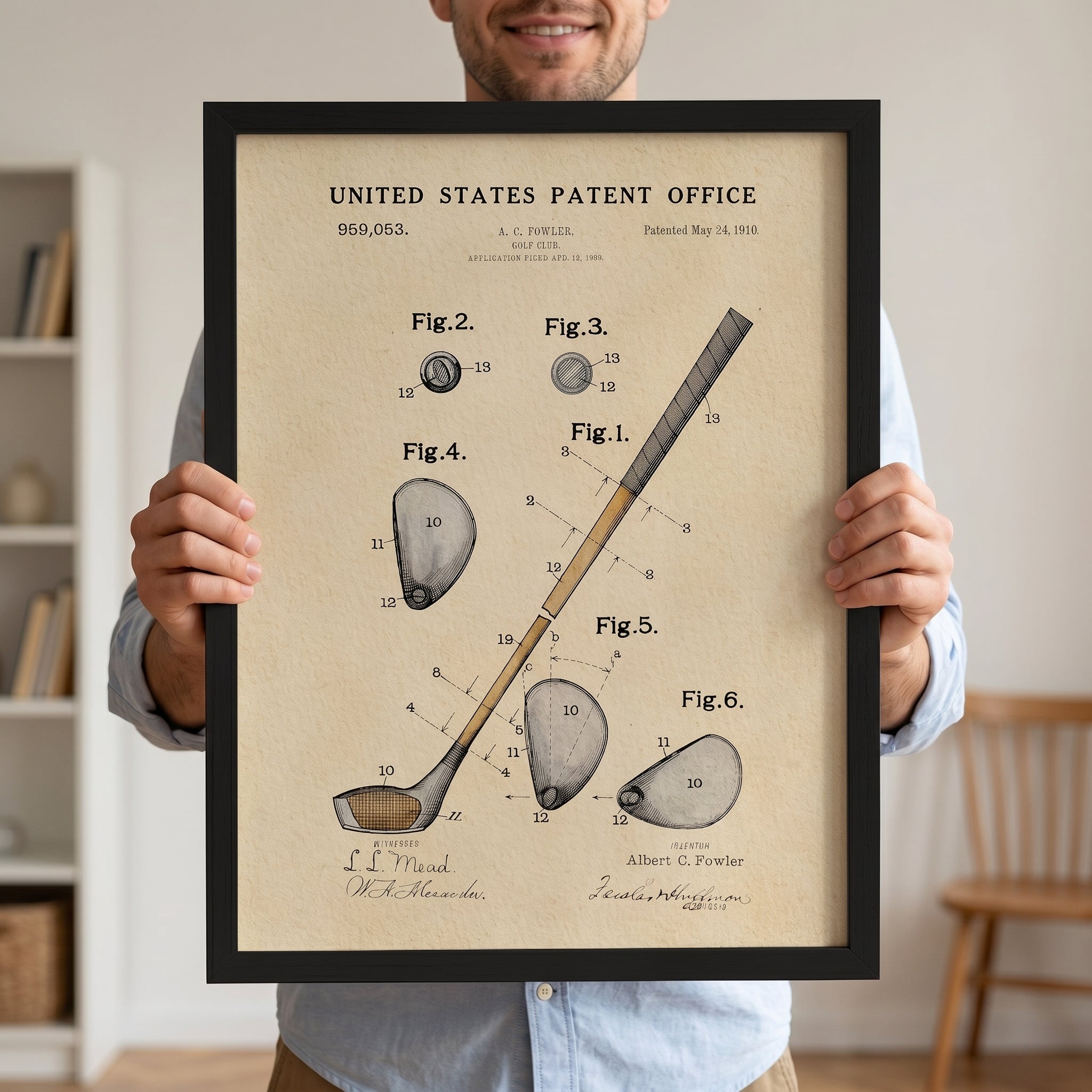
4. Golf Club (1910), Albert C. Fowler
Fowler's 1910 patent lands in the middle of a pivotal transition in club design, the shift from hand-forged, one-off craftsmanship toward systematic engineering and reproducible manufacturing. The drawing shows the precision and intention behind what looks, at first glance, like a simple tool.
This is the top-selling print in the collection for a reason. The lines are clean, the proportions are right, and any golfer who looks at it knows exactly what it is. It doesn't require explanation. It works on the wall of a golf room, an office, or a living room without being aggressively sports-themed.
If you're buying a first patent art gift and you're not sure which print to choose, this is the right one. Read more about the history of the golf club patent.
Best for: Any golfer, home office or den, first patent art gift, safe choice when you don't know their specific preferences

Which Golf Patent Prints Work Best as Statement Pieces?
5. Golf Flag (1913), David Foulis
David Foulis designed the 1913 flag at a moment when American golf was standardizing fast. The USGA had been formalizing rules and equipment specifications since the 1890s, and hole markers were among the pieces being codified from course to course. What makes the patent drawing interesting is what it shows you had to specify at the time: flag dimensions, staff height, the taper of the pole, the angle of attachment. Things that seem obvious now had to be worked out by someone.
The composition is the cleanest in the golf collection. Where the club and bag drawings are dense with mechanical detail, the flag print is open and vertical. It works as a standalone piece in rooms where you want something that reads as golf without displaying a piece of equipment.
Best for: Golf course owners, people who work in the golf industry, anyone who wants something graphic rather than technical

6. Golf Wood (1926), Albert C. Link
Persimmon-era golf has an almost mythological status among older players. The persimmon wood driver was harder to hit, less forgiving, and demanded a purer swing, and the players who grew up with them will tell you about it at length.
Link's 1926 patent records the design of the golf wood during that era, before metal woods and titanium and carbon fiber changed the equipment conversation permanently. For golfers who learned to play with actual woods, this print is a piece of equipment nostalgia. For younger players, it's a look at how different the game was one generation ago.
Link's drawing shows the persimmon wood head in cross-section, the grain lines of the wood itself mapped alongside the bore for the shaft. It's the rare print in the collection that shows the material, not just the form, and that detail rewards a second look.
Best for: Golfers who played the persimmon era, anyone who follows the history of equipment, older golfers looking for a meaningful piece of golf memorabilia

7. Golf Shoes (1932), Milton B. Reach
Golf shoes get taken for granted. They're the piece of kit every golfer owns, rarely thinks about until the spikes wear down, and replaces without ceremony. Reach's 1932 patent captures the moment when golf-specific footwear was being engineered deliberately, spike placement, sole construction, the details that make 18 holes in wet grass manageable.
This is the most unexpected pick in the collection, which is exactly what makes it work as a gift. If the golfer you're buying for already owns the obvious prints, the club, the ball, the bag, the shoes print is the one they definitely don't have, from an angle they haven't considered.
Best for: Avid golfers who own other prints, people who appreciate unexpected gift choices, golfers particular about their gear

What Are the Most Unique Golf Patent Art Gifts?
8. Golf Iron (1936), George E. Barnhart
Irons are the most debated clubs in any golfer's bag. Blade versus cavity-back, loft angles, offset, bounce, equipment discussions among serious golfers eventually come back to irons. Barnhart's 1936 patent traces the cavity design that preceded the modern cavity-back iron, the innovation that made the game significantly more forgiving for recreational players and reshaped how irons were manufactured for decades.
For a golfer who spends time working on their ball-striking, taking lessons, grinding at the range, obsessing over their iron game, this print speaks to something specific. It's not generic golf art. It's about the club they care most about.
Best for: Serious amateur golfers, players focused on improving their ball-striking, anyone who follows equipment development

9. Golf Putter (1958), Vaughn E. Morrison
The putter is the most personal club in any golfer's bag. Serious players develop near-superstitious attachments to their putters, many stick with the same head design for a decade or more, adjusting everything around it but never the flat stick. Morrison's 1958 patent captures the midcentury refinement of the blade putter, the style that still dominates the professional game.
Morrison's 1958 drawing shows the face angle geometry and weight distribution that defined the blade putter for decades. That same profile — flat face, rear-weighted blade, minimal offset — is what you still see in the hands of most tour pros today. For the golfer with strong opinions about their flat stick, this one reads as knowledgeable without being insider.
Best for: Golfers serious about their putting, anyone who follows the PGA Tour, players who've had the same putter for years

10. Golf Cart (1989), John A. Moglia
Available in Blue or Green, Moglia's 1989 golf cart patent is the most contemporary and most casual piece in the collection. By 1989, carts were standard equipment on American courses, and the design had accumulated decades of refinement since the first electric models appeared in the 1950s.
This is the right pick for golfers who ride rather than walk, or who take a more relaxed approach to the game. The two color options let the gift fit the room: the Blue version reads cooler and more graphic; the Green version is a natural fit for anything golf-themed.
Best for: Casual golfers, cart riders, golf-themed home bars or entertainment rooms, color-specific wall decor

Why Does Patent Art Work as a Golf Gift?
Golfers are equipment obsessives. Any serious player knows the evolution from persimmon woods to titanium drivers, can explain the difference between a blade and a cavity-back, and has strong opinions about shaft flex. The engineering behind the game is part of the game.
Patent prints tap directly into that. They're the original artifacts, the drawings that legally protected each invention when it was new. Not a stock photo of a golf course. Not a generic motivational print. The actual 1910 engineering diagram for the golf club, drawn by the inventor, filed with the federal government.
Frequently Asked Questions
What makes patent art a better golf gift than something from a golf shop?
Patent art prints are the original engineering documents, the drawings filed with the U.S. Patent Office when each invention was new. They're a piece of actual history, not a generic sports print. Every golfer has received a logoed polo or a sleeve of balls. Almost none have a framed print of the 1899 golf tee patent or the 1910 club design. The rarity is the point.
Do the prints come framed?
Yes. Every Timeless Patents print is available unframed or framed in four colors: Black, Walnut, Natural, and White. Framed prints arrive ready to hang — ideal if you want the gift to be complete out of the box. Unframed is the better option if your recipient has a specific wall space in mind or prefers to choose their own frame and matting to match their room. All four frame colors work with most home decor: Black is sharp and classic, Walnut adds warmth, Natural is lighter and casual, White suits modern or bright spaces.
What sizes are available?
Four sizes per print: 8×10, 12×16, 16×20, and 18×24. The 16×20 is the most popular — large enough to make an impression without overwhelming a wall. The 18×24 is the right call as a centerpiece on a larger wall or in a dedicated golf room. The 12×16 works well on a desk, shelf, or tighter wall space. The 8×10 is best as part of a grouped gallery display. Each product page includes a room mockup showing how the size reads in an actual room, which is helpful before committing.
Which print is best for a golfer who already has everything?
The Golf Tee (1899) if you want the one with the best story behind it, George F. Grant's overlooked role in golf history is genuinely surprising to most golfers. The Golf Club (1910) is the bestseller and works for anyone. If they're already a Timeless Patents collector, the Golf Shoes (1932) or Golf Putter (1958) are the most unexpected picks.
Can I buy multiple prints as a set?
Yes — the Golf Club, Golf Ball, and Golf Tee make a natural trio if you want to tell the full story of the game's core equipment: three inventions, three different eras, three different inventors. Grouped together on a wall, they read as a deliberate collection rather than a random assortment. Several customers display matched prints as gallery walls. The Timeless Patents watercolor style is consistent across all prints, so they hang together cleanly without needing custom framing to tie them together.
How long does shipping take?
Most prints ship within 3-5 business days. Standard delivery typically takes 7-10 business days. If you're ordering for a specific date, check the product page for current lead times or contact us before ordering.
Timeless Patents makes museum-quality patent art prints from original U.S. Patent Office documents, celebrating the inventors behind your favorite sports, hobbies, and passions. Every print is available framed or unframed, starting at $49.99. Shop the full golf collection →
