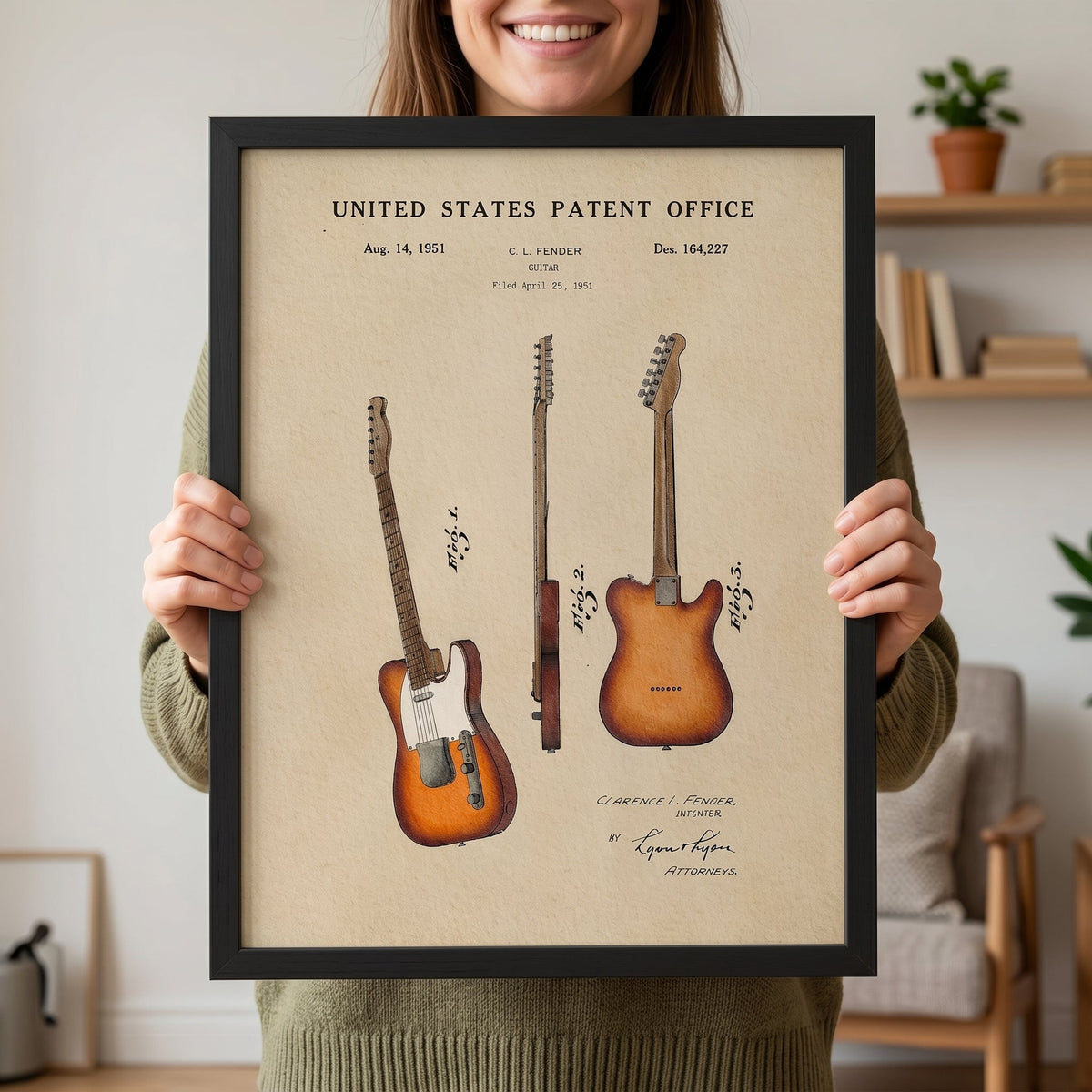
TL;DR: Guitarists already own the picks, the strap, the tuner, and more pedals than they'll admit to. Patent art prints are something different: reproductions of the original U.S. Patent Office drawings behind the Telecaster, the Les Paul, the Flying V, and the Fender bass. They look right on a music room wall, and no guitarist on your list has received one before. Starting at $49.99, framed or unframed.
You've already bought the strings. The personalized pick tin. The capo they lost a month later. The gift card to the guitar shop that went toward something boring like a cable.
Here's what you haven't bought: the original patent drawing for the guitar they've wanted since they were fifteen. Every print in this guide is a reproduction of an actual U.S. Patent Office document, signed by inventors like Leo Fender and Gibson's Ted McCarty, rendered in a watercolor style on museum-quality paper. Guitarists can name the year their favorite model came out. Almost none have seen the drawing that protected it.
What Are the Best Guitar Patent Art Prints?
1. Orange Electric Guitar (1951), Clarence L. Fender
This is the Telecaster. Leo Fender's design patent, Des. 164,227, was filed on April 23, 1951 and granted that August, the same year his first solid-body electric finally settled on the Telecaster name after being sold as the Esquire and the Broadcaster. It was a plain slab of wood with a bolt-on neck, built to be easy to manufacture and easy to repair, and it changed what an electric guitar could be.
The print shows the guitar from three angles: front, side, and back, with the signature single-cutaway body in a sunburst finish. Anyone who has played a Tele will recognize the shape from across the room. For country players, indie players, and anyone who prefers a guitar that does exactly what it's told, this is the one.
Best for: Telecaster players, Fender loyalists, first patent art gift, home studio or office wall

2. Red Electric Guitar (1955), Theodore M. McCarty
If the Telecaster is Fender's founding document, this is Gibson's answer. Ted McCarty ran Gibson through the 1950s, and his Patent No. 2,714,326, filed in January 1953 and granted on August 2, 1955, covers a combined bridge and tailpiece for "stringed musical instrument of the guitar type." The guitar in the drawing is unmistakable: the carved single-cutaway body of the Les Paul.
The print pairs a front view in deep red with a side cutaway showing the internal construction, numbered reference marks and all. It's the warmest, most saturated print in the guitar collection and makes a strong statement on its own. For anyone who has spent years chasing a Les Paul tone, this one needs no introduction.
Best for: Les Paul players, Gibson loyalists, rock and blues guitarists, music room centerpiece

3. Brown V Electric Guitar (1958), Theodore M. McCarty
The Flying V. McCarty filed this design patent, Des. 181,867, in June 1957, assigned to Gibson in Kalamazoo, Michigan. Gibson introduced the guitar in 1958 as a deliberately futuristic design, and buyers weren't ready for it: sales were slow, and production stopped after a short run. It took another decade for rock players to catch up, and original late-1950s Flying Vs are now among the most sought-after electric guitars ever made.
The drawing is spare and graphic: the V-shaped body from the front and a single side profile, with nothing else competing for attention. It reads as bold modern design even to people who don't play. For a metal or hard rock guitarist, or anyone who likes owning the guitar that was too far ahead of its time, this is the pick.
Best for: Rock and metal guitarists, design lovers, anyone who appreciates a comeback story

Which Prints Work Best for Bass Players and Gear Obsessives?
4. Bass Guitar (1960), Clarence L. Fender
Bass players rarely get their own gift. This print fixes that. Leo Fender's Precision Bass, introduced in 1951, is the instrument that made the electric bass a standard part of the band, and this design patent, Des. 187,001 (application filed January 6, 1959), documents the updated body shape with its split pickup. Look closely at the references printed at the bottom of the sheet: the patent cites Fender's own earlier bass design patent from 1953.
The print includes three views: the full bass from the front, a side profile, and the bare body from the back, all in a red-to-yellow sunburst. The long neck makes it a tall, striking composition that fills a vertical wall space well.
Best for: Bass players, Precision Bass owners, the band member who never gets a gift guide of their own

5. Electric Guitar (1964), Clarence L. Fender
Not every great guitar patent is about a body shape. Patent No. 3,143,028, granted August 4, 1964, is titled "Adjustable Neck Construction for Guitars and the Like," and it covers the engineering that keeps a neck playable over years of string tension, humidity, and gigging. It's the kind of detail that only matters when it goes wrong, which is exactly why guitarists who do their own setups will appreciate it.
The drawing shows a compact Fender with a single pickup, a dark pickguard, and a sunburst finish, with reference numbers running along the neck. It's a quieter print than the Telecaster or Les Paul, which makes it easier to place in an office or living room where you want something that rewards a second look.
Best for: Guitarists who do their own setups, guitar techs, gear obsessives, workshop or studio wall

What Are the Most Unique Guitar Patent Art Gifts?
6. Acoustic Guitar (1966), Clarence L. Fender
Most people don't know Leo Fender patented an acoustic guitar. Patent No. 3,290,980, filed in February 1965 and granted December 13, 1966, covers "Bridge Constructions for Guitars." It was filed just weeks after Fender sold his company to CBS in January 1965, which makes it one of the last chapters of the original Fender era.
The drawing gives it away as a Fender immediately: a dreadnought-style acoustic body topped with an electric-style headstock. A detailed cross-section of the bridge runs alongside it. For an acoustic player, or an electric player who also owns an acoustic, this is the print that starts a conversation. Almost nobody has seen it before.
Best for: Acoustic guitarists, singer-songwriters, Fender collectors, anyone who loves a deep-cut fact

7. Banjo (1889), Emile Boulanger
At 1889, Patent No. 415,019 is the oldest print in the collection by more than sixty years. Emile Boulanger's banjo patent comes from an era when the banjo was one of the most popular instruments in America, decades before the electric guitar existed. The drawing shows the classic open-back form, round pot, long neck, and the short fifth-string peg partway up the neck that gives the banjo its distinctive sound.
The composition is simple and centered, with Victorian-era lettering and signatures framing a single instrument. For a bluegrass or folk player, or a guitarist who has picked up a banjo on the side, this is the most unexpected gift in the guide.
Best for: Banjo players, bluegrass and folk musicians, multi-instrumentalists, vintage and antique collectors

Why Does Patent Art Work as a Guitar Gift?
Guitarists care about where their gear came from. They can tell you which year a model changed its pickups, why one neck profile feels better than another, and whose signature belongs on which headstock. The history is part of the hobby.
Patent prints tap directly into that. They aren't generic "music" posters or a silhouette of a guitar on a canvas. They're the original legal documents, with the inventor's name, the patent number, and the filing date printed right on the sheet. For a deeper look at how the instrument evolved, read The History of Guitar, the history of the electric guitar patent, and the history of the guitar pickup.
Frequently Asked Questions
What makes patent art a better guitar gift than gear?
Gear is personal. Guitarists are particular about strings, picks, and pedals, and a well-meant gear gift often ends up in a drawer. A patent print avoids that problem entirely. It celebrates the instrument they already love without asking them to change their setup, and it's something they're unlikely to buy for themselves.
Do the prints come framed?
Yes. Every Timeless Patents print is available unframed or framed in four colors: Black, Walnut, Natural, and White. Framed prints arrive ready to hang, ideal if you want the gift to be complete out of the box. Unframed is the better option if your recipient has a specific wall in mind or prefers to choose their own frame. Black suits a studio or rehearsal space; Walnut and Natural pick up the wood tones of the guitars themselves.
What sizes are available?
Four sizes per print: 8×10, 12×16, 16×20, and 18×24. The 16×20 is the most popular, large enough to make an impression without overwhelming a wall. The 18×24 works as a centerpiece above an amp or in a dedicated music room. The 12×16 fits a desk, shelf, or the narrow space between guitar hangers. Each product page includes a room mockup showing how the size reads on a real wall.
Which print is best for a Fender player vs. a Gibson player?
For a Fender player, the Orange Electric Guitar (1951) is the Telecaster design patent signed by Leo Fender himself. For a Gibson player, choose the Red Electric Guitar (1955), which shows the Les Paul, or the Brown V Electric Guitar (1958), the Flying V. Both Gibson patents were filed by Ted McCarty. Not sure which side they're on? Look at their headstock.
Can I buy multiple prints as a set?
Yes. The Telecaster (1951), Les Paul (1955), and Flying V (1958) make a natural trio covering the three most recognizable electric guitar shapes of the 1950s, from both of the decade's great rivals. If your guitarist plays in a band, add the Bass Guitar (1960) for the bass player. The watercolor style is consistent across all prints, so they hang together as a deliberate collection.
How long does shipping take?
Most prints ship within 3-5 business days. Standard delivery typically takes 7-10 business days. If you're ordering for a birthday or the holidays, check the product page for current lead times or contact us before ordering.
Written by Jackie Crino, owner of Timeless Patents. Timeless Patents makes museum-quality patent art prints from original U.S. Patent Office documents, celebrating the inventors behind your favorite sports, hobbies, and passions. Every print is available framed or unframed, starting at $49.99. Shop the full guitar collection →
