TL;DR: Roger Bresnahan, a Hall of Fame catcher, introduced the first batting helmet in 1907 after being hit in the head by a pitch. MLB didn't make helmets mandatory until 1971, despite a fatal beaning in 1920. Creighton Hale's 1960 patent documented the design the league eventually standardized. Original prints are available framed or unframed.
In 1920, Ray Chapman, shortstop for the Cleveland Indians, was hit in the head by a pitch thrown by the New York Yankees' Carl Mays. Chapman died the following morning. He is still the only player in Major League Baseball history to die from an on-field injury. The league did not make batting helmets mandatory for another 51 years.
That gap, between a fatal beaning and a rule change, is the central story of the batting helmet. The technology existed. The need was obvious. The resistance was cultural: professional players, for decades, considered a helmet an admission of vulnerability. The path from Roger Bresnahan's 1907 invention to Creighton Hale's 1960 patent to the 1971 mandate runs straight through one of the more stubborn safety failures in professional sports.
Roger Bresnahan and the First Batting Helmet
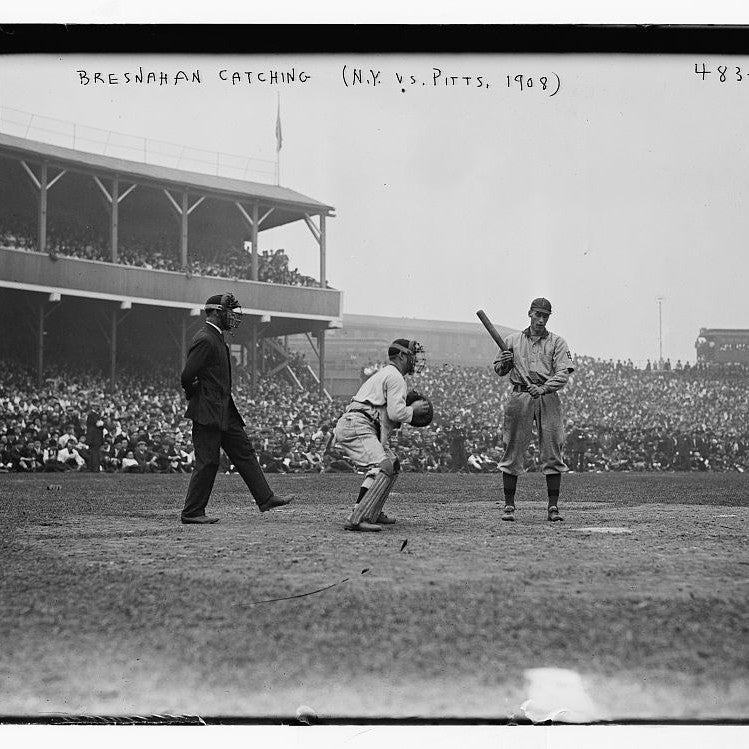
Roger Bresnahan was a catcher for the New York Giants, a player skilled enough to be inducted into the Baseball Hall of Fame in 1945. He was also an innovator. Bresnahan introduced shin guards for catchers in 1907, adapting cricket leg guards for baseball use. In the same year, he began wearing a padded insert inside his cap after being struck in the head by a pitch.

Bresnahan's solution was not a helmet in the modern sense: it was a leather insert fitted inside a standard cap, providing some padding over the skull. The design was a reasonable response to a real problem. Pitchers in the early 1900s threw hard and inside, and batters stood close to the plate with no protection beyond the cap on their head.
Despite Bresnahan's influence in the game, the padded insert did not catch on. Other players saw it as an affectation. The stigma against protective gear was already entrenched in a sport that prized toughness above most other virtues. Bresnahan's own teammates were reportedly resistant to adopting the device.
Ray Chapman, the Spitball, and 51 Years of Delay
The 1920 death of Ray Chapman shifted the conversation but did not resolve it. The Chapman beaning was partly attributed to the spitball, a pitch that moved unpredictably in flight and was difficult for batters to track. The response was to ban the spitball (grandfathered for existing practitioners) rather than to require protective headgear.

Throughout the 1930s and 1940s, individual players experimented with various forms of head protection. Some wore plastic liners inside their caps. A few clubs, including the Cleveland Indians, briefly required their batters to wear some form of protection, but enforcement was inconsistent and the rules were rolled back. The Pittsburgh Pirates, under general manager Branch Rickey, introduced a plastic batting helmet in the late 1940s and required their players to wear them.
The Pittsburgh experiment was significant. The Pirates' helmet, designed in part by Rickey, was the first purpose-built batting helmet mandated by a major league organization. It drew mockery from other teams and some resistance within the club. But it also worked: no Pirates batter suffered a serious head injury during this period, and the design began influencing other teams' thinking.
By the late 1950s, several clubs had adopted helmets voluntarily. The National League recommended helmets in 1956. The American League followed. But recommendation and mandate are different things, and not every player complied. The transition from voluntary adoption to universal requirement would take another 15 years.
Creighton Hale and the 1960 Patent
In 1960, Creighton Hale of Williamsport, Pennsylvania, was granted a patent for a sports helmet that closely resembles the batting helmet in modern use. Hale's design featured a hard outer shell with padding, a brim, and two ear flaps, one on each side.
The patent was an ornamental design patent, meaning it protected the helmet's appearance rather than its mechanical construction. This is common for non-mechanical consumer products where the visual form is the primary commercial asset. Hale filed one other patent, for a chest and throat protector for catchers, suggesting a sustained interest in protective baseball equipment.
Hale's 1960 filing is notable for including the ear flaps that would become mandatory in 1983. The helmet that the patent illustrates is essentially the same object a batter wears today, filed more than two decades before the ear flap requirement existed.
The 1971 Mandate and What Came After
In 1971, following a series of head-injury hospitalizations across the league, MLB made batting helmets mandatory for all batters. The rule came with a grandfather clause: players who had been in the majors before 1971 could choose not to wear a helmet. Several veterans exercised this option. The last player to bat helmetless in a major league game was Bob Montgomery of the Boston Red Sox, who retired in 1979.

Ear flaps became mandatory in 1983. The standard today requires a single ear flap oriented toward the pitcher: right-handed batters protect their left ear; left-handed batters protect their right. Double-flap helmets exist for players who prefer them, and some high-risk fielding positions, particularly pitchers and corner infielders, have increasingly adopted helmets while in the field.
The modern batting helmet is a certified piece of safety equipment, tested to standards set by NOCSAE (the National Operating Committee on Standards for Athletic Equipment). The hard outer shell, the interior foam padding, and the flap configuration Hale illustrated in 1960 remain the fundamental design. What changed between 1907 and 1971 was not the technology. It was the culture.
Frequently Asked Questions
Who invented the baseball batting helmet?
Roger Bresnahan, a Hall of Fame catcher for the New York Giants, introduced the first batting head protection in 1907 after being struck by a pitch. His design was a padded leather insert fitted inside a standard cap. Bresnahan was also the inventor of the modern shin guard for catchers, introduced the same year.
When did MLB make batting helmets mandatory?
MLB made batting helmets mandatory in 1971, 64 years after Roger Bresnahan's first design and 51 years after Ray Chapman's fatal beaning in 1920. The 1971 rule included a grandfather clause allowing pre-1971 players to continue batting without a helmet if they chose. Ear flaps became mandatory in 1983.
What does the 1960 baseball helmet patent cover?
Creighton Hale's 1960 patent is an ornamental design patent, which protects the visual appearance of the helmet rather than its mechanical construction. The design features a hard shell, brim, and two ear flaps, closely matching the helmets used in MLB today. Hale filed the patent more than a decade before helmets became mandatory, and more than two decades before ear flaps were required.
Was anyone killed by a pitch in MLB history?
Ray Chapman, shortstop for the Cleveland Indians, died on August 17, 1920, the day after being struck in the head by a pitch from Yankees pitcher Carl Mays. He remains the only player to die from an injury suffered in a major league game. The beaning contributed to the ban on the spitball but did not produce an immediate helmet mandate.
Is a baseball helmet patent print a good gift for a baseball fan?
It's one of the more specific and historically grounded options for a serious fan. The 1960 Hale patent connects the batting helmet to an inventor, a date, and a story most fans have never heard. It pairs well with other baseball patent prints, and it works equally well in a fan room, a home office, or a baseball-themed space. Available framed or unframed starting at $49.99.
Written by Rider Tuff, founder of Timeless Patents. Timeless Patents makes museum-quality patent art prints from original U.S. Patent Office documents, celebrating the inventors behind your favorite sports, hobbies, and passions. Every print is available framed or unframed, starting at $49.99. Shop the full baseball collection →