TL;DR: People have been drinking beer for more than 10,000 years, and the vessel has evolved from animal-skin pouches to hand-blown glass to the handled mug we know today. In 1876, a Pittsburgh craftsman named William King filed one of the first 10,000 patents ever approved in the United States, protecting a beer mug design with convex vertical flutings and a handle. Original prints of that patent are available framed or unframed.
Beer is older than writing. We know this because the earliest written records, clay tablets from ancient Sumer dating to around 3400 BC, already describe beer as an established part of daily life, traded in quantities, rationed to workers, and offered to gods. The vessel used to drink it has been changing ever since, shaped by the materials each civilization could master and the rituals they built around the act of drinking.
What makes the story worth tracing is what the beer mug reveals about the broader arc of craft and manufacturing. Each major shift in how people drank, from skin pouch to clay bowl to blown glass to pressed mug, reflects something larger happening in the world around it: a new kiln, a new trade route, a new city.
From Animal Skin to Terra Cotta: The First 8,000 Years
The earliest containers for any liquid were organic. Animal skins, hollowed gourds, and tightly woven plant fibers served as vessels for water, fermented drinks, and anything else people needed to carry. These materials were practical and portable, but they degraded quickly and were difficult to clean.
By around 8,000 BC, the development of kilns and the pottery wheel gave ancient brewers something more durable: terra cotta. Fired clay pots and bowls could be shaped consistently, held liquid without leaking, and survived long enough to be passed down. Archaeological sites across Mesopotamia, Egypt, and the Indus Valley have yielded clay drinking vessels from this period, many with residue that chemical analysis has since confirmed as beer.

The Sumerians had a particular relationship with beer. The "Hymn to Ninkasi," written around 1800 BC, is both a prayer to the goddess of brewing and a detailed recipe for beer production. It describes a process using bread as a fermentation base, filtered through a strainer, and poured into a collecting vessel. The vessel was functional, not decorative, but it was specific to the drink.
Clay and stone remained the primary vessel materials for thousands of years. Egyptian workers building the pyramids received daily beer rations, measured and distributed in standardized clay containers. Roman soldiers carried ceramic flasks. The vessel's form was practical. Aesthetics came later.
Glassblowing Changes Everything
Around 50 BC, Phoenician craftsmen on the Syrian coast developed a technique that transformed the history of the drinking vessel: glassblowing. By gathering molten glass on the end of a hollow pipe and inflating it, they could create thin-walled containers in a fraction of the time it took to grind or cast glass. The technique spread rapidly through the Roman Empire.
Glass changed drinking in ways that clay never could. It was transparent, which meant you could see the liquid inside. It didn't impart flavor the way clay did. It could be shaped into almost any form. And crucially, it could be made in large quantities at relatively low cost. Roman glassmakers in the first century AD were producing cups, flasks, and jugs for ordinary households, not just wealthy patrons.
Glassblowing spread through Europe and the Mediterranean over the following centuries, carried along trade routes and by craftsmen who moved between Roman provinces. By the early medieval period, glassware was well established across much of the continent, though production remained artisanal and quantities were limited by the scale of individual workshops.
The Tankard and the Beer Stein: Medieval Purpose-Built Vessels
The 14th century introduced something new: vessels designed specifically for beer. The tankard and the beer stein were not adaptations of general-purpose drinking cups. They were engineered for the particular act of drinking ale or beer, typically in quantity, in contexts where durability and volume mattered.

The tankard was typically made from wood, leather, or pewter. It held more liquid than a cup, had a flat base for stability on rough surfaces, and was robust enough to survive a tavern environment. The handled design kept the drinker's hand away from the vessel's contents, which mattered when the liquid was hot or when shared drinking from communal containers was common.
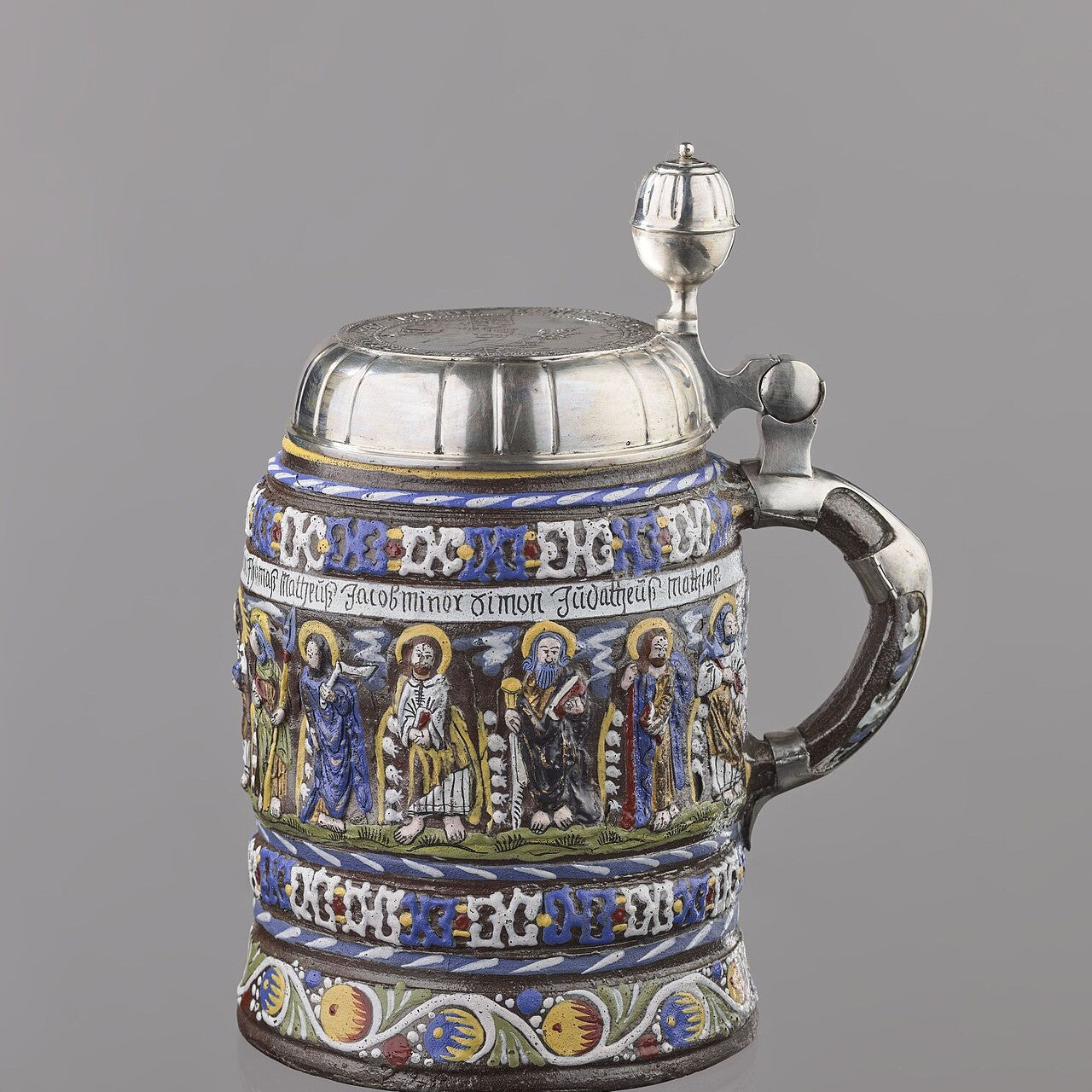
The lidded beer stein, particularly associated with German-speaking regions, emerged partly for sanitary reasons. Fly screens had been a persistent concern in brewing cultures, and the hinged lid, operable with the thumb while the rest of the hand held the handle, kept insects out without requiring a second hand to manage it. The German Beer Institute traces the lidded stein to regulations in 14th-century Bavaria requiring covered vessels in food service.
By the 15th and 16th centuries, guild craftsmen across Germany, England, and the Low Countries were producing decorated steins in faience, stoneware, and silver, objects that signaled wealth as much as they served a function. The vessel had become culture.
Industrial Production and the Modern Beer Glass
The 1800s brought industrialization to glassmaking. Machine-pressed glass, developed in the United States in the 1820s and refined through the mid-century, made it possible to produce identical glass vessels at scale for the first time. What had been an artisanal craft became a manufacturing process.
By the late 19th century, the proliferation of styles reflected both the growth of commercial brewing and the new possibilities of machine production. Dimpled pub glasses, thin-waisted pint glasses, and handled mugs each served slightly different contexts and markets. The handled mug in particular gained popularity across both sides of the Atlantic, combining the durability associations of the old tankard with the clarity of glass.

Regional preferences shaped specific forms. British pub culture embraced the pint glass in its various iterations. German brewing culture retained its attachment to the handled stein and the handled mug. American breweries, growing rapidly through the late 19th century, needed vessels that could be mass-produced and standardized across a national market.
William King's 1876 Patent: One of the First 10,000
In 1876, a Pittsburgh craftsman named William King filed a patent with the U.S. Patent Office for a beer mug with a distinctive design: convex vertical flutings running the length of the body, a sturdy handle, and proportions calculated for both grip and capacity. What makes this patent notable is its place in American history. King's design was among the first 10,000 patents approved in the United States, a period when the Patent Office was still establishing its procedures and the country's industrial character was just beginning to take shape.
King's mug was not just decorative. The convex flutings served a functional purpose: they increased the grip surface for a wet hand and added structural rigidity to the glass walls without adding significant weight. The handle, positioned and sized carefully, reduced fatigue during extended drinking and kept hand heat from warming the contents.
King went on to file additional patents for glass jug and jar designs in the years that followed. But the beer mug remains the piece that sits at the intersection of craft tradition and American manufacturing ambition. It was filed during the same decade that saw the country's centennial, the opening of the Centennial Exposition in Philadelphia, and a broad national conversation about American invention and industrial identity.
The patent drawing itself captures something that text alone can't: the precision of the fluting pattern, the geometry of the handle attachment, the proportions that make the design look both deliberate and inevitable. It's an engineering document that also works as an object of industrial art.
Shop Beer Mug Patent Art Prints
The original U.S. Patent Office drawing that defined the American beer mug. Starting at $49.99 unframed.
Beer Mug (1876), William King
King's 1876 design is one of the earliest beer mug patents in American history, filed when the U.S. Patent Office had issued fewer than 10,000 patents total. The convex fluted body and handled form he protected are still recognizable in beer mugs today. This print works in a home bar, a den, or a kitchen and bridges the gap between functional object and piece of American craft history.
Best for: Home bar owners, beer enthusiasts, history-minded gift buyers, anyone who appreciates American industrial craft

Frequently Asked Questions
How old is the beer mug?
Handled vessels designed specifically for beer date to the 14th century in Europe, when tankards and lidded steins became common in German-speaking regions and England. Earlier drinking vessels used for beer, including terra cotta bowls and clay cups, go back more than 8,000 years, though these were general-purpose containers rather than purpose-built beer vessels.
Who invented the beer mug?
No single inventor created the beer mug. The handled mug evolved over centuries from the medieval tankard, itself derived from earlier cup forms. William King of Pittsburgh filed one of the earliest U.S. patents for a specific beer mug design in 1876, protecting his convex fluted glass with a handle. His patent is among the first 10,000 ever approved by the U.S. Patent Office.
What is William King's 1876 beer mug patent?
King's patent covers a glass beer mug with a series of convex vertical flutings along the body and a handle. The flutings improved grip and added structural rigidity to the glass walls. King filed the patent in Pittsburgh, Pennsylvania, and went on to patent additional glass jug and jar designs. His beer mug patent remains one of his most historically significant contributions.
Why did beer steins have lids?
Lidded beer steins, particularly common in German brewing culture, were designed to keep insects out of the drink. A hinged pewter or ceramic lid operable with the thumb allowed drinkers to open and close the vessel with one hand. Sanitary regulations in 14th-century Bavaria reportedly required covered vessels in food and drink service, which accelerated the adoption of the lidded design.
Is a beer mug patent print a good gift?
It's a specific, conversation-starting piece for anyone who spends time in a home bar, brewery, or kitchen. The 1876 William King patent is a legitimate piece of American manufacturing history, not a novelty item, and the framed print works as wall art in spaces where typical sports memorabilia would look out of place. Available framed or unframed starting at $49.99.
Written by Jackie Crino, owner of Timeless Patents. Timeless Patents makes museum-quality patent art prints from original U.S. Patent Office documents, celebrating the inventors behind your favorite sports, hobbies, and passions. Every print is available framed or unframed, starting at $49.99. Shop the full beer collection →