TL;DR: Photography evolved from the ancient camera obscura through daguerreotypes and glass plates before George Eastman's invention of roll film in 1884 made mass-market cameras possible for the first time. In 1902, Frank Brownell of Rochester -- the engineer behind Kodak's most popular cameras -- patented a folding accordion-style camera design assigned to Eastman Kodak, the direct ancestor of the compact cameras that put photography in the hands of everyday people. Original patent prints are available framed or unframed.
The first photograph required an eight-hour exposure. The subject was a rooftop in Burgundy, France, seen from an upstairs window in 1827. By the time the image had registered on its pewter plate coated in bitumen, the sunlight had moved so far across the sky that both sides of the rooftops appeared simultaneously illuminated, as though the sun were in two places at once. The man who made it, Joseph Nicephore Niepce, had been working on the problem for years. The result was a blurry, strange artifact that proved the concept and little else.
A hundred and thirty-five years later, Kodak's Instamatic camera would take a snapshot in one-hundredth of a second. The distance between those two images -- an eight-hour exposure and a moment's press of a button -- is the history of photography, and a significant part of that history runs directly through a patent filed in Rochester, New York in 1902.
The Camera Obscura: Projecting Without Capturing
The idea that a small hole in a dark box could project an image of the outside world onto a surface was understood in antiquity. Ancient Greek philosophers documented the principle. Chinese scholars described similar devices. By the Renaissance, the camera obscura ("dark chamber") was a practical tool used by artists, architects, and natural philosophers across Europe.

Leonardo da Vinci described and used the camera obscura as an aid to accurate drawing. Johannes Vermeer may have used a version of it in his studio to achieve the unusual precision of light and perspective in his paintings -- a hypothesis that has generated serious debate among art historians and scientists. The device came in room-sized versions that a person walked inside and portable box versions that could be carried into the field.
What the camera obscura could not do was save what it projected. The image appeared, was traced if someone was quick enough, and disappeared when the box was opened or the light changed. The projection was ephemeral. The challenge that occupied inventors from the 17th century onward was finding a way to make it permanent.

Niepce, Daguerre, and the Race to Capture an Image
The competition to fix a photographic image on a stable surface was largely a contest between British and French inventors in the early 19th century, and France won it twice. Joseph Nicephore Niepce made the first permanent photograph in 1827, exposing a pewter plate coated in bitumen of Judea for approximately eight hours in a camera obscura pointed at his courtyard roof. The image survived because the bitumen hardened where light struck it, leaving a faint but permanent record.
Niepce subsequently partnered with Louis Daguerre, a French artist and showman who ran a popular theatrical spectacle called the Diorama in Paris. Daguerre had been working independently on photographic processes, and the two combined their efforts in 1829. Niepce died in 1833, but Daguerre continued the work and produced the daguerreotype process in 1837: a polished silver plate treated with iodine vapors that produced images of extraordinary clarity in a fraction of the time Niepce's bitumen method required.

In 1839, Daguerre took what is believed to be the first photograph of a human being: a Parisian street scene that required a long enough exposure (roughly ten minutes) to blur all the moving pedestrians and vehicles into invisibility, except one man who stood still to have his boots polished. That stationary shoe-shining customer became the first person ever photographed without knowing or intending it.
The daguerreotype was an immediate sensation. Within months of the French government purchasing the patent and releasing it publicly, daguerreotype studios had opened across Europe and North America. But the process had significant limitations: each image was unique, fragile, and could not be duplicated. Photography needed a different approach to become truly mass-market.
George Eastman and the Roll Film Revolution
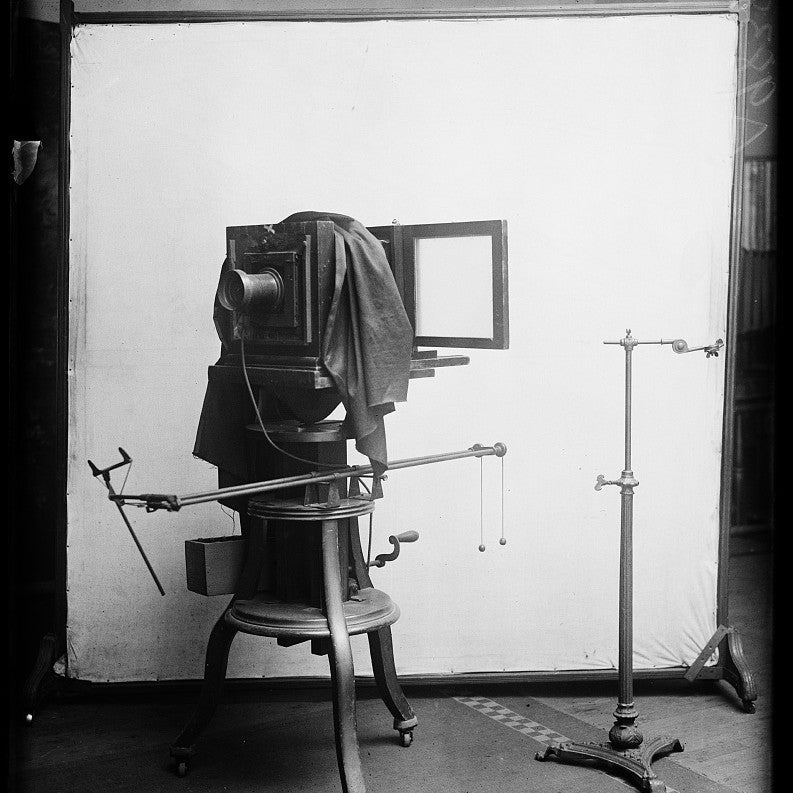
The decisive shift came from a bank clerk in Rochester, New York who became interested in photography as a hobby and then as a business. George Eastman began experimenting with photographic chemistry in the late 1870s and identified the central bottleneck holding back mass adoption: the need to coat glass plates with photographic emulsion immediately before use, then process them before they dried. This wet-plate process required carrying a darkroom into the field, which made spontaneous photography essentially impossible.
Eastman developed a dry-plate process that allowed plates to be prepared in advance and exposed later, which was a significant improvement. But the real breakthrough came in 1884 when he invented roll film: a flexible, light-sensitive material wound on a spool that could hold multiple exposures and did not need to be processed between shots. A camera using roll film could be taken out, used to photograph dozens of subjects, and then sent to a processor -- the photographer did not need to understand chemistry at all.

Eastman's Kodak company, founded in 1888, built its entire business model around this insight. The first Kodak camera sold preloaded with film. When the roll was finished, the customer mailed the entire camera to Kodak, which developed the film, printed the photographs, reloaded the camera with fresh film, and mailed everything back. The slogan "You press the button, we do the rest" was not just advertising copy. It was an accurate description of the transaction.
The Brownie camera, introduced in 1900 at a price of one dollar, extended this democratization further. Designed to be simple enough for children to use, the Brownie was marketed directly at young people and sold in enormous numbers. The concept of photography as an activity that required no technical knowledge beyond pointing and pressing a button was Eastman's central commercial insight, and it created a mass market for cameras and film that had not existed before.
SLR Cameras, the Polaroid, and the Road to Digital
The Single Lens Reflex camera, which uses a mirror system to show the photographer exactly what the lens sees, had existed since the 19th century but remained large and cumbersome until postwar miniaturization made compact SLR designs practical. By the 1950s and 1960s, 35mm SLR cameras from German and Japanese manufacturers had become the professional photographer's standard tool, offering precision and flexibility that box cameras could not match.

The Polaroid camera, introduced by Edwin Land in 1948, solved a different problem: the delay between taking a photograph and seeing the result. Polaroid's instant development chemistry allowed a print to emerge from the camera within minutes. The Swinger, introduced in 1965 at a price of less than twenty dollars, became one of the best-selling cameras in American history by making instant photography accessible to ordinary consumers.
Digital photography arrived through the 1980s and 1990s, with the first consumer digital cameras reaching the market in the early 1990s. By 2004, digital cameras were outselling film cameras globally, and the transition away from film that Eastman had enabled with roll film was complete.
Frank Brownell's 1902 Patent: The Folding Camera
Frank Brownell was the engineer at Eastman Kodak responsible for designing many of the company's most commercially significant cameras, including the first Brownie. His name appears on the camera that introduced millions of people to photography, though he was far less famous than his employer.
In 1902, soon after the Brownie's release, Brownell received a patent assigned to Eastman Kodak for a camera design that incorporated an accordion-style bellows mechanism. The design allowed the camera lens assembly to be extended outward from the camera body on a collapsible bellows, creating a longer focal length for sharper images, and then folded back in for compact storage and carrying.
This folding bellows design addressed a genuine tension in camera engineering: the optical requirement for a longer lens distance versus the practical need for a portable, pocketable device. A fixed-body camera that could achieve the focal length of Brownell's design would have been too large to carry conveniently. The accordion mechanism was the engineering solution that let the camera be both optically capable and practically compact.

Brownell's patent remained under Kodak's control until 1919, when it expired. The folding camera design it protected remained a standard form factor in consumer photography for decades, visible in the folding Kodak cameras of the 1920s through 1940s that many families used to document their lives. The accordion bellows mechanism that Brownell engineered in 1902 is the direct ancestor of the compact camera category -- the design principle that let photography leave the studio and enter the pocket.
Shop Compact Camera Patent Art Prints
The original U.S. Patent Office drawing that defined the folding compact camera. Starting at $49.99 unframed.
Modern Camera (1962)
The original U.S. Patent Office drawing that captures camera design at a pivotal moment in photographic history. A striking piece for any photographer's wall, home office, or studio -- clean technical lines, deep history, and a direct connection to the engineering decisions that put cameras in everyone's hands. Particularly meaningful for photographers who appreciate where the craft came from before digital made it invisible.
Best for: Photographers, home office or studio decor, gift buyers for anyone passionate about photography or visual art

Frequently Asked Questions
Who invented the camera?
The camera as an optical instrument traces back to the ancient camera obscura, a device that projected exterior scenes onto a surface and was documented by Greek, Chinese, and Renaissance scholars. The first camera capable of permanently capturing an image was made by Joseph Nicephore Niepce of France in 1827, using a pewter plate coated in bitumen. Louis Daguerre refined the process into the commercially practical daguerreotype in 1837.
Who invented the Kodak camera?
George Eastman founded Eastman Kodak in 1888 and developed the roll film system that made mass-market photography possible. The specific camera designs sold under the Kodak brand were largely engineered by Frank Brownell, an Eastman Kodak employee who designed the original Brownie (1900) and patented several subsequent camera designs, including a folding bellows camera in 1902.
What was the first mass-market camera?
The Kodak Brownie, introduced in 1900 at a price of one dollar, was the first camera marketed for and accessible to the general public. Designed to be simple enough for children, it used roll film and required no photographic knowledge. Kodak's business model handled film development and printing, removing the technical barrier that had kept photography limited to professionals and serious amateurs.
What did Frank Brownell's 1902 patent cover?
Frank Brownell's 1902 patent, assigned to Eastman Kodak, covered a camera design incorporating an accordion-style bellows mechanism that allowed the lens assembly to extend for longer focal-length photography and collapse for compact storage. The design solved the practical problem of fitting a longer focal length into a pocketable form factor. The patent remained under Kodak's control until it expired in 1919.
How did photography transition from film to digital?
George Eastman's invention of roll film in 1884 replaced the wet-plate and dry-plate processes that required chemistry in the field, making portable photography practical. Digital camera technology emerged in the 1980s and reached consumer markets in the early 1990s. By 2004, digital cameras were outselling film cameras globally. The compact, pocketable camera form factor pioneered by the folding bellows designs of the early 1900s was carried forward into digital design, eventually becoming the smartphone camera in every pocket today.
Written by Rider Tuff, founder of Timeless Patents. Timeless Patents makes museum-quality patent art prints from original U.S. Patent Office documents, celebrating the inventors behind your favorite sports, hobbies, and passions. Every print is available framed or unframed, starting at $49.99. Shop the full collection →