TL;DR: Builders have been measuring level and plumb since the ancient Egyptians, who achieved engineering precision good enough to build the pyramids using only a plumb bob and a string. The bubble spirit level, which made the process faster, more portable, and readable at a glance, was refined through the 18th and 19th centuries, and in 1886 a New York inventor patented a version that could check both horizontal and vertical alignment simultaneously. Original patent prints from Gustavus Cook's 1886 design are available framed or unframed.
The Great Pyramid of Giza is level to within 2.1 centimeters across its entire 230-meter base. No modern laser, no digital sensor, no instrument more sophisticated than a plumb bob and a stretched string helped achieve that accuracy. Egyptian builders around 2560 BCE measured true vertical by hanging a weight on a string: gravity did the work. They measured true horizontal as a right angle from that vertical. The result was a structure whose alignment with the cardinal directions and whose dimensional accuracy still impresses structural engineers today. That the most fundamental measurement tool in construction, the ability to determine level and plumb, traces to an instrument as simple as a weight on a string, is worth pausing on before examining what came after.
What came after took thousands of years, and the core insight, that liquid surfaces are always level and that gravity defines vertical, is the same one the Egyptians used. Every spirit level ever made is a refinement of that idea.
The Plumb Bob: Ancient Egypt Through the Renaissance
The plumb bob, a pointed weight suspended from a cord, is among the oldest precision tools in recorded history. Egyptian builders used it in the construction of the pyramids, the temples of Karnak and Luxor, and virtually every significant structure in the ancient world. The tool's logic is perfect: gravity pulls the weight directly toward the Earth's center, and the cord above it traces the true vertical. Any surface aligned with that cord is plumb; any surface perpendicular to it is level.

Greek and Roman builders inherited the plumb bob and added the "A-frame level," also called the chorobates or the libella. This was a simple frame shaped like the letter A, with a plumb bob hanging from the apex. When the plumb bob cord aligned with a mark on the crossbar, the base of the frame was level. Roman engineers used the chorobates to survey aqueducts across hundreds of miles of terrain, achieving grades precise enough to maintain steady water flow. The aqueducts of the Roman Empire, some of which are still standing after two millennia, were built with this instrument.
The plumb bob remained the dominant leveling tool through the medieval period and into the Renaissance. Sands Level, the wooden instrument visible in early 19th-century American workshops, operated on exactly the same principle the Romans had used: a weighted cord indicating vertical, and a frame providing the reference for horizontal.

Medieval builders refined the application of the plumb bob into the "level staff," a longer instrument that extended the measurement across greater distances. The level staff consisted of a wooden staff with a crosspiece at the top and a plumb bob at the base. By placing the staff on a surface and checking the plumb bob's alignment, masons and carpenters could assess levelness across spans too wide for a simple frame.

The Spirit Level: A French Innovation
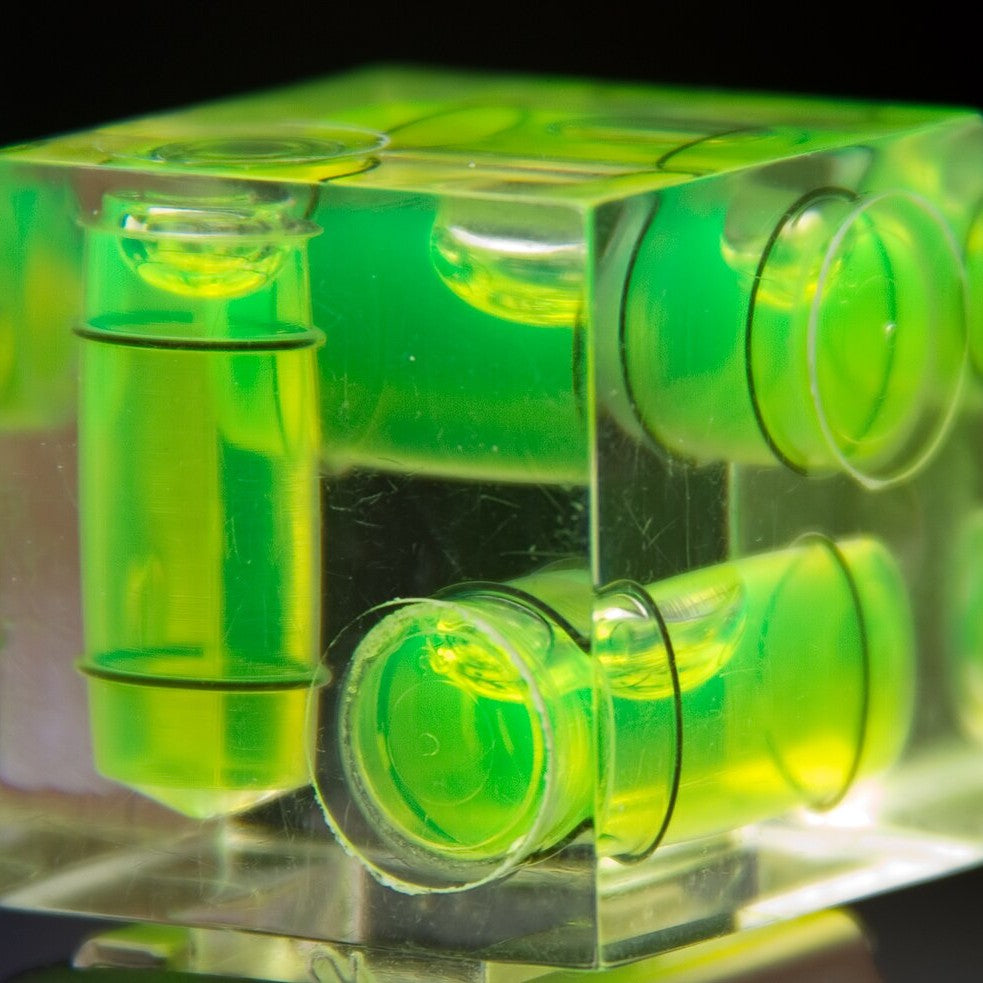
The spirit level, the instrument with a sealed liquid-filled tube and a bubble, was a conceptual departure from the plumb bob tradition. Instead of using gravity acting on a hanging weight, the spirit level uses gravity acting on a liquid: the bubble in a partially-filled curved tube always rises to the highest point. When the bubble is centered between two marks, the surface is level. When the tube is curved with the arc facing upward, centering the bubble indicates horizontal. When a tube is oriented vertically, it becomes a plumb indicator.
The spirit level was developed in France in the late 17th century. Melchisedech Thevenot, a French scholar and diplomat, is credited with describing the instrument in 1661. Thevenot was interested in the problem of establishing a perfect horizontal for a variety of scientific and practical purposes, and he recognized that a sealed tube partially filled with a liquid and a small air bubble provided a far more sensitive and portable indicator of level than any plumb-bob instrument.
Early spirit levels used water, but water was problematic: it froze in cold conditions, evaporated slowly, and changed density with temperature, affecting accuracy. The substitution of alcohol (spirits of wine, which is why the instrument is called a spirit level) solved these problems. Alcohol remained liquid at temperatures well below freezing, did not evaporate readily through sealed glass, and maintained consistent density across a useful range of temperatures.
The instrument spread from France through Europe over the following decades. Instrument makers in England, Germany, and the Netherlands were producing spirit levels by the early 18th century. The French carpenter Jean-Baptiste Pagnon developed a refined wooden-framed version in the late 18th century that became influential in European carpentry practice: a wooden frame with parallel grooves running along its length, incorporating a spirit vial in a position where it could be read easily while the tool was in use.
American Manufacture and the Industrial Level
American manufacturers took the spirit level seriously as a production item from the mid-19th century onward. The Stanley Rule and Level Company, founded in 1857 in New Britain, Connecticut, industrialized the manufacture of levels and other measuring tools, bringing consistent tolerances to what had previously been artisanal production. A Stanley level from the 1880s would perform identically to one from the same production run; handmade levels from individual craftsmen did not offer that consistency.

The industrial-era level market produced significant engineering competition. Manufacturers competed on accuracy, durability, ease of reading, and the number of measurements a single instrument could take simultaneously. The original carpenter's level could assess one plane at a time. A level that could check both horizontal and vertical without repositioning would save time and reduce error on the job site. The engineering challenge was building a single frame that incorporated vials oriented for both axes and made the bubble readable in both orientations.
This is the problem Gustavus Cook solved in 1886.
Gustavus Cook and the 1886 Patent
In 1886, Gustavus Cook of Watertown, New York was granted a patent for an improved spirit level. Cook's design addressed a limitation that carpenters and builders encountered every day: the standard level could check whether a surface was horizontal, or whether a surface was vertical, but not both at the same time without rotating the instrument. Repositioning took time and introduced the possibility of error.
Cook's patent incorporated both a horizontal vial and a vertical vial into a single frame, with the bubble in each vial visible from both sides of the instrument. The two-sided visibility was the key practical improvement: a carpenter aligning a door frame or a cabinet could check plumb and level simultaneously, and the bubbles were readable regardless of which side of the frame the carpenter was standing on. This seems obvious in retrospect, which is usually the sign of a genuinely useful idea.
The design also improved on the common carpenter level by making the instrument's straightness checkable without a reference surface: the dual-vial arrangement provided enough information to verify the tool itself. A level that might have been dropped or warped could be checked against its own readings rather than requiring a perfectly flat reference.
Cook's 1886 spirit level patent is one entry in a long history of incremental refinement, but it represents the moment when the carpenter's level gained the dual-axis functionality that modern levels still use. The form factor of Cook's design, a rectangular frame with horizontal and vertical vials, both readable from either side, is the form factor of virtually every level sold today.
The drawing filed with the U.S. Patent Office in 1886 shows Cook's engineering solution: the arrangement of vials, the frame geometry, and the construction detail that made level and plumb readable at a glance, from a single position, in a single operation.
Frequently Asked Questions
Who invented the spirit level?
Melchisedech Thevenot, a French scholar, is credited with describing the spirit level in 1661. His design used a sealed, partially-filled glass tube with an air bubble that rises to the high point, indicating horizontal or vertical alignment. The use of alcohol (spirits of wine) rather than water gave the instrument its common name and solved the problem of freezing in cold conditions.
How did ancient builders measure level without modern tools?
Ancient Egyptian, Greek, and Roman builders used the plumb bob: a weighted cord that, under gravity, traces the true vertical. Any surface aligned with the cord is plumb; any surface perpendicular to it is level. Roman engineers used a refined version called the chorobates or libella to survey aqueducts across hundreds of miles with sufficient precision to maintain steady water flow. This simple instrument was accurate enough to build the pyramids, which are level to within 2.1 centimeters across a 230-meter base.
What is the difference between level and plumb?
Level means horizontal: a surface is level when it runs at right angles to the direction of gravity, like the surface of still water. Plumb means vertical: a surface is plumb when it runs parallel to the direction of gravity, like a hanging weight. A spirit level uses separate vials for each measurement: a horizontal vial checks level and a vertical vial checks plumb. Gustavus Cook's 1886 patent combined both in a single instrument readable from either side.
When did the Stanley Level Company start making levels?
The Stanley Rule and Level Company was founded in 1857 in New Britain, Connecticut, and industrialized the production of measuring tools including levels. Before industrial manufacture, levels were handmade by individual craftsmen, which meant inconsistent tolerances between instruments. Stanley's production approach brought consistent accuracy to the market and helped standardize the carpenter's level as a reliable precision instrument rather than an artisanal object.
What makes Gustavus Cook's 1886 level patent significant?
Cook's 1886 patent combined horizontal and vertical measurement vials in a single instrument, with both bubbles readable from either side of the level. This meant a carpenter could check both level and plumb simultaneously without repositioning the tool, and could read the instrument regardless of which side of the work they were standing on. The dual-axis, dual-sided design Cook patented in 1886 remains the standard form factor for virtually every spirit level manufactured today.
Written by Rider Tuff, founder of Timeless Patents. Timeless Patents makes museum-quality patent art prints from original U.S. Patent Office documents, celebrating the inventors behind the tools and objects that built the world around us. Every print is available framed or unframed. Shop the full collection →
Cover image: "Building and repairing railways - Forming one of the series of the volumes comprised in the Revised and enlarged edition of The science of railways, (1906) (14574707158)" by Internet Archive Book Images, licensed under No restrictions, via Wikimedia Commons.