TL;DR: Basketball started in 1891 with a soccer ball, evolved through rubber bladders and leather panels over the next six decades, and reached a turning point in 1958 when Ralph Wheeler of Springfield, Massachusetts patented a design with improved grip through smart panel construction and deep channel grooves. Wheeler's patent influenced the basketballs used at every level of the game today. Original patent art prints of Wheeler's design are available framed or unframed.
On a December afternoon in 1891, James Naismith asked a janitor at the YMCA International Training School in Springfield, Massachusetts for two boxes. The janitor found peach baskets instead. Naismith nailed them to a gymnasium balcony railing, handed his students a soccer ball, and a sport with over a billion fans worldwide was born using equipment designed for something else entirely.
The ball took decades to catch up to the game it was supposed to serve. That gap between what basketball needed and what its ball could deliver drove sixty-seven years of invention before Ralph Wheeler's 1958 patent finally addressed the fundamental problem: grip.
James Naismith and the First Ball
Naismith created basketball in the winter of 1891 in response to a specific challenge. He was a physical education instructor at the YMCA's teacher training school, and his students needed an indoor activity to stay fit during the harsh Massachusetts winter. Football was too rough for the gymnasium. Baseball required too much open space. Naismith developed a new game in roughly two weeks, drafting 13 rules and requesting equipment from the building's supply room.

The soccer ball was a compromise from the start. It was round, available, and bounced reasonably well on hardwood. But it was built for a sport played primarily with the feet, without the grip requirements of a game in which players handle the ball with their hands at speed. The laced exterior of the soccer ball created an uneven surface. Passing and dribbling, especially as the game accelerated, were limited by what the ball allowed rather than what the players could do.
The first public basketball game was played on March 11, 1892, in Springfield. The audience included faculty, students, and community members who were quickly captivated by the new game. Within months, Naismith's rules had been circulated to YMCA branches across North America, and basketball was spreading faster than any administrative body could track it.
Spalding Steps In
In 1894, Naismith approached A.G. Spalding and Brothers, the sporting goods manufacturer that had already produced equipment for baseball and football, to develop a ball designed specifically for basketball. Spalding's first basketball was laced, made of leather panels over a rubber bladder, and slightly larger than a soccer ball.

Spalding's 1894 ball was a significant improvement over the soccer ball but still reflected the manufacturing constraints of the era. The leather panels were stitched by hand. The rubber bladder inside, inflated through a valve, could not hold consistent pressure for extended periods. The lacing created an irregular surface that made the ball bounce unpredictably at times. Players adapted to these limitations because they had no alternative.
The ball's circumference was set at between 29.5 and 30.25 inches, a specification that remains the standard for men's basketball today. That measurement was established not through scientific analysis but through practical trial, and it happened to be correct enough that no subsequent generation has found reason to change it.
Professional Basketball and the Ball's Evolution
The first professional basketball league, the National Basketball League, was founded in 1898 with teams in the Philadelphia and New Jersey area. The league operated for several years before folding, but professional basketball continued to develop in various regional leagues through the early 20th century.

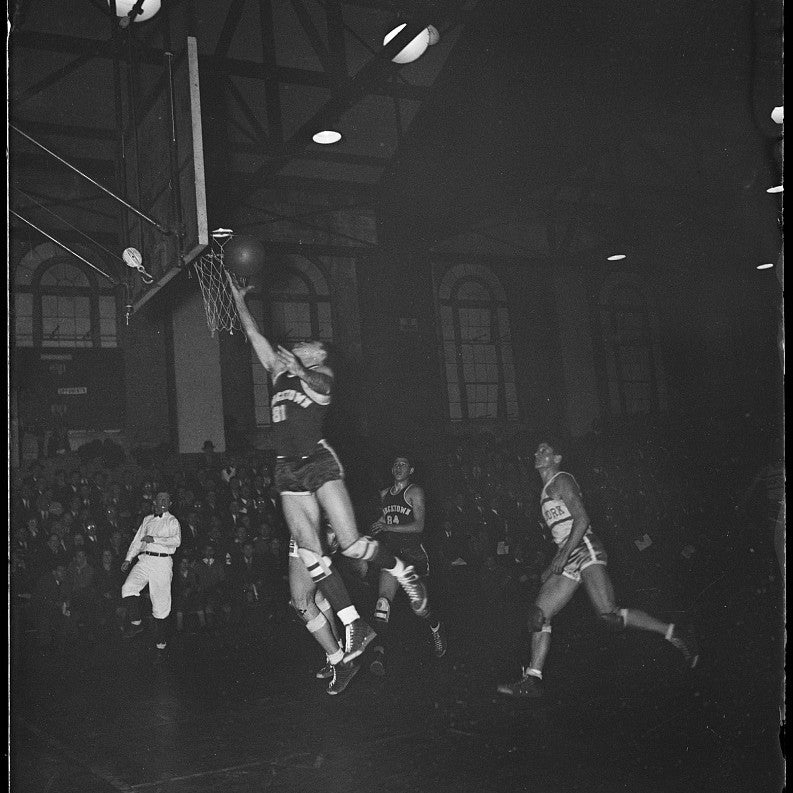
As the game became faster and more physical through the 1920s, 1930s, and 1940s, the limitations of the leather ball became more apparent. Dribbling in the early game was a limited skill partly because the ball's irregular bounce made sustained dribbling unreliable. The forward who caught a pass on the baseline and drove to the basket was a more advanced maneuver than the game's inventors had imagined possible, and the ball had to evolve to enable it.
Manufacturers experimented with different leather grades, stitching patterns, and bladder materials through the middle decades of the 20th century. The laces that had been a feature of every basketball since 1894 were finally eliminated in the 1930s when valve technology improved enough to allow bladder inflation without an exterior lacing channel. The removal of the laces made the ball's surface more uniform and significantly improved dribbling consistency.
The Basketball Association of America, founded in 1946, merged with the National Basketball League in 1949 to form the NBA. The new professional league now had a national audience and commercial interests that made the quality and consistency of the ball a serious concern. When a ball behaved unpredictably, it affected outcomes. When outcomes affected betting and broadcasting revenue, ball quality was no longer just an equipment matter.
The Engineering Problem of Grip
By the mid-1950s, the basketball had a persistent unsolved problem: grip. Players with large hands could hold the ball effectively, but players with smaller hands, or players who were wet from sweat in the later minutes of a game, found controlling the ball significantly harder than controlling it when fresh. The leather panels that made up the ball's exterior were smooth when new and became more slippery as they absorbed sweat and moisture.
The ball also needed consistent behavior when gripped differently. A player shooting a jump shot grips the ball from the back. A player making a bounce pass grips it from the sides. A post player catching a lob grips it from underneath. Each of these contact geometries placed different demands on the ball's surface, and a ball optimized for one could work against another.
This was the problem Ralph Wheeler set out to solve.
Ralph Wheeler's 1958 Patent
In July 1958, Ralph Wheeler of Springfield, Massachusetts, the same city where Naismith had invented the sport 67 years earlier, was granted a patent for a basketball featuring significantly improved grip through two design changes: smart leather panel construction that distributed contact surface more evenly across a player's hand, and deep grooves between panels that allowed fingers to seat naturally against the ball.
Wheeler's design recognized that grip is not simply a matter of surface texture. It depends on how the panels are laid out relative to where hands typically contact the ball, how the grooves between panels direct finger placement, and how the overall geometry of the ball interacts with hands of varying sizes. His patent addressed all three.
The deep channel grooves between Wheeler's panels were particularly consequential. Where earlier balls had relatively shallow seams that did little to guide finger placement, Wheeler's grooves gave players a tactile reference point for finding a consistent grip quickly. In game conditions, where players receive a pass and must immediately shoot or drive, that fraction of a second saved in finding grip can be decisive.
Wheeler's basketball patent was one contribution in a prolific inventive career that also included patents for ski poles, golf clubs, and baseball gloves. He approached sports equipment as an engineering problem, not a manufacturing one, and the distinction shows in the specificity of his basketball patent's claims.
The basketballs used in the NBA, NCAA, and recreational leagues today reflect decades of refinement built on principles that Wheeler formalized in 1958. The Spalding Official NBA Game Ball, used in professional play through 2021, and the Wilson Official NBA Game Ball introduced that year both feature the panel construction and groove geometry that Wheeler's patent established as the engineering baseline for the modern basketball.
Shop Basketball Patent Art Prints
The original U.S. Patent Office drawings that defined the game's equipment. Available framed or unframed.
Basketball (1958), Ralph Wheeler
Wheeler's 1958 patent drawing shows the panel layout and groove geometry that addressed the grip problems players had dealt with since Naismith handed them a soccer ball in 1891. The drawing is precise and geometric, with the ball's surface laid out in technical cross-section. It reads as a serious engineering document, which it was. A strong choice for basketball players, coaches, or anyone interested in how the objects at the center of sports actually came to be.
Best for: Basketball players and coaches, sports history enthusiasts, gift buyers looking for something unexpected

Frequently Asked Questions
Who invented basketball?
James Naismith, a physical education instructor at the YMCA International Training School in Springfield, Massachusetts, invented basketball in December 1891. He designed the game in roughly two weeks as an indoor winter activity for his students, drafting 13 rules and using a soccer ball and two peach baskets nailed to a gymnasium balcony railing.
What ball did the first basketball games use?
The first basketball games used a soccer ball. In 1894, James Naismith contracted A.G. Spalding and Brothers to develop the first ball specifically designed for basketball. Spalding's design used leather panels over a rubber bladder, with a laced exterior. The laces were eliminated in the 1930s when improved valve technology made them unnecessary.
Who patented the modern basketball?
Ralph Wheeler of Springfield, Massachusetts patented a basketball in July 1958 featuring improved grip through smart leather panel construction and deep channel grooves between panels. Wheeler's design addressed the persistent problem of grip consistency under game conditions and is considered a foundational design in the development of the modern basketball. Wheeler also patented ski poles, golf clubs, and baseball gloves during his career.
When was the first professional basketball league founded?
The first professional basketball league, the National Basketball League, was founded in 1898 with six teams operating in the Philadelphia and New Jersey area. The league folded by 1904. The Basketball Association of America was founded in 1946 and merged with a later National Basketball League in 1949 to form the NBA.
What are the official dimensions of a basketball?
The official NBA basketball has a circumference of 29.5 inches, a weight of 22 ounces, and is inflated to between 7.5 and 8.5 pounds per square inch. This circumference standard traces to Spalding's original 1894 design and has remained essentially unchanged through more than 130 years of the sport's history.
Written by Jackie Crino, owner of Timeless Patents. Timeless Patents makes museum-quality patent art prints from original U.S. Patent Office documents, celebrating the inventors behind your favorite sports, hobbies, and passions. Every print is available framed or unframed. Shop the full basketball collection →