TL;DR: The camera's history spans from the ancient camera obscura through the 1827 invention of photography to the mass-market Kodak Brownie of 1900. In 1979, a Polaroid engineer named Harvey Friedman patented a film roller that enabled uniform fluid distribution for instant photography. That patent captures the camera at a specific moment in its evolution, just before digital technology changed everything. Original prints are available framed or unframed.
The first photograph ever taken required eight hours of exposure time. Nicephore Niepce, a French inventor working in Burgundy, placed a pewter plate coated with bitumen of Judea inside a camera obscura, positioned it to face the courtyard outside his upstairs window, and left it for most of a day in 1827. The result was a blurry image of rooftops and a courtyard that is still the oldest surviving photograph in existence.
That eight-hour exposure time tells you something important about the state of the art in 1827. Photography was possible in principle, as Niepce had just proved. Making it fast enough to capture anything that moved, cheap enough for ordinary people to use, and convenient enough to carry anywhere: those problems would take another 75 years to solve. Every camera patent filed in the intervening decades was an attempt to close some part of that gap.
The Camera Obscura: Optics Before Photography
The camera obscura predates photography by roughly two thousand years. The principle is simple: light passing through a small hole in a darkened chamber or box projects an inverted image of whatever is outside onto the opposite surface. The ancient Greek philosopher Aristotle described the optical principle. Chinese philosopher Mozi wrote about it in the 5th century BC. By the 11th century, Arab scholar Ibn al-Haytham had described the camera obscura as a tool for studying solar eclipses.

Renaissance artists used the camera obscura extensively. Leonardo da Vinci described its use in his notebooks, and scholars have argued that Vermeer, Canaletto, and other masters used the device to achieve the precise perspective and optical qualities visible in their paintings. The camera obscura was not a secret tool but a widely known optical aid. What it couldn't do was fix the image it projected. The picture disappeared the moment you removed the light source. Capturing and preserving that projected image was the problem photography solved.
By the early 19th century, portable camera obscuras were common equipment for artists and surveyors. The devices could project detailed images onto paper or glass, which artists traced by hand. The optical engineering was established. The missing piece was a light-sensitive material that would record what the lens projected without requiring a human hand to trace it.
Niepce, Daguerre, and the Birth of Photography
The race to fix a photographic image involved several inventors working in parallel, with the French leading the way. Niepce's 1827 image of his courtyard was the first success, but the eight-hour exposure time made it impractical for almost any purpose. Niepce began collaborating with Louis Daguerre, a French showman and artist who had developed the diorama, a popular theatrical display using painted scenery and theatrical lighting.

Niepce died in 1833 before the collaboration produced its key results. Daguerre continued working and in 1839 announced the daguerreotype process, which produced detailed, well-exposed images on silver-coated copper plates treated with mercury vapor. Exposure times were reduced to minutes rather than hours. The French Academy of Sciences announced the invention in August 1839 and the French government immediately made the process freely available to the world as a gift to humanity, without patent protection.

In England, William Henry Fox Talbot had been working on a competing process using paper coated with silver chloride. Talbot's calotype process produced a paper negative from which multiple prints could be made, establishing the negative-positive workflow that dominated photography for the next 150 years. Talbot did patent his process, and the patents created considerable friction in the development of British photography through the 1840s.
The competitive dynamic between French and English photography in those early decades was real. Niepce and Daguerre were French. Talbot was English. Each national tradition pursued photographic technology through the 1840s and 1850s with distinct approaches and competing claims. The French daguerreotype and the English calotype were genuinely different technical solutions to the same problem.
Film, Kodak, and Mass Photography
The daguerreotype and its successors were professional or semi-professional tools. They required chemical preparation, significant equipment, and technical knowledge. Photography in the 1840s through 1870s was not something ordinary people did for themselves.
George Eastman changed that. Eastman, a Rochester, New York bank clerk turned entrepreneur, recognized that making photography accessible to ordinary people required simplifying both the camera and the chemistry. In 1884, he introduced flexible roll film on a paper base, followed in 1888 by the first Kodak camera, a simple box loaded with enough film for 100 exposures. The camera was sold pre-loaded, and when the film was finished, the entire camera was returned to Kodak for processing and reloading. The tagline was direct: "You press the button, we do the rest."

In 1900, Kodak introduced the Brownie, a cardboard-and-metal camera designed and priced for children and families. It sold for one dollar. Film was fifteen cents a roll. The Brownie put a working camera in the hands of millions of people who had never owned one and had no intention of learning chemical photography. It sold continuously through the 1960s, with various models produced over six decades. According to the George Eastman Museum, Eastman's democratization of photography fundamentally changed how people documented their own lives.
The Brownie era established snapshot photography as a mass cultural practice. Families documented holidays, birthdays, and everyday moments in ways that had been impossible before. The photographic archive of the 20th century is largely the product of the infrastructure Eastman built.
The SLR, the Polaroid, and Instant Photography
The single-lens reflex camera, which uses a mirror and prism to let the photographer see through the actual taking lens, had existed since the late 19th century. It became the dominant professional camera format after World War II when Japanese manufacturers, particularly Asahi (Pentax), Nikon, and Canon, produced compact, affordable SLR models that combined precision optics with manageable size and weight.
SLR cameras gave photographers an accurate preview of exactly what the film would record, eliminating the parallax errors common in viewfinder cameras. Through the 1960s and 1970s, the 35mm SLR became the standard tool for photojournalists, nature photographers, and serious amateur photographers worldwide.
Edwin Land's Polaroid camera, introduced in 1948, took a different approach entirely. Rather than separating exposure from processing, the Polaroid system developed the image inside the camera immediately after exposure, producing a finished print within minutes. The Polaroid SX-70, introduced in 1972, reduced the process to a single ejected print that developed in daylight without any peeling or timing. Polaroid cameras became one of the most commercially successful camera platforms of the 20th century, particularly popular for parties, Realtors, and anyone who needed an immediate physical image.

Harvey Friedman's 1979 Patent: Solving the Film Roller Problem
By the late 1970s, Polaroid's instant photography system was mature and widely used, but the internal chemistry of the camera remained an engineering challenge. The instant development process required precise, uniform distribution of chemical fluid across the film surface immediately after exposure. If the distribution was uneven, the developed image would show streaks, bands, or areas of under-development.
In 1979, Harvey Friedman, a Polaroid engineer based in Natick, Massachusetts, filed a patent for a new film roller design that addressed this problem directly. Friedman's design enabled uniform distribution of the processing fluid across the film surface as it passed through the rollers, producing more consistent development and higher image quality.
The engineering challenge Friedman solved was specific: the rollers that spread processing fluid in Polaroid cameras needed to apply even pressure across the full width of the film without gaps or excess. Variations in roller pressure produced visible development artifacts. His patent covered a roller geometry and mounting configuration that improved consistency, a quiet engineering contribution that most Polaroid users benefited from without knowing it existed.
Friedman filed his patent in 1979, a year before Polaroid introduced the Time-Zero SX-70 film that became popular with artists for its manipulable image surface. His work was part of the sustained engineering effort that kept Polaroid cameras competitive through a period of increasing pressure from 35mm SLR systems and, just over the horizon, the first digital cameras.
The patent drawing captures the camera at a specific transitional moment. Polaroid was at its commercial peak. Film photography was standard. Digital was years away from consumer availability. The roller mechanism Friedman patented was solving a real problem in a technology that millions of people used every day, and the drawing shows that mechanism with the clarity and precision that patent documents require.
Shop Camera Patent Art Prints
The original U.S. Patent Office drawings behind the history of photography. Starting at $49.99 unframed.
Camera Film Roller (1979), Harvey Friedman
Friedman's 1979 Polaroid patent represents photography at a pivot point, a mechanical solution to an instant-chemistry problem, filed just before digital technology changed what "taking a picture" meant forever. The print works in a photography studio, a darkroom, a home office, or any space where the craft and history of photography belong on the wall. It's a specific piece of photo history that most photographers have never encountered.
Best for: Photographers, darkroom enthusiasts, Polaroid collectors, photography students, visual artists, gifts for anyone who loves the history of the medium

Frequently Asked Questions
When was the camera invented?
The camera obscura, which projects images optically but cannot record them, dates back to ancient times. The first photograph was taken in 1827 by Nicephore Niepce, using an eight-hour exposure. Louis Daguerre's daguerreotype process, announced in 1839, reduced exposure times to minutes and is generally considered the beginning of practical photography. George Eastman's roll film (1884) and the Kodak Brownie camera (1900) brought photography to the general public.
Who took the first photograph?
Nicephore Niepce, a French inventor, took the oldest surviving photograph in 1827. The image, a view of the courtyard outside his window in Burgundy, required approximately eight hours of exposure and was captured on a pewter plate coated with bitumen of Judea. Niepce later collaborated with Louis Daguerre, who announced the daguerreotype process in 1839 after Niepce's death in 1833.
Who invented the Kodak camera?
George Eastman, a Rochester, New York entrepreneur, developed flexible roll film in 1884 and introduced the first Kodak camera in 1888. The 1900 Kodak Brownie, priced at one dollar, made photography affordable for ordinary families and is widely credited with creating snapshot photography as a mass cultural practice. The Brownie sold continuously for more than six decades.
What is Harvey Friedman's 1979 camera patent?
Harvey Friedman, a Polaroid engineer in Natick, Massachusetts, patented a film roller design in 1979 that enabled uniform distribution of the chemical fluid used in Polaroid instant photography. His design improved the consistency of film development by ensuring even roller pressure across the full width of the film surface, reducing the streaking and banding artifacts that could appear with uneven fluid distribution.
Is a camera patent print a good gift for a photographer?
It's a strong choice for anyone who cares about photography's history rather than just the latest equipment. The Friedman patent connects to the Polaroid era that many photographers have strong personal memories of, and the engineering drawing is precise and visually interesting. Available framed or unframed from $49.99, it works in a photography studio, a home office, or any space where the craft of photography belongs on the wall.
Written by Jackie Crino, owner of Timeless Patents. Timeless Patents makes museum-quality patent art prints from original U.S. Patent Office documents, celebrating the inventors behind your favorite sports, hobbies, and passions. Every print is available framed or unframed, starting at $49.99. Shop the full photography collection →
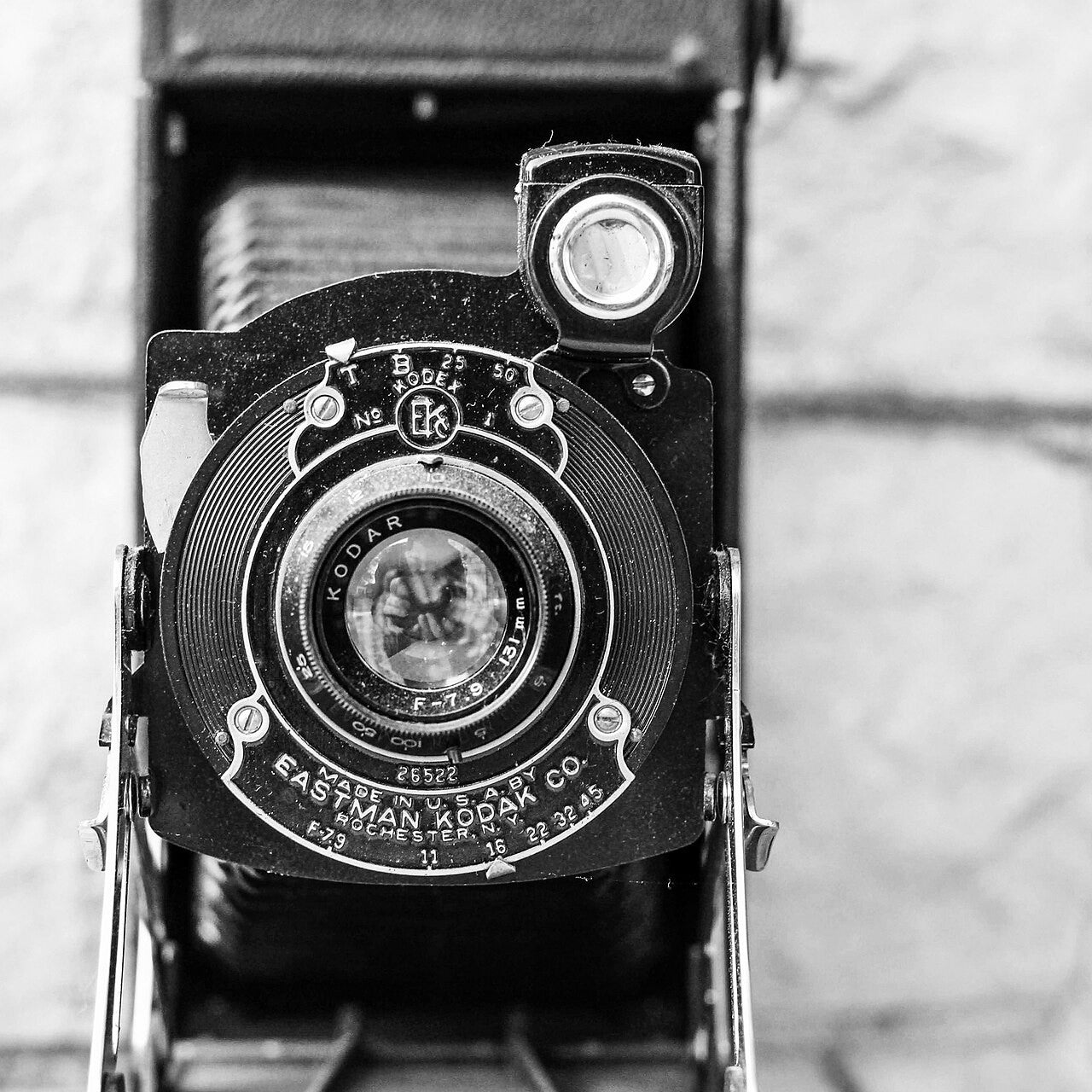
Cover image: "Black and White Image of Vintage Kodak Camera" by Dustininala, licensed under CC BY-SA 4.0, via Wikimedia Commons.