TL;DR: Horseshoes have protected horses' hooves for over 2,400 years, beginning with woven plant coverings in ancient Asia and advancing to nailed metal shoes in medieval Europe. In 1898, Peter and John Hoppesch patented a removable spring-plate horseshoe that let farriers swap out the cushioning layer without removing the shoe from the horse's hoof. Prints of the original patent are available framed or unframed.
A horse's hoof is a remarkable structure. Made of the same protein, keratin, that forms human fingernails, it grows continuously and can withstand tremendous force. But it has limits. Work a horse hard on rocky terrain, cobblestone roads, or frozen ground, and the hoof wears down faster than it regrows, cracks, and eventually fails. A horse with damaged hooves cannot work, cannot carry weight, cannot cover ground. In an era when horses were the primary means of transportation, agriculture, and military power, a lame horse was an economic and strategic disaster.
The horseshoe was the solution humans developed to that problem, and the history of its refinement stretches from ancient Greece and Rome through the industrial revolution and into the age of competitive equestrian sport. The 1898 patent filed by Peter and John Hoppesch was one episode in that long story, a specific engineering solution to a specific maintenance problem. But to understand why it mattered, you have to understand how the horseshoe got there.
The Earliest Hoof Protection: Ancient Asia and Rome
The earliest known attempts to protect horses' hooves date to approximately 400 BC. Ancient Asian cultures, particularly in regions where horses were used extensively for agriculture and transport, developed coverings made from woven plants, rawhide, and leather straps. These were not nailed to the hoof but tied or strapped around it. They provided some cushioning and protection on soft terrain but offered limited durability on hard surfaces and could not be secured tightly enough to stay in place during sustained work.

The Romans developed a device called the hipposandal, a metal plate attached to a leather boot that could be fastened to the horse's foot. Roman hipposandals have been found across the territories the empire occupied, from Britain to North Africa. They were removable and reusable, which made them practical for military use where replacement materials were limited. But they were not nailed to the hoof, which meant they could come loose during movement, particularly at speed or on uneven terrain.
In ancient Asia, the most common hoof protection was made from woven plant material. The technique was effective on soft ground but offered little protection on the stone roads that characterized Roman military infrastructure or the rocky terrain of mountainous regions. The fundamental limitation of these early designs was adhesion: a covering that could not be permanently attached to the hoof would always be less reliable than one that moved with it.
Nailed Metal Shoes in Northern Europe
The shift to permanently attached metal shoes appears to have occurred in Northern Europe, where cold, wet conditions created terrain that soft coverings could not address. Horses working in cold, muddy, or icy conditions needed traction that woven or leather coverings could not provide, and they needed protection that would stay in place through extended work.

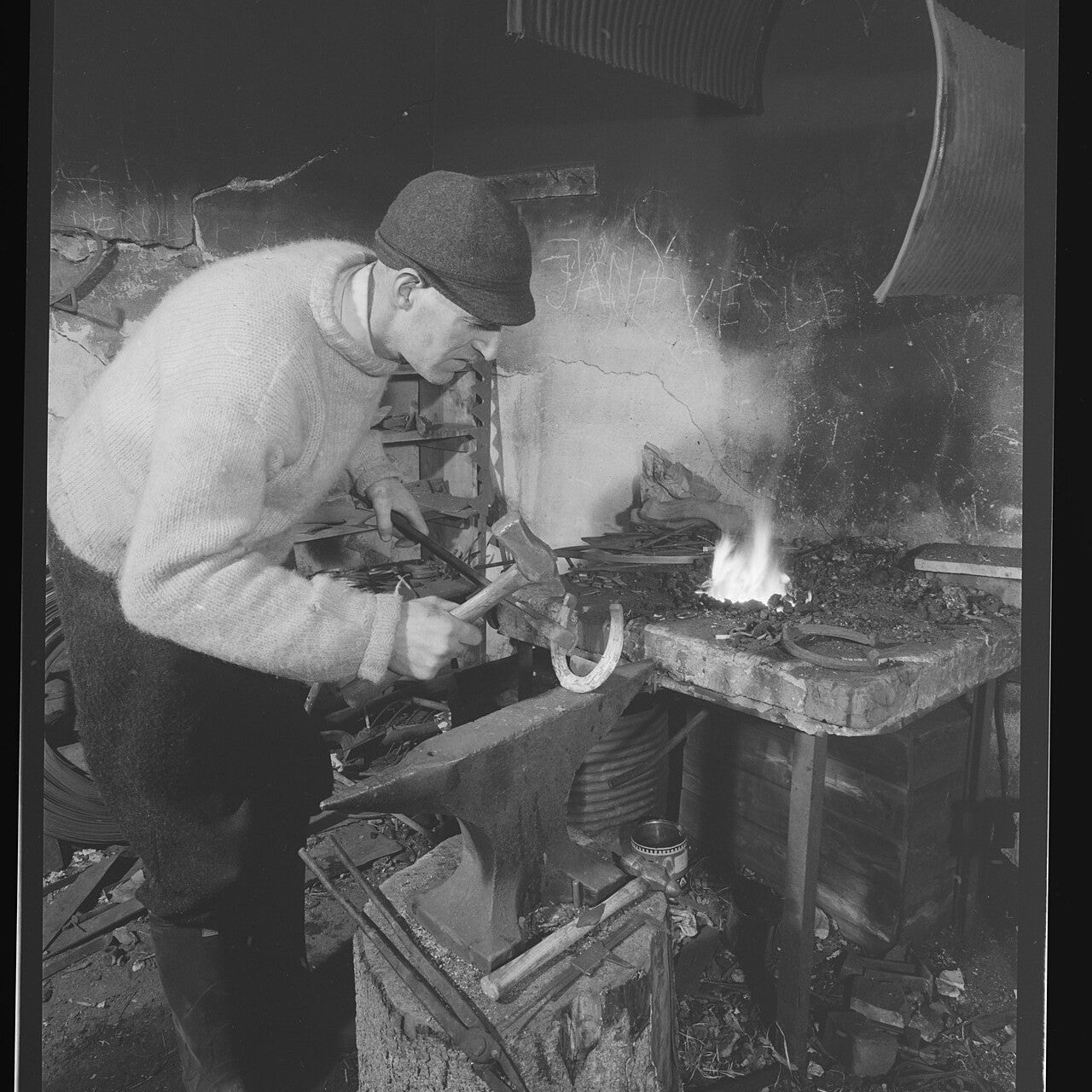
The practice of nailing metal shoes to horses' hooves developed in Northern Europe beginning in the 6th and 7th centuries. The technique took time to spread because it required specific skills: a farrier needed to understand hoof anatomy well enough to nail into the hoof wall without damaging the sensitive internal structures. Nailing too deep or at the wrong angle could cause permanent lameness. Done correctly, the nails passed through the outer hoof wall, which has no nerve endings, and were clenched on the outside surface. The horse felt nothing, and the shoe was secure.
By approximately 1000 AD, nailed metal horseshoes had become common across Europe. The design was simple: a curved metal bar, shaped to fit the bottom of the hoof, with nail holes punched through it. The blacksmith who made the shoe and the farrier who applied it were often the same person in rural areas. The skills were not easily separated.
From Commodity to War Advantage
By the 14th century, horseshoes had become commodities, traded at markets and produced in large quantities by specialized smiths. The standardization of the horseshoe as a commercial product made horses more widely available for agricultural work, transportation, and military service. A farmer who could buy horseshoes at market did not need to produce them himself, which lowered the cost of horse ownership and extended the practical working life of agricultural animals.
The industrial revolution changed horseshoe manufacturing fundamentally. Machine production replaced hand forging for standard shoe sizes and shapes, dramatically reducing cost and increasing availability. Horseshoes that had been artisanal objects, made individually to fit a specific horse, became mass-produced commodities available in graduated sizes.

During the American Civil War, the Union Army's ability to manufacture and distribute horseshoes at industrial scale provided a logistics advantage over the Confederacy, which relied more heavily on artisanal production. A cavalry force that could not shoe its horses could not move reliably. The Union's manufacturing capacity helped sustain its cavalry operations through years of intensive campaigning. Horseshoes, rarely considered a strategic material, were as important to the war's outcome as rifles.
The Equestrian Horseshoe and the Olympic Era
The late 19th century brought a new category of horseshoe design: specialized shoes for competitive and sporting use. As horse racing grew in popularity and formalized into a professional industry, the limitations of standard agricultural horseshoes became apparent. A shoe designed for pulling a plow had very different requirements than a shoe designed for a thoroughbred racing at 35 mph. Weight, traction geometry, and material composition all mattered differently.

Equestrian sport became part of the Olympic Games in 1900, in Paris, formalizing competitive riding as an international discipline. The Olympic equestrian events, which included show jumping, dressage, and eventing, required horses capable of performing precise athletic movements under competitive conditions. The shoes for Olympic-level equestrian horses were lighter than agricultural shoes and engineered for grip and energy transmission rather than durability under grinding daily work.
Since the early 20th century, the fundamental design of the horseshoe has changed relatively little. Materials have evolved, with aluminum, titanium, and specialized alloys replacing iron for performance applications. Adhesive bonding has become an alternative to nailing for horses with thin or damaged hoof walls. But the curved metal plate fitted to the hoof and secured at the hoof wall remains the same basic solution that northern European farriers developed in the 6th century.
The 1898 Hoppesch Patent
In 1898, two years before equestrian sport entered the Olympics, Peter and John Hoppesch filed a U.S. patent for a horseshoe design that addressed a specific maintenance problem. Their innovation was a removable spring plate that could be inserted into the shoe and secured without removing the shoe from the horse's hoof. The spring plate provided cushioning between the shoe and the hoof, absorbing impact on hard surfaces. When the plate wore down or needed replacement, the farrier could swap it out without the time and labor of removing and re-applying the entire shoe.

The design reflected a practical understanding of how horses were maintained in working conditions. Removing a shoe to replace worn cushioning was time-consuming and required the horse to stand still for an extended period, which was not always practical in a working yard or racing stable. The Hoppesch spring plate solved the maintenance problem without creating a new one. It was the kind of incremental engineering that doesn't attract historical attention but represents exactly the kind of systematic problem-solving that the patent system was designed to reward and preserve.
The 1898 patent is a record of that moment: two inventors who knew the problem, designed a solution, and put it on paper for the U.S. Patent Office to document. The horseshoe has been protecting horses for 2,400 years, and the Hoppesch design is one carefully considered step in that long line of refinement.
Shop Horseshoe Patent Art Prints
Horseshoe (1898), Peter and John Hoppesch
The Hoppesch 1898 patent captures the horseshoe at the moment when two centuries of industrial refinement met the specialized demands of competitive equestrian sport. A clean, precise engineering drawing with the kind of symmetrical form that works on any wall, in any room. A piece that reads as art to anyone who doesn't know what it is and as history to anyone who does.
Best for: Equestrian enthusiasts, horse owners, history collectors, anyone with a connection to horses
Frequently Asked Questions
When were horseshoes invented?
The earliest hoof protection devices date to approximately 400 BC, with ancient Asian cultures using woven plant materials and leather coverings. The Romans developed the hipposandal, a removable metal boot, around the same period. Nailed metal horseshoes, which permanently attach to the hoof wall, developed in Northern Europe beginning in the 6th and 7th centuries and became common across Europe by approximately 1000 AD.
Why do horses need horseshoes?
Horses' hooves wear down faster than they regrow when the horse works on hard terrain, such as stone roads, rocky ground, or frozen soil. Horseshoes protect the hoof wall from excessive wear, provide traction on slippery surfaces, and distribute the impact force of each step across a larger area. A working horse without shoes on hard terrain will develop hoof damage that leads to lameness. Horses kept on soft pasture without heavy work often do not require shoes.
What did the Hoppesch brothers patent in 1898?
Peter and John Hoppesch filed a U.S. patent in 1898 for a horseshoe design with a removable spring plate. The spring plate provided cushioning between the shoe and the hoof, and it could be replaced without removing the shoe from the horse's hoof. The design allowed farriers to swap out worn cushioning without the time and labor involved in fully re-shoeing the horse.
When did horseshoes change for equestrian sport?
As horse racing formalized in the late 19th century and equestrian sport entered the Olympic Games in 1900, specialized horseshoes were developed for competitive use. Performance shoes were lighter than agricultural designs and engineered for grip and energy transmission. Modern competitive horseshoes use aluminum, titanium, and specialized alloys rather than iron, though the fundamental curved plate design has remained unchanged.
What horseshoe patent art prints are available?
The original U.S. Patent Office drawing from the 1898 Hoppesch horseshoe patent is available as a framed or unframed art print. The print reproduces the actual engineering drawing filed by Peter and John Hoppesch, showing the spring plate design that allowed removable cushioning without removing the shoe, rendered in a watercolor style on museum-quality paper. Shop the Horseshoe Print →
Written by Jackie Crino, owner of Timeless Patents. Timeless Patents makes museum-quality patent art prints from original U.S. Patent Office documents, celebrating the inventors and designers behind the objects that shaped history. Every print is available framed or unframed. Shop the full collection →