TL;DR: The first motorcycle was built in 1885 from a wooden frame and topped out at 10 mph. In 1924, William S. Harley patented the Harley-Davidson motorcycle (No. 1,510,937), formalizing the design of the machine that built American motorcycle culture. Original patent art prints are available framed or unframed.
In 1885, Gottlieb Daimler and Wilhelm Maybach built a vehicle they called the Reitwagen. The frame was made of wood. The engine displaced less than half a liter and produced less than one horsepower. It caught fire during one of its test runs, burning the seat. The two engineers considered it a proof of concept, not a finished product, and never intended to manufacture it at scale. What they had built, almost by accident, was the first motorcycle.
That a machine conceived as an engineering experiment would evolve into the defining symbol of American freedom and outlawry is one of the more unlikely arcs in industrial history. The path from the Reitwagen to a Harley-Davidson touring bike took less than 100 years and involved world wars, a counterculture, and a long line of inventors who made it possible.
The First Motorcycles: 1885 to 1910
The Daimler Reitwagen established the basic concept: an internal combustion engine mounted to a two-wheeled frame. But the machine itself was crude by any standard. The wooden frame offered no suspension. The single-cylinder engine ran on ligroin, a petroleum distillate that was difficult to obtain reliably. The top speed was approximately 10 mph, and the design had no practical commercial application that Daimler or Maybach pursued.

Real motorcycle manufacturing began in the late 1890s, when European manufacturers including Hildebrand and Wolfmuller in Germany, De Dion-Bouton in France, and Triumph in England began producing machines intended for public sale. These early motorcycles used petroleum engines mounted to reinforced bicycle frames, with leather belt drives connecting the engine to the rear wheel.
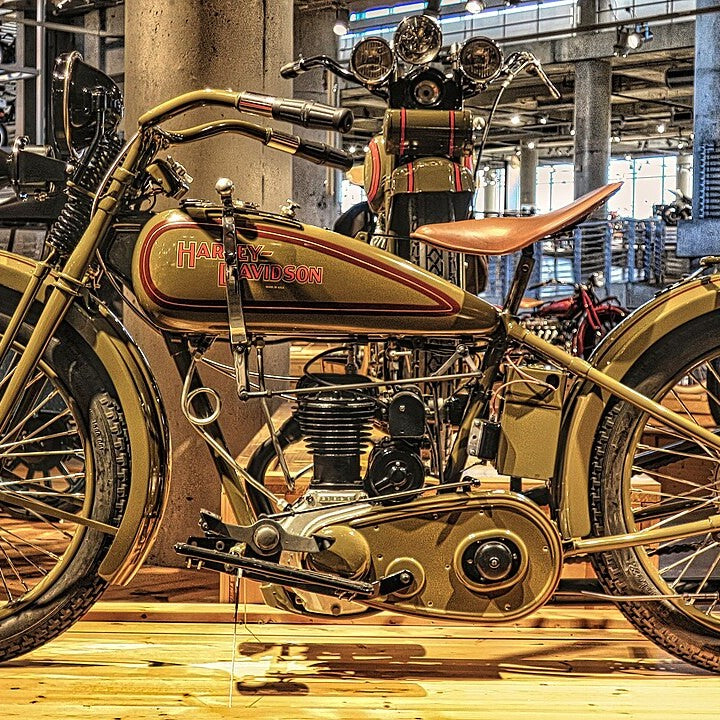
In the United States, motorcycle manufacturing began in earnest around 1901. Indian Motorcycle Company was founded in Springfield, Massachusetts, in 1901. Two years later, William Harley and the Davidson brothers built their first motorcycle in Milwaukee, beginning what would become the most iconic motorcycle brand in American history.

By 1910, motorcycle production in the United States had grown substantially. Harley-Davidson alone was producing over 3,000 machines per year. The machines had evolved from modified bicycles into purpose-built vehicles with steel frames, V-twin engines, and chain drives. They were marketed primarily as economical transportation, a cheaper alternative to the automobile for working people.
The 1920s and the Rise of American Motorcycle Culture
The 1920s marked the decade when the American motorcycle began to acquire cultural identity. Companies including Harley-Davidson, Indian, and the short-lived Excelsior-Henderson were producing machines capable of 60 mph. The engines were reliable enough for long-distance riding, and a loose network of roads connecting American cities made cross-country travel possible for the first time.

Racing became a central part of motorcycle culture in the 1920s. Board tracks, steeply banked oval circuits made from pine boards, drew large crowds to watch motorcycle racing at speeds that shocked the public. The sport was extraordinarily dangerous: board track racing killed dozens of competitors and spectators before the tracks were abandoned in the early 1930s. The danger was partly the point.
The V-twin engine configuration, with two cylinders arranged in a V, became the defining feature of American motorcycles during this period. The configuration produced a distinctive rumble at low speeds, a sound that would become inseparable from the American motorcycle identity. Harley-Davidson standardized its V-twin design in the 1920s, and has remained committed to the configuration ever since.
The 1930s Through the 1950s: War, Rebellion, and the Chopper
The Great Depression devastated the American motorcycle industry. Indian and Harley-Davidson were the only major American manufacturers to survive. Both companies pivoted to military contracts during World War II, producing motorcycles for reconnaissance, communication, and light transport. The U.S. military used over 90,000 Harley-Davidson WLA models during the war. Many returning veterans kept their military motorcycles or purchased similar machines when they came home.

The sidecar became a practical accessory during the 1930s and 1940s. Military sidecars allowed a soldier to carry a machine gun or a passenger across terrain too rough for a standard vehicle. Civilian sidecars extended the utility of the motorcycle to families who could not afford an automobile.

The counterculture shift came in the 1950s. Veterans who had ridden motorcycles during the war formed clubs, some of which became the outlaw motorcycle gangs that defined the public perception of motorcycling for the next generation. The chopper style emerged from this culture: stripped-down machines with extended forks, high handlebars, and custom paint. The look was confrontational by design. It was the visual language of a subculture that wanted to be left alone.

The 1960s and 1970s: Cafe Racers and the Japanese Invasion
The 1960s brought a different kind of motorcycle culture. The cafe racer, a style that emerged in England around the coffee shops and transport cafes near London, prioritized speed and handling over customization. These were lighter, more aggressive machines ridden low, with the rider leaning forward over the tank. The aesthetic influence spread globally.

Honda's arrival in the American market in the early 1960s changed the industry permanently. The Honda Super Cub, introduced in 1958 and marketed in the United States with the slogan "You meet the nicest people on a Honda," was targeted at commuters and new riders rather than the outlaw image that American manufacturers had cultivated. It became the best-selling motor vehicle of all time. Yamaha, Kawasaki, and Suzuki followed Honda into the American market, offering reliable, affordable machines at price points below American competitors.
The 1970s brought electronic ignition, disc brakes, and air-cooled multi-cylinder engines. Japanese manufacturers were producing superbikes with performance that American and European manufacturers could not match at comparable price points. Harley-Davidson survived the decade largely on brand loyalty and government tariff protection.
The 1980s to Today: Engineering, Electronics, and the Touring Icon
The 1980s marked Harley-Davidson's revival. The company was purchased from AMF in 1981 by a group led by Vaughn Beals and Willie G. Davidson. The new ownership invested in quality control and began producing machines that could compete on reliability. The Harley-Davidson touring motorcycle, the Road King and Electra Glide variants, became the defining American road machine of the decade.

Electronic fuel injection replaced carburetors in the late 1980s and 1990s. Anti-lock brakes, originally developed for aircraft, became available on production motorcycles. Adjustable suspension systems allowed riders to tune their machines to specific riding conditions. The motorcycle had completed its evolution from a proof-of-concept wooden frame to a sophisticated, electronically managed vehicle.
In 1924, William S. Harley received U.S. Patent No. 1,510,937 for the Harley-Davidson motorcycle, filed back in 1919. The drawing captured the machine that defined the early American road bike: the diamond frame, the V-twin engine slung low between the wheels, the sprung front fork, and the proportions that made a Harley instantly recognizable. It was the formal record of the design that carried Harley-Davidson from a Milwaukee shed to the dominant name in American motorcycling.

Today, motorcycles remain a defining object in American culture. The machines that trace their lineage to the wooden Reitwagen of 1885 are now built with the same engineering precision as aircraft. But the 1924 Harley patent is a reminder that behind every iconic machine is a specific moment when someone set the design down on paper.
Shop Motorcycle Patent Art Prints
Black Motorcycle (1924), William S. Harley
Harley's 1924 patent (No. 1,510,937) records the early Harley-Davidson motorcycle in precise engineering detail: the diamond frame, the low-slung V-twin, and the lines that would define the American road machine for the next century. A piece that works in a garage, a den, or any space where someone cares about the history of the machine they ride.
Best for: Motorcycle enthusiasts, Harley-Davidson fans, riders who appreciate design history
Frequently Asked Questions
Who invented the motorcycle?
Gottlieb Daimler and Wilhelm Maybach built the first motorcycle in 1885. Called the Reitwagen, it had a wooden frame, a single-cylinder petroleum engine, and a top speed of about 10 mph. The two engineers treated it as an engineering proof of concept rather than a commercial product, but it established the fundamental design that all motorcycles follow.
When did Harley-Davidson start making motorcycles?
William Harley and the Davidson brothers built their first motorcycle in a small shed in Milwaukee, Wisconsin, in 1903. The company grew steadily through military contracts and domestic sales, surviving the Great Depression as one of only two American motorcycle manufacturers still in operation. Harley-Davidson remains the dominant American motorcycle brand and one of the most recognized brand names in the world.
What is a chopper motorcycle?
A chopper is a style of custom motorcycle that emerged in American post-war culture during the 1950s. Choppers feature extended front forks, high handlebars, stripped-down bodywork, and custom paint. The style grew from the veteran motorcycle clubs of the late 1940s and became a symbol of American counterculture through the 1960s and 1970s, popularized by films like Easy Rider.
What did the 1924 Harley-Davidson motorcycle patent cover?
William S. Harley received U.S. Patent No. 1,510,937 in 1924 for the Harley-Davidson motorcycle, filed in 1919. The patent documented the construction of the machine, including its diamond frame and low-slung V-twin engine arrangement. It is one of the foundational patents behind the most recognized motorcycle brand in American history.
What motorcycle patent art prints are available?
The original U.S. Patent Office drawing from William S. Harley's 1924 Harley-Davidson motorcycle patent (No. 1,510,937) is available as a framed or unframed art print. The print is a reproduction of the actual engineering drawing filed with the patent office, rendered in a watercolor style on museum-quality paper. Shop the Black Motorcycle Print →
Written by Jackie Crino, owner of Timeless Patents. Timeless Patents makes museum-quality patent art prints from original U.S. Patent Office documents, celebrating the inventors behind iconic machines, sports, and everyday objects. Every print is available framed or unframed. Shop the full collection →