TL;DR: The camera's first working photograph required an eight-hour exposure in 1826, and it took another 136 years of compounding invention before Edgar Sauer of Stuttgart patented the coupled exposure meter in 1962, the mechanism that finally let cameras meter light automatically without a separate device. That patent drawing is available as a print, framed or unframed.
The world's first photograph took eight hours to make. Joseph Nicéphore Niépce pointed a camera obscura out of an upstairs window at his estate in Burgundy in 1826, coated a pewter plate with bitumen of Judea, and left the shutter open from morning to late afternoon. The result was a blurry, barely legible image of rooftops. It is the oldest surviving photograph in existence.
That the direct technological descendant of that eight-hour experiment would fit in a pocket and take a sharp image in a fraction of a second is one of the more compressed technological journeys in history. What makes it more interesting is how many distinct inventions had to stack on top of each other, each solving a problem the previous generation could not, before photography became what it is today.
The Camera Obscura and the First Photographs
The camera obscura, a darkened room or box with a small hole that projected an inverted image of the outside world onto a surface, had been known since antiquity. Arab scholar Ibn al-Haytham described it in detail in the 11th century. Renaissance painters used portable versions to trace architectural perspectives. The device was well understood for 800 years before anyone figured out how to make it retain an image.

Niépce's 1826 exposure demonstrated that it was possible to fix an image chemically. But the process required hours of light and produced a single, irreproducible result. The next step was to find a faster and more reliable photosensitive material and to make images that could be reproduced.
The Daguerreotype and the Birth of Commercial Photography
In 1839, Louis Daguerre, working from the research he had conducted jointly with Niépce before Niépce's death in 1833, announced the daguerreotype. The process used a silver-plated copper sheet polished to a mirror finish, exposed to iodine vapor to create a light-sensitive surface, and then developed over heated mercury. Exposure times dropped from hours to minutes. The resulting images were extraordinarily sharp and detailed, one-of-a-kind objects with a luminous quality that has never been fully replicated by later processes.

The French government purchased the rights to the daguerreotype and released it to the world without patent restrictions, an unusual act of public generosity that accelerated adoption dramatically. Within months, daguerreotype studios had opened in Paris, London, New York, and dozens of other cities. Portrait photography, which had previously meant painted miniatures at considerable expense, became accessible to the middle class for the first time.
The daguerreotype's limitation was that each image was a unique object. You could not make copies. Every portrait was an original.
The Wet Plate Process and the Negative
In 1851, English sculptor and inventor Frederick Scott Archer published the wet collodion process, which solved the duplication problem. Archer's method involved coating a glass plate with collodion, a syrupy solution of nitrocellulose in ether and alcohol, then dipping it in silver nitrate to sensitize it. The plate had to be exposed while still wet, then developed immediately, which required photographers to carry a portable darkroom everywhere they worked. It was inconvenient, messy, and occasionally explosive. It was also dramatically superior to anything that had come before.

The wet plate produced a glass negative from which any number of positive prints could be made. Exposure times dropped to a few seconds. The process was fast enough for portraiture, detailed enough for architectural and documentary photography, and cheap enough to enable mass production of images for the first time. Archer published the process freely, without seeking a patent, and died in poverty in 1857. The photographic industry built on his invention made fortunes for others.
Eastman, Film, and the Democratization of the Camera
The wet plate process dominated photography for three decades, but it required technical skill, specialized chemicals, and immediate processing. Photography remained the province of professionals and dedicated amateurs. George Eastman changed that.

Eastman, a bank clerk from Rochester, New York, had been an enthusiastic amateur photographer frustrated by the weight and complexity of the wet plate system. In 1880 he began manufacturing dry plates, pre-sensitized glass plates that could be exposed and developed at the photographer's convenience rather than immediately. In 1884 he introduced paper roll film, eliminating the glass entirely. In 1888, he launched the Kodak camera: a small, simple box loaded with a roll of film sufficient for 100 exposures.
The Kodak's marketing slogan was "You press the button, we do the rest." When the roll was finished, the entire camera was mailed to Eastman's factory in Rochester. The film was developed, prints were made, and the camera was reloaded and returned. Photography no longer required a darkroom, specialized chemicals, or technical knowledge. It required $25 and a willingness to point the camera at something interesting.
Eastman introduced flexible celluloid film in 1889, replacing the paper base and producing a sharper, more stable negative. That celluloid film, scaled to 35mm width for motion picture cameras by Thomas Edison's workshop in 1891, became the standard format that still defines analog photography today.
The 35mm Camera and the Leica Revolution
The 35mm format used for cinema was adapted for still photography in the early 20th century, but the camera that made it the dominant standard was introduced in 1925. Oskar Barnack, a German engineer at the Ernst Leitz Optische Werke in Wetzlar, had developed a compact camera using 35mm motion picture film as early as 1913. The resulting camera, the Leica, was introduced to the market in 1925 after years of refinement.

The Leica was small enough to carry in a coat pocket, fast enough to capture moving subjects, and mechanically precise enough to produce sharp images at high magnification. It created an entirely new style of photography: unobtrusive, spontaneous, and documentary. Henri Cartier-Bresson used a Leica to develop the concept of the "decisive moment." War photographers Robert Capa and Gerda Taro worked with Leicas. The compact 35mm camera made photojournalism as we know it possible.
The 35mm format spawned an entire ecosystem of camera manufacturers: Contax, Canon, Nikon, Zeiss, and dozens of others. Each competed on optical quality, mechanical precision, and the engineering of the shutter, viewfinder, and exposure systems that determined what a camera could do.
Exposure Metering and the 1962 Sauer Patent
Among the most technically demanding problems in camera design was exposure metering: determining how long the shutter needed to stay open for a given light level and film sensitivity. Early photographers calculated this by experience and tables. Handheld light meters became available in the 1930s, allowing more precise measurement, but they required a separate device and a manual transfer of the reading to the camera's settings.

In 1962, Edgar Sauer of Stuttgart, Germany, working for the Zeiss Ikon company, filed a patent for a photographic camera with a coupled exposure meter. Sauer's design integrated a light-sensitive meter directly into the camera body, connected mechanically to the shutter control so that the measured light value automatically set the correct exposure time. The shutter was a curtain type, its duration controlled by a knob at the top of the camera, with the metering mechanism coupling to that control so the photographer needed only to confirm the reading rather than manually dial in a separate value.
Zeiss Ikon was among the most technically sophisticated camera manufacturers in the world, and Sauer's patent was one of dozens he filed over his career for the company. The coupled exposure meter he designed was a key step in the chain of automation that eventually produced the fully automatic cameras of the 1970s and 1980s, cameras that handled exposure, focus, and film advance without any manual input. Every camera with an automatic mode, from a 1980s point-and-shoot to a smartphone, builds on the logic Sauer formalized in 1962.
Digital Photography and the Camera Today
The digital camera had a longer gestation than most technologies. Steven Sasson at Eastman Kodak built the first working digital camera prototype in 1975, using a CCD image sensor from Fairchild Semiconductor and recording images onto a cassette tape. The prototype weighed 3.6 kilograms and captured images at a resolution of 0.01 megapixels. Kodak did not pursue commercialization, concerned about cannibilizing its enormously profitable film business.
Consumer digital cameras became available in the early 1990s and mainstream by the late 1990s. By 2000, digital had begun displacing film in professional photography. By 2010, film photography had become a specialty rather than a standard. The smartphone camera, integrated into a device people already carried everywhere, completed the transformation: by 2023, roughly 1.4 trillion photographs were taken per year worldwide, nearly all of them digital, nearly all of them on phones.
The camera that resulted from this century and a half of compounding invention is virtually unrecognizable as a descendant of Niépce's pewter plate and eight-hour exposure. What has not changed is the fundamental geometry: a light-sensitive surface, a lens to focus the image, and a mechanism to control how long light reaches the surface. Sauer's 1962 patent was one of the critical steps in making that mechanism automatic, removing the last significant manual calculation from the act of taking a photograph.
Shop Modern Camera Patent Art Prints
Modern Camera (1962), Edgar Sauer
Sauer's 1962 patent for the Zeiss Ikon company captures the moment when camera engineering moved from skilled manual operation to integrated automation. The curtain shutter and coupled metering system represented a precise solution to a problem photographers had been wrestling with for decades. The drawing is clean, technically intricate, and immediately recognizable to anyone who has ever held a film camera. A strong piece for a photography enthusiast, a darkroom user, or anyone who appreciates the engineering behind a tool that changed how humans see the world.
Best for: Photographers, darkroom enthusiasts, Zeiss or film camera collectors, home office or studio walls

Frequently Asked Questions
Who took the first photograph?
Joseph Nicéphore Niépce took the oldest surviving photograph in 1826, using a camera obscura and a pewter plate coated with bitumen of Judea. The exposure lasted approximately eight hours. Niépce collaborated with Louis Daguerre in the years before his death in 1833, and Daguerre's subsequent development of the daguerreotype process in 1839 became the first commercially successful photographic technology.
Who invented the modern camera?
No single inventor created the modern camera. Niépce demonstrated that images could be fixed chemically. Daguerre made the process commercially viable. Frederick Scott Archer's 1851 wet collodion process made negatives and print reproduction possible. George Eastman's flexible film and the Kodak camera of 1888 democratized photography. Oskar Barnack's 1925 Leica defined the compact 35mm format. Edgar Sauer's 1962 patent integrated the exposure meter directly into the camera body. Each solved a specific problem the previous generation could not.
When was the first digital camera invented?
Steven Sasson, an engineer at Eastman Kodak, built the first working digital camera prototype in 1975. It used a CCD image sensor, recorded to cassette tape, weighed 3.6 kilograms, and captured images at 0.01 megapixels. Kodak chose not to commercialize the technology. Consumer digital cameras became widely available in the 1990s, and digital photography surpassed film in professional use by the mid-2000s.
What did the 1962 Sauer patent cover?
Edgar Sauer's 1962 patent, assigned to the Zeiss Ikon company, covered a photographic camera with a coupled exposure meter: a design that integrated a light-metering cell directly into the camera body and connected it mechanically to the shutter control. Rather than measuring light with a separate handheld meter and manually transferring the reading, the photographer could read and set exposure from a single integrated control. It was a foundational step toward the automatic exposure systems used in every camera today.
What camera patent art prints are available?
The original 1962 U.S. Patent Office drawing filed by Edgar Sauer for the Zeiss Ikon company is available as a framed or unframed print. It is a reproduction of the actual engineering drawing for the photographic camera with coupled exposure meter, rendered in a watercolor style on museum-quality paper. Shop the Modern Camera Patent Print →
Written by Rider Tuff, founder of Timeless Patents. Timeless Patents makes museum-quality patent art prints from original U.S. Patent Office documents, celebrating the inventors behind the tools and technologies that shaped modern life. Every print is available framed or unframed. Shop the full collection →
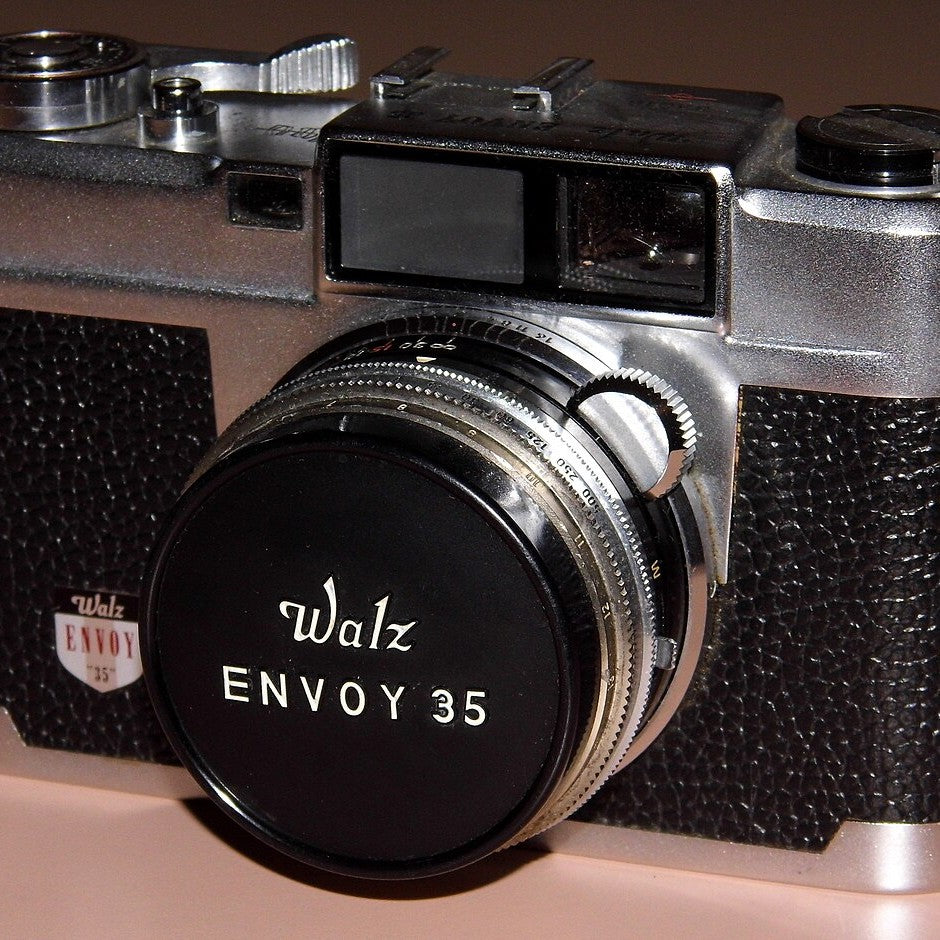
Cover image: "Vintage Walz Envoy 35, A 35mm Rangefinder Camera By The Japanese Company Walz, Circa Late 1950s (13521198474)" by Joe Haupt from USA, licensed under CC BY-SA 2.0, via Wikimedia Commons.